
 Access
 Login/Register
 Supplier Login












The Automotive Division of the Society of Plastics Engineers (SPE®) announced the winners for its 54th annual Automotive Innovation Awards Program, the oldest and largest recognition event (established in 1970) in the automotive and plastics industries. The announcement was made on the evening of November 5, 2025, during the 54th SPE Automotive Innovation Awards Gala held at Laurel Manor in Livonia, Michigan, USA.
Winners of major categories bared
The Grand Award & Body Exterior Category Winner went to the Multi-Flex Mid-gate of OEM make & model 2024MY General Motors Co. Chevrolet Silverado & GMC Sierra EV. Supplied by Flex-N-Gate LLC, with material processor Molded Fiber Glass (MFG) Companies and material supplier CSP utilizing resin 834UV SMC. GM reimagined the mid-gate with its Multi-Flex/Multi-Pro version, including a flipper door that accommodates the vehicle’s 60/40 split door. This enables access to the cab for through-bed cargo while keeping a rear-seat passenger or child seat in place. A weatherable 834UV SMC compression-moulded gate replaces a steel structure with no loss in structural performance. Stowable bed space spans nearly 11 ft. with the end-gate load step up. A one-button smart latching structure makes it easy to switch between multiple configurations. Back glass can be stowed in the flipper door. During development, 3D printed parts and bucks validated sealing; production parts boast leak-free performance.
The Aftermarket and Limited Edition/Specialty Vehicles category winner is the E Trunk Cargo Sliding Tray in the 2025MY General Motors Co. Cadillac Escalade IQ & IQL. A first at GM, and first known industry-wide, the E Trunk slide-out cargo tray solves the reach problem in a 55-inch-deep front trunk. By bringing gear forward, the tray avoids extended reach and twisting that can strain users accessing the cargo area. Engineered to support 200 lb. at full extension, the tray also maintains a slim profile, preserving usable volume. An innovative attachment method between chrome-plated ABS and TPO eliminates four metal mechanical fasteners for a cleaner interface.
In the Body Interior category, the winner is the Power Sliding Console from 2025MY Ford Motor Co. Ford Expedition, with system supplier Summit Polymers, Inc. and material supplier Washington Penn & Celanese. Redesigned power sliding console mechanism and structure delivers best-in-class 32.4 L storage (open or closed). Executed in 35% glass- and talc-filled PP, it replaces cast magnesium with a POM bracket and PP upper retainer with integrated third rail that trims mass by 2 kg (≈20% vs. direct competitors), cuts part count in half, and saves about US$20 per vehicle while maintaining rigidity. The console travels 200 mm, adds a locking feature to protect valuables, and places an intuitive power switch ahead of the armrest. Hidden storage sits beneath the cupholders/media tray, with 47% recycled resin used in the upper retainer/rail.
In the category Chassis/Hardware, the Integrated Seal Bumper Retainer from the 2024MY Toyota Motor Corp. Toyota Crown Signia was awarded. The system supplier is Nifco America Corp. and Celanese being the material supplier. A patent-pending integrated seal bumper retainer replaces the add-on foam gasket with a moulded “umbrella” around the grommets, delivering water sealing without foam or manual assembly. POM brings a balance of flexibility and stiffness, enabling compression and rebound while enhancing Nifco’s quarter-turn push-pin system that streamlines repairs. A dual-slide tool minimizes umbrella size and keeps the sealing surface free of parting lines, forming the required four contact points to maintain compression against the body. Translatable to other vehicles, program economics include ~15% cost savings, and the all-POM construction supports Toyota’s circular factory recycling goals.
Taking the lead in the Electric and Autonomous Vehicle Systems is the Battery Pack Weld Splatter Shield from 2025MY General Motors Co. Corvette ZR1X & E-Ray, with system supplier Creative Foam Corporation and material supplier Klöckner Pentaplast of America, Inc. Patented, industry-first integrated shield prevents molten weld spatter from damaging critical battery pack components, reducing isolation faults and scrap. Laser tab welding poses a high-stakes risk: molten spatter can reach the cell stack, damage isolation films, and create electrical faults. The solution is this thin-gauge PVC shield that nests beneath the ICB, blocks debris by melting around particles without pass-through, and drops into the existing module envelope. The 0.3 mm, inherently V-0 film also guides cell tabs during installation, improving decking quality and speed while reducing rework and scrap. Commodity packaging-grade PVC keeps cost low, and specialized knife-cut tooling delivers intricate geometry.
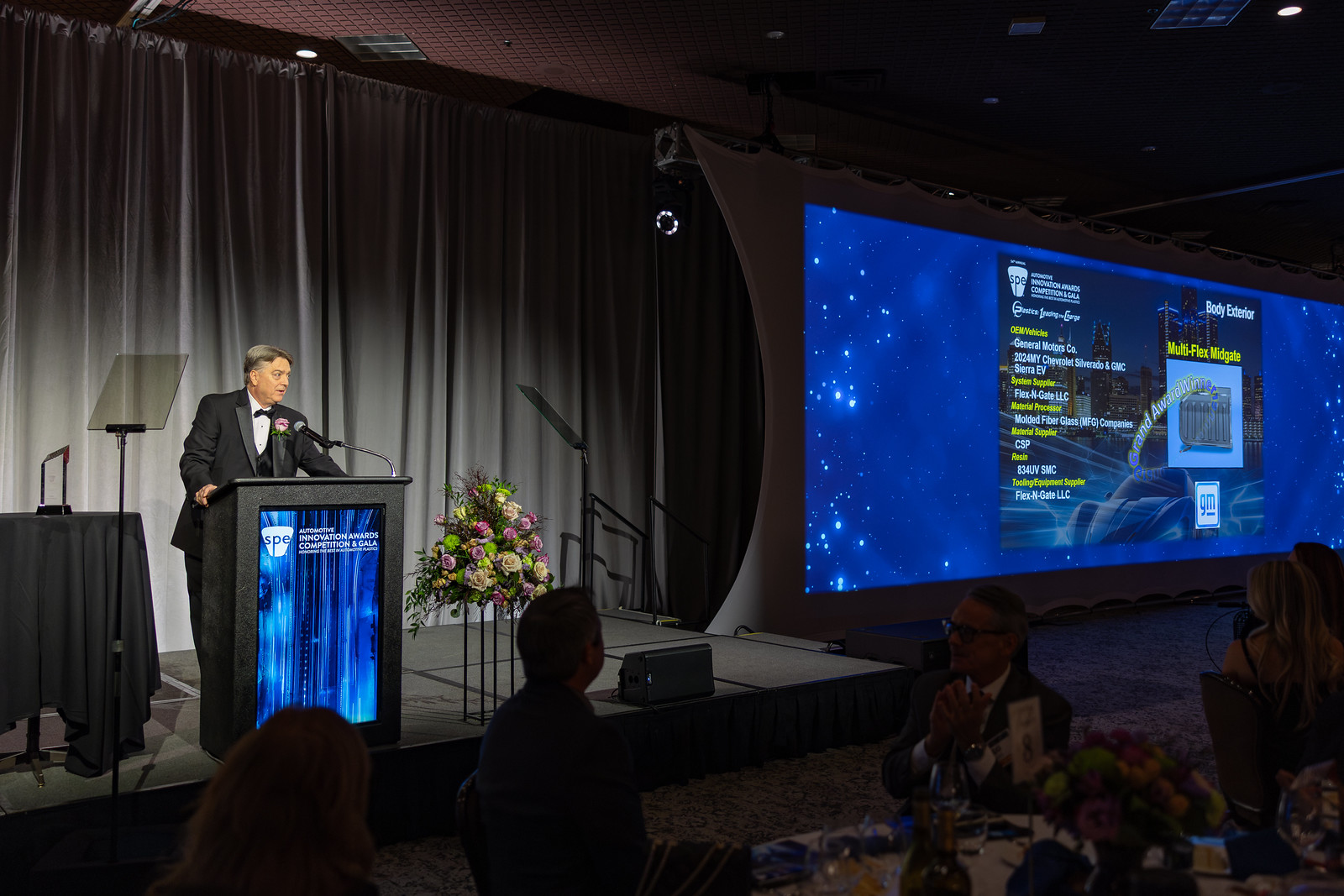
The 54th annual Automotive Innovation Awards Program is the oldest and largest recognition event) in the automotive and plastics industries.
Winners of other categories
In the Materials category, this year’s winner is the Fluoropolymer for Engine Seals in the 2025MY General Motors Co. Chevrolet Silverado & GMC Sierra by material supplier Syensqo with its resin Tecnoflon FKM Fluoroelastomer. A patented polymerization route for FKM (vinylidene fluoride-based fluoroelastomer) enables PCV valve, PCV hose, and oil-gallery plug O-rings to meet rigorous constraints while eliminating the PFAS surfactants traditionally used in emulsion polymerization. Believed to be an industry first, the material holds performance at 175°C and −40°C, resists hot oil and blow-by gases, and achieves tear strength ≥18 kN/m to meet ASTM D624. Sealing stability includes compression set at 175°C for 72 hours at 15% compression and ≥30% retained force in compression stress relaxation. The material guards against O-ring degradation that could result in stalling, increased emissions, and engine fire.
The Powertrain category winner is the Thin Wall ETC Actuator Gears of model 2025MY General Motors Co. Chevrolet Equinox & GMC Terrain, with system supplier Schaeffler AG and material supplied by Envalior (Stanyl PA46). First known ultra-thin wall gear design for electronic throttle control delivers accurate pedal-to-throttle response with a mid-gear design that absorbs impact to eliminate tooth breakage. High-flow PA46 blended with PTFE and 50 to 60% glass fibre achieves maximum stiffness and minimum wear. Gears achieve precise geometry via post-mould heat treating for 30% higher stiffness and 20% increased wear resistance. Novel gate strategy enables ultra-thin sections, required fibre orientation, tight gear tooth tolerances and balanced fill to minimize warpage with controlled shrinkage. Ultra-thin wall gear design enables the electronic throttle control to have 30% weight reduction, 20% cost reduction and 20% space reduction vs. a 1.5mm thick standard wall gear design in an electronic throttle control.
The Process/Assembly/Enabling Technologies winner is the Tail Lamp Piano Key Lens in the 2025MY General Motors Co. Cadillac Escalade IQ with system supplier Forvia SE and material supplier Covestro AG. In a first-known application use in North America, the team used three-shot rotary moulding with reverse ejection to create a signature lens with 17% more optical efficiency. Staying on the moving side for all shots, the lens is transferred to the stationary side for ejection. Six potential injection sequences for the multicolour / multigrade PC shots (red, clear, black) are optimized to prevent colour bleeding. Sculptural sections (4 to 10 mm) are filled from thin to thick, while revised draft angles protect optical quality. Tooling manages >250 shutoffs, versus the typical 10 to 20. Part savings: 20% weight, 50% assembly.
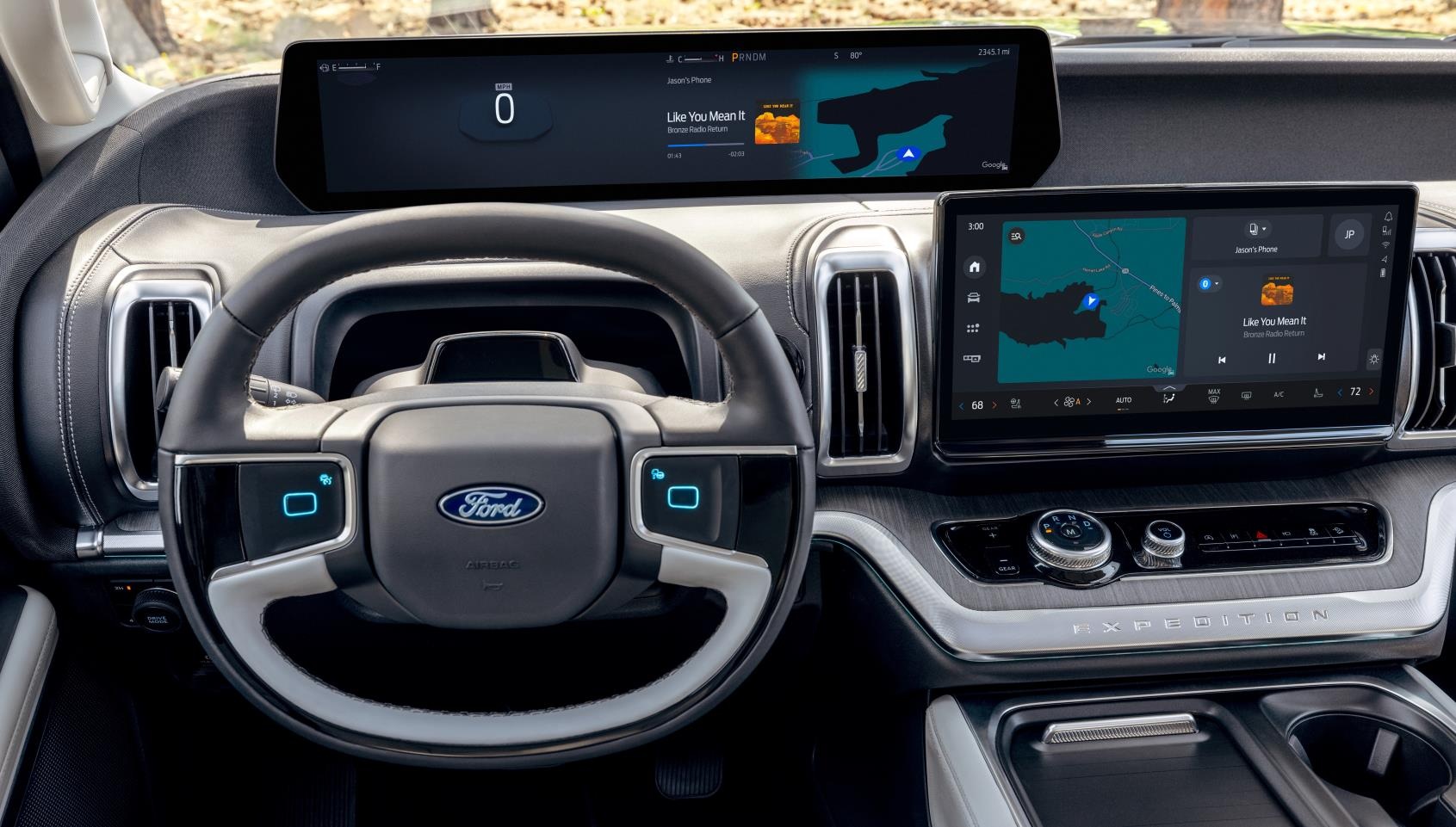
Plastics enable the development of new automotive parts and components meeting stringent standards.
The winner in the Safety category is the Integrated Dual Brightness Enhancement Film of 2025MY Ford Motor Co. Lincoln Navigator and Ford Expedition, with system supplier AUO Corporation and material supplier 3M Company. Designing a car-forward, pillar-to-pillar display created safety concerns due to windshield reflection. ALCF A5+ film from 3M integrates its Light Control and Dual Brightness Enhancement Films, other layers, and LCD panels to remove that reflection. In this first/largest application of the hybrid film, a 48-inch display is viewable over the steering wheel with a narrowed viewing angle. A PC louver layer tilts toward the driver eye box by about 3–5 degrees while another layer maintains display efficiency. Consolidation trims parts and assembly for about $10/part cost savings. 3M uses roll-to-roll microreplication along with other processes to create the hybrid film.
The category winner for Sustainability went to Hydrocarbon Modified Wood/PP Composites of model 2025MY Hyundai Motor Company Kia EV5, with system supplier KAIS, LLC and material supplier MIKA Inc. Creating a hydrocarbon-modified wood flour masterbatch (70%) is the innovation that allowed this team to achieve large parts at final loadings of 20–30% wood while maintaining flow and dimensional control. The solids-phase surface treatment they developed using hentriacontane - found in bees and plants - weakens hydrogen bonding in cellulose, improving dispersibility and allowing processing at 180 - 190°C to minimize odour. Pairing recycled ELV PP with wood lifts eco-materials content above 50 wt% and supports door centre trim substrates that will be covered with fabric or leather. Parts achieve 30% cost savings compared to a 10% bio-PE / PP blend.
Recognizing the contributions to the automotive industry
The Hall of Fame Award this year went to the First Automotive Seat Belt. The industry’s first application of a seat belt – a two-point front seat lap belt - used on the 1949 Nash Motors Airflyte and Ambassador vehicle models has been named the 2025 Hall of Fame Winner by the Automotive Division of the Society of Plastics Engineers (SPE®). This was the first OEM installation of seat belts, and since that time millions of vehicles have used Nylon and Polyester enabling improvements in mass production, automotive comfort and aesthetics, and most importantly – safety. Seat belts, a novel combination of metal and plastics, are now used worldwide on all automotive vehicles. To be considered for a Hall of Fame (HOF) Award, an automotive plastic or composite component must have been in continuous service in some form for 15 years or more, made a significant and lasting contribution to the application of plastics in automotive vehicles, and broadly adopted and/or expanded upon in the automotive industry.
The Lifetime Achievement Award was given to Robert Spiers III, professor emeritus and former chair of the Ferris State University Plastic Program, was named the 2025 Lifetime Achievement Award winner by the Automotive Division of the Society of Plastics Engineers (SPE®). Speir’s academic program leadership, professorship, and personal guidance motivated a multitude of students to pursue successful careers in plastics engineering resulting in growing the industry today and into the future.
The winner of the Vehicle Engineering Team Award (VETA) is the Ford Expedition SUV. Designed for real life with smart tech, versatility, and an adventurous attitude, the 2025 Ford Expedition turns school runs and road trips into premium, connected experiences powered by plastics engineering. In light of their advances, Ford Motor Co. (Dearborn) and its suppliers for the all-new, full-size SUV clinched the Vehicle Engineering Team Award (VETA).