
 Access
 Login/Register
 Supplier Login












Technological innovations, digital intelligence and sustainability can be effectively combined and this was demonstrated at the K 2025 by ENGEL. The trade fair presentation focused on industry-specific injection moulding solutions that enable companies to manufacture more efficiently, precisely and flexibly. ENGEL demonstrated its technologies and solutions in practical operation – from the use of artificial intelligence in the running injection moulding process to highly integrated production cells for the automotive, medical, technical moulding and packaging sectors.

Efficient production systems for automotive, medical products an packaging
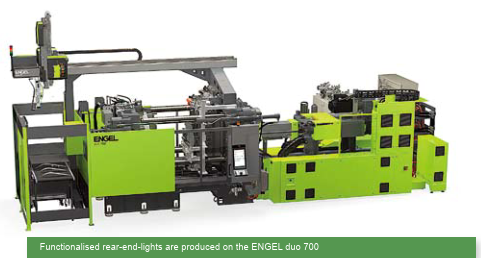
For the automotive sector, ENGEL demonstrated the highly integrated series production of innovative rear-end-lights on a high-performance duo 700 two-platen injection moulding machine with 7000 kN clamping force. The visible parts, measuring 600 x 240 mm, were manufactured using a combination of decorative foilmelt and functional clearmelt technologies in a vertical rotary table mould. In addition to design freedom, downstream processes are integrated into the injection moulding cell, and a separate hardcoating process is no longer required thanks to clearmelt. While the transfer of colour design from a decorative foil is applied to the component on one mould side by back-injection of thermoplastics (foilmelt), the opposite side is overflooded with polyurethane (clearmelt) to form a highly transparent and robust protective layer. A space-saving integrated automation system with a viper 40 linear robot enables short cycle times within a compact and efficient cell. The transfer foil was supplied by LEONHARD KURZ. At the partner’s stand, the component is further processed using an integrated LED function foil.
With this application, ENGEL demonstrates how visible parts in the automotive sector can be both functionalised and decorated – economically, with high precision, and in a compact production process.
A production cell with a vertical insert 150 injection moulding machine, offering 1500 kN clamping force, demonstrated the fully automated manufacturing of liquid silicone rubber (LSR) seals on sensitive gas diffusion layers (GDL) for fuel cells. The LSR seal is applied with absolute platen parallelism directly in the machine, inspected in the mould and the component is immediately removed. The automation system, featuring ENGEL easix articulated robot and a rotary table mould supplied by ACH, ensures short cycle times and high process reliability. To save space, the control cabinet is integrated directly into the machine frame. ENGEL is showcasing a highly cost-efficient solution for fully automated overmoulding with thin LSR layers in a compact footprint.
A novel bicycle handlebar is manufactured as a hollow component on a tie-bar-less ENGEL victory 180 injection moulding machine with 1800 kN clamping force. The fluidmelt process is used to create the hollow structure, while unidirectional continuous carbon fibre tapes are simultaneously integrated using the organomelt process. This innovative combination of technologies enables maximum part performance with minimal weight and a short cycle time of just one minute. The process is fully automated with an easix articulated robot. With these technologies, ENGEL once again sets new benchmarks in production efficiency and sustainability – opening up new markets for plastic components in applications traditionally dominated by metal.
A B-pillar trim component was demonstrated being produced in just 50 seconds using the ENGEL foammelt technology on a t-win 6500 two-platen injection moulding machine from the WINTEC brand, part of the ENGEL Group. The foamed part, weighing 290 g, is made of mineral-filled PP from Sabic. ENGEL’s foammelt technology reduces weight and cuts material and production costs while achieving excellent surface replication. Automation is handled by a highly integrated viper 20 robot. WINTEC here demonstrates a cost-effective solution for producing visible interior automotive components.
In the Medical area, ENGEL showcased a highly efficient injection moulding cell built around an all-electric e-motion 260 combi M injection moulding machine equipped with two injection units and a central rotary platen. Using a stack mould from Hack, 24-well cell culture plates and matching polycarbonate lids were produced simultaneously in a single shot – with a cycle time of just 11 seconds. The additional injection unit was arranged at an angle to shorten the hot runner path, enable central injection without weld lines and improve material protection. This manufacturing solution, featuring a side-entry robot from Ilsemann, delivers the entire process including assembly and packaging in a compact, ergonomic setup.
A key highlight shown was the validation solution jointly developed by ENGEL and toolmaker Hack. This system enables structured and digital documentation of all validation phases – from Design Qualification (DQ) to Performance Qualification (PQ). Machine- and tool-integrated sensor technology, combined with products from the ENGEL iQ family and standardised documentation modules, significantly reduce the effort required. As a result, the time- and personnel-intensive validation process is substantially shortened.
ENGEL demonstrated a series-ready solution for processing rPET in thin-walled packaging on an all-electric e-motion 420 injection moulding machine with 4,200 kN clamping force. What was previously only feasible using hydraulic injection, ENGEL now achieves electrically. A 6+6-cavity stack mould from Plastisud was used to produce yoghurt cups made from 70 % virgin material and 30 % bottle-grade rPET. The rPET was supplied by NGR and upgraded for food contact via Liquid-State Polycondensation.
This production setup delivers excellent repeatability at high performance. The combination of injection compression moulding, iQ motion control, and iQ weight control plus enables the manufacture of thin-walled, precise cups with minimal material usage. The application already complies with the requirements of the Packaging and Packaging Waste Directive for 2030. Moreover, it illustrated the potential to replace thermoforming as the preferred manufacturing process, enabling producers to save on upstream steps (film production) and material (trimming waste). ENGEL thus presented a practical example of how sustainability and precision can be combined in an economically viable production environment.
Technical Moulding: Saving resources and using installation space efficiently
One of the highlights at the ENGEL stand was the world premiere of the latest generation of its electric tie-bar-less victory injection moulding machines. The new ENGEL victory electric impresses not only with technical precision but also with clear economic advantages. Its compact design reduces the overall machine length by around 200 mm, allowing for optimised production layouts. At the same time, the tie-bar-less design enables the use of significantly larger moulds compared to conventional machines of the same clamping force class – without additional investment. For example, a mould that would typically require around 3200 kN can be operated on a victory electric 220 with just 2200 kN clamping force.
Blocks made from recycled material with high structural stability
On an all-electric e-mac 220 injection moulding machine with 2,200 kN clamping force, ENGEL produced thick-walled, foamed construction blocks for the building industry. The material comes from yellow bag household waste, reprocessed by EREMA. Mould and foaming agent formulation are supplied by Moxietec. For optimum foam homogeneity, an optimised mixing screw is used during plasticising. The result: components with up to 30% weight reduction and 10% higher strength. This technology is particularly well suited for logistics pallets and as a substitute for concrete in construction applications.
As 100% post-consumer recyclate with corresponding material fluctuations is processed, the new iQ weight control plus plays a key role. After defining just two parameters, the digital assistance system automatically adjusts the switchover point and pressure curve during every injection cycle. This reduces scrap by up to 50%.
An integrated automation solution with servo sprue picker and an integrated conveyor belt inside the machine makes the cell particularly energy-efficient and compact.
Digital intelligence for real-world production benefits
With inject AI, ENGEL is taking its inject 4.0 programme to the next level and at the exhibition, ENGEL presented the next step towards self-optimising machines by integrating artificial intelligence into many new and existing ENGEL products. The iQ process observer monitors up to 1,000 parameters per shot, detects process deviations in real time, and provides AI-supported automatic correction suggestions – a key contribution to process optimisation and scrap reduction. The systems continuously learn from the data of all connected machines, creating added value for every new project – a genuine boost for quality and efficiency.
ENGEL does not see AI as a replacement, but as a complement to human expertise. Adaptive assistance systems ease the burden on personnel, stabilise processes and increase equipment availability – an especially valuable benefit in times of skilled labour shortages. In this way, the self-regulating machine is gradually becoming a reality.
In the event of machine or process faults, a new AI-supported feature in the e-connect portal provides machine-specific assistance – quickly, precisely, around the clock, and in all languages. Thanks to intelligent search functionality in the ENGEL machine manuals, downtime can be significantly reduced.