
 Access
 Login/Register
 Supplier Login












Rapidly rising recycling rates, fluctuating input qualities and high demands on product purity pose major challenges for recyclers – especially in filtration. BB Engineering GmbH is responding to this with an innovative filter system: the COBRA filter. This combines large-area fine filtration with inline cleaning and promises not only increased efficiency and low operating costs, but also noticeable cost reductions.

Matthias Schmitz, Head of Engineering Recycling Technology, BB Engineering
The filtration requirements in PET recycling are high. The input material is often heavily contaminated, but at the same time the quality of the end product must be right. Conventional filter systems quickly reach their limits – either they cannot achieve the necessary filtration fineness, or they are extremely maintenance- intensive and complicated to handle. And yet filtration plays a key role in recycling. BB Engineering’s motivation was to develop a system that could overcome these challenges – efficiently, automatically and with as little waste of resources as possible. The result is an automated large-area fine filter with inline cleaning – a system that has never existed before – the COBRA filter.
“Our COBRA filter is a continuous large-area fine filter with an automated cleaning process directly in the filter – a novelty in this form. We use pleated filter cartridges in two filter inserts so that COBRA can produce non-stop. Switching between the two filter inserts is automated, as is inline intermediate cleaning. While one filter insert is in production, the other insert is cleaned. The whole system is closed and runs without manual intervention or cleaning chemicals. Our ‘White Filter Cleaning’ technology works exclusively with superheated steam and restores the filter cartridges to an operational condition. This extends the ser- vice life of the filter many times over and protects the materials,” according to Matthias Schmitz, Head of Engineering Recycling Technology at BB Engineering.
The COBRA filter achieves significant efficiency gains through integrated intermediate cleaning, requires only minimal operating effort thanks to automation, and is very safe in terms of both process stability and handling.
Reducing maintenance costs
Large-area filtration has the stigma of high costs, high maintenance and time-consuming conversion and cleaning work. This is why many producers shy away from large-area filters. However, they offer the best filtration performance, which is essential, especially with increasing rPET proportions. “That is why we have created a large-area filter that precisely overcomes these known weaknesses. With its pleated filter cartridges, COBRA offers a filter area of up to 24 m² with a fineness of up to 20 μm. COBRA therefore filters more finely than screen changers or laser filters and can absorb a larger amount of contamination. This makes it perfect for recycling applications or other demanding filtrations tasks, such as synthetic fibre spinning and film production. In a filter test with rPET, the COBRA filter with 20 μm showed a filter pressure value of 1,5 bar/kg/cm², which corresponds to the quality of virgin material,” Mr. Schmitz emphasized.
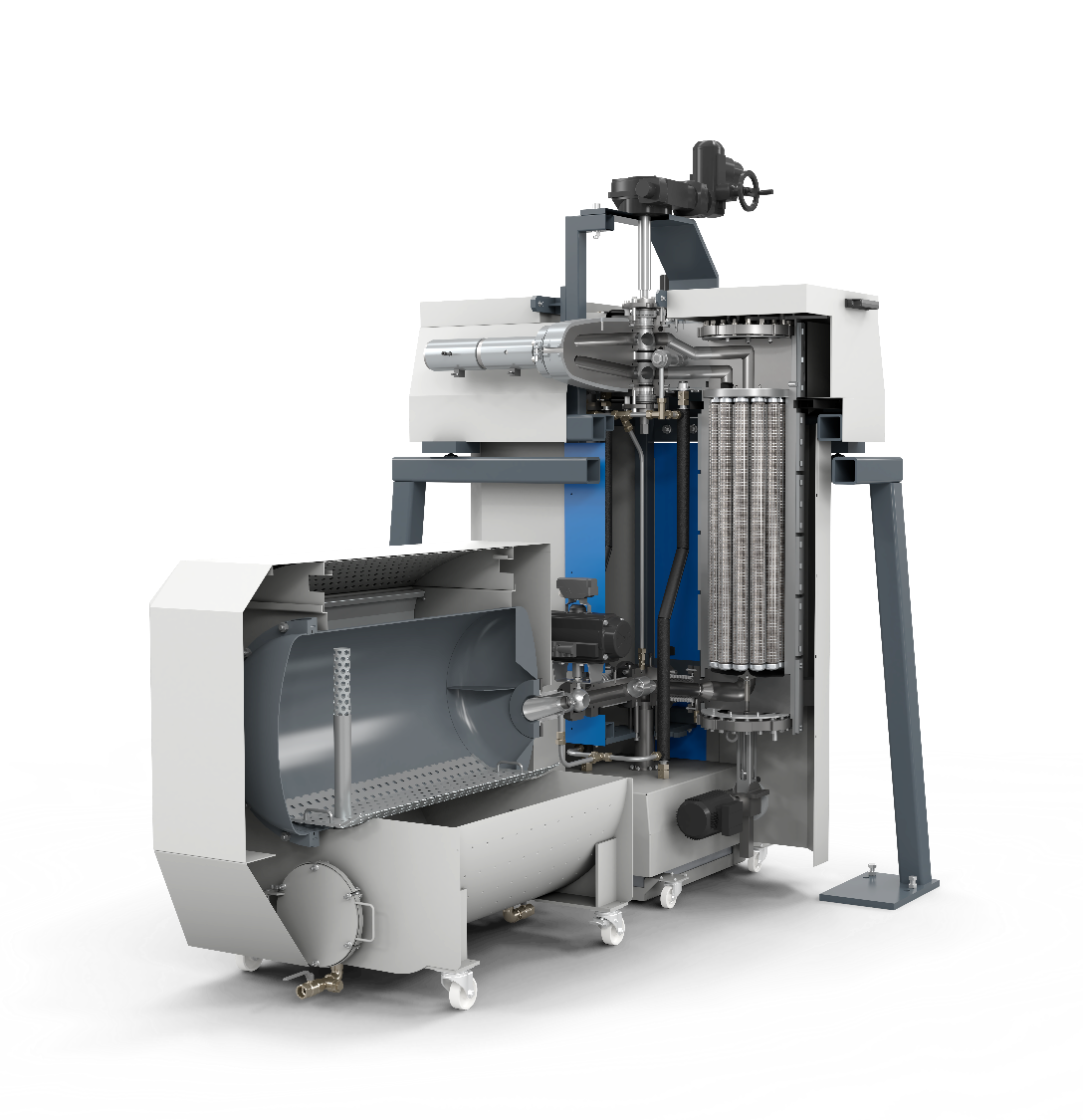
COBRA filter is a continuous large-area fine filter with an automated cleaning process directly in the filter.
BB Engineering has been offering our White Filter Cleaning (WFC) filter cleaning system as a standalone solution for several years now. This intermediate cleaning of filter inserts does not require any chemicals and uses only superheated steam. This protects the components, is more cost-effective and also significantly safer for operators and, of course, for the environment. The WFC system is now fully integrated into the COBRA and can therefore be used as a closed system with filtration to its full advantage. The filter control system signals when intermediate cleaning is required, switches production to the second filter insert and initiates cleaning. The filter insert remains in the filter and is automatically drained and then repeatedly exposed to superheated water vapour in several hundred cycles until it is ready for operation again. The cleaning process takes only 10 hours, whereas pyrolysis and chemical cleaning require several days.
Eliminating costs with high filtration performance
COBRA offers advantages in many respects. Operators do not have to handle molten liquids or hot components, and there is no need to spend time on changeovers and cleaning. Furthermore, the consumables and materials have a longer service life because they are cleaned gently, without aggressive chemicals or the extremely high temperatures of pyrolysis. The costs for chemicals and their disposal are eliminated. Ultimately, COBRA’s automation and intermediate cleaning lead to noticeable OPEX savings in terms of personnel, energy, materials, and parts. “However, in our view, the biggest advantage is the significantly longer service life of the filter. Thanks to the intermediate cleaning cycles, the filter can remain in use approx. 3-5 times longer before it needs to be cleaned and inspected again. This means a significant increase in efficiency, especially in recycling, where service lives tend to be shorter rather than longer. This also applies to downstream processes,” according to Mr. Schmitz. .
The high filtration performance of the COBRA filter makes the melt so clean that downstream cleaning steps are significantly reduced or even eliminated. This saves time, material, and energy. In addition, there are fewer interruptions in the production chain due to residual particles in the melt. This is a decisive advantage, especially in demanding applications, such as the packaging or textile industry.
Beyond PET recycling
Although the COBRA filter was developed with a focus on PET recycling, its modular design means it can also be used in other areas – such as plastic spinning or the processing of technical plastics. Wherever high-purity melt is required, and contamination is to be expected, COBRA can demonstrate its strengths, even as a retrofit solution in existing plants.
“Filtration already plays a key role in recycling and will become even more critical if we want to achieve really high recycled content in high quality products. To do this, filters have to perform well under high levels of contamination while remaining efficient. What’s more, sustainability doesn’t just start with the product, but with the process design. I believe that solutions such as COBRA help to ensure that recycling remains economical, becomes more efficient and becomes even more widespread in industrial applications,” Mr. Schmitz stressed.