
 Access
 Login/Register
 Supplier Login












The Extended Producer Responsibility (EPR) framework across Southeast Asia is gaining support as governments acknowledge the urgency of implementing regulations to achieve a circular economy. In essence, the EPR law holds the producers accountable for the lifecycle of the products they manufacture. It mandates producers to manage the waste generated from their products and take steps towards reducing plastic waste. Producers and importers must bear the responsibility of managing the end-of-life phase of their products. The Philippines, Indonesia, Singapore, and Viet Nam have introduced or are developing EPR-type regulatory frameworks based on this principle and have been encouraging producers to align to the sustainability targets. While there are challenges in the implementation of EPR such as the lack of efficient waste collection and recycling infrastructure, large volumes of plastic waste, high cost of technologies and equipment, many governments in the region continue to explore sustainable production and waste management solutions.

Ms. Deva Dharmapuspa, Head of Supply Chain, Quality, Health & Safety,
and Material Innovation at Dynapack Asia
In Indonesia, the EPR law forms part of the strategy to alleviate plastic waste as it requires producers to develop and submit compliance schemes a scheme to effectively perform waste collection, sorting, recycling and disposal. The EPR implementing rules and regulations – drawn from Ministry of Environment and Forestry Regulation No. 75/2019 roadmap for plastic waste management - are currently under development and expected to be phased in around 2026. Since the EPR law applies to different sectors such as food and beverage, household goods, electronics and personal care products, producers and importers/sellers that will be affected are now stepping up their initiatives to comply with the regulations.
At the 2025 ASEAN Manufacturing Summit in Jakarta, experts from Dynapack Asia and Danone Indonesia shared how their companies are aligning operations with EPR principles through innovations in their manufacturing operations and products. The annual regional forum, hosted by Ringier Events, convened policymakers, manufacturers, recyclers, and sustainability leaders to discuss how Southeast Asia can transition toward a circular economy. This year’s theme— “Creating a Circular Economy for Plastics: Sustainable Packaging, Recycling Technology, Intelligence, and Automation”—reflected growing recognition that the region’s environmental and economic future hinges on how its plastics value chain evolves.
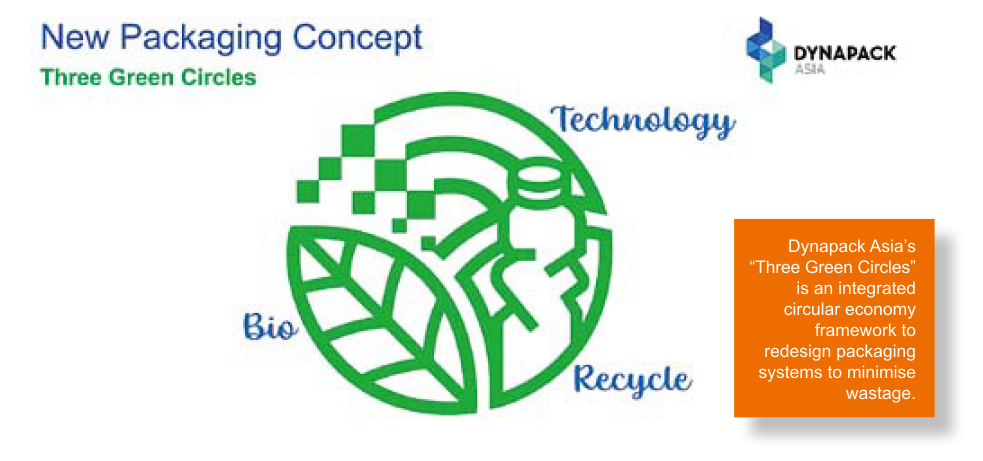
Dynapack Asia: “Three Green Circles” an integrated circular economy framework
Dynapack Asia’s contribution focused on the “Three Green Circles,” an integrated circular economy framework presented by Ms. Deva Dharmapuspa, Head of Supply Chain, Quality, Health & Safety, and Material Innovation. The concept outlines a strategic approach for redesigning packaging systems so that materials remain in productive use for as long as possible, minimising waste, reducing emissions, and preserving natural resources.
At its core, the Three Green Circles approach connects three mutually reinforcing priorities: bio-based material development, post-consumer resin integration, and advanced manufacturing innovation. Rather than positioning sustainability as a compliance obligation or cost center, Dynapack Asia frames it as a foundation for long-term competitiveness and value creation.
“Sustainability today requires more than incremental improvements,” Ms. Dharmapuspa explained. “It demands systemic transformation—aligning material choices, production technologies, and business behaviour with the needs of both the environment and the market.”
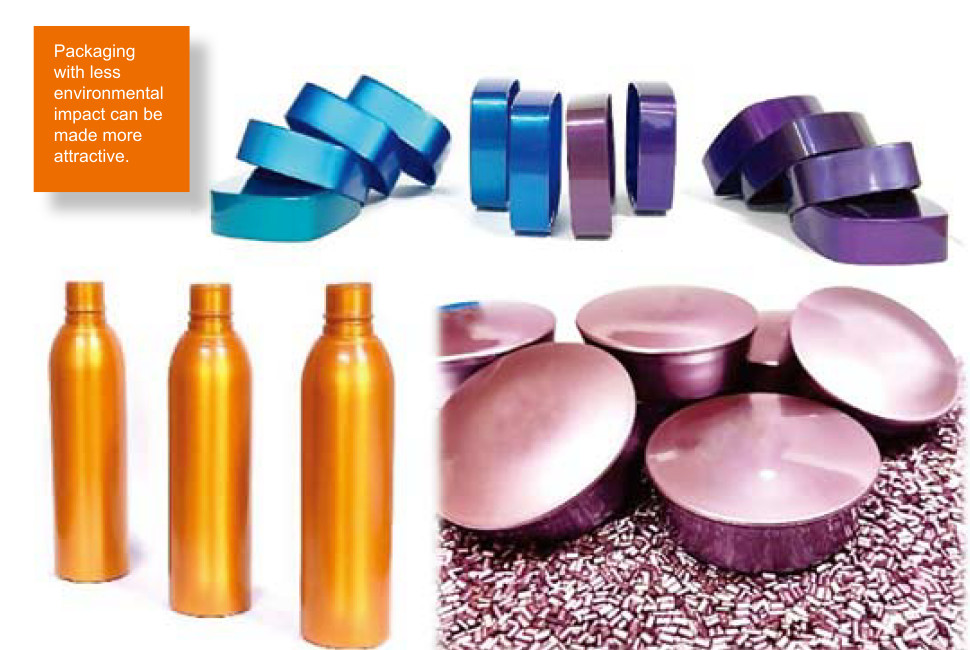
The first circle focuses on bio-based feedstocks, particularly renewable and lower-carbon raw materials that can reduce dependence on fossil-based plastics. The second emphasizes recycled plastics, with an aim to achieve consistency, safety, and performance suitable for mainstream commercial applications. The third advances in manufacturing innovation, including lightweighting, improved barrier technology for shelf life, precision coloration, and reducing overall material intensity.
What distinguishes this approach is that it recognises circularity as an ecosystem challenge—not a problem any single company can solve independently. The shift requires coordinated investment in collection and sorting infrastructure, higher consumer awareness, and alignment across brand owners, resin producers, converters, recyclers, and retail channels. Ultimately, a circular economy is shaped as much by social systems and policy as by technology.
This message was reinforced by other contributors at the summit, including the Packaging Development Federation (PDF), Indonesian Packaging Federation, Indonesia ISO Expert Association (IIEA), and the Indonesia Plastic Recycling Association (ADUPI). Across panel discussions and technical forums, a shared theme emerged: the road to circularity is collaborative and iterative. Success depends on designing value chains that reward resource efficiency, product durability, and recycling performancenot volume and disposability.
For Southeast Asia region with rapidly growing consumption, expanding industrial capacity, and pressing waste management challenges, the opportunity is significant. Companies that lead on circular transformation can help shape new market standards, strengthen brand trust, and position themselves. Dynapack Asia’s Three Green Circles offer not just a framework, but a signal of where the plastics industry may be heading: toward systems designed to regenerate, not deplete.
Global Commitment 2030 and Dynapack Asia
Dynapack Asia joined the Ellen MacArthur Foundation’s New Plastics Economy Global Commitment in 2018, representing a strategic shift toward integrating circular economic principles into operational decisions, product design, and long-term competitiveness. The initiative has since become a proving ground for how manufacturers can create value by redesigning systems rather than simply optimising existing ones.
Globally, the Commitment has demonstrated the potential of coordinated action. According to Ellen MacArthur Foundation reporting, signatories have avoided 14 million tonnes of virgin plastic, reduced annual CO₂ emissions by 7.8 million tonnes, and saved the equivalent of one barrel of oil every second, as reported by the Ellen MacArthur Foundation. These collective outcomes highlight an emerging dynamic: circularity is no longer a niche environmental concept, but a scalable business strategy enabled by data, technology, and cross-sector collaboration.
For Dynapack Asia, the Global Commitment serves as a strategic framework, enabling the company to structure and accelerate its circularity efforts on a global platform. In its 2025 disclosure, Dynapack Asia reported products designed to be 84.1% recyclable (+4 points from the previous year), 8% post-consumer recycled (PCR) content (+1.4 points), and 1.7% of packaging portfolio by weight is reusable (+1.67 points). These steady year-on-year gains reflect structural shifts in how packaging is designed, sourced, and recovered across its operations in Indonesia, Malaysia, Thailand, Vietnam, Singapore, and China.
The next phase, the Global Commitment 2030, signals a maturing global approach. The framework streamlines mandatory metrics by more than 80% to reduce administrative burden and increase participation, while retaining one core requirement for packaging producers: PCR content. Within this new landscape, Dynapack Asia has set targets of 30% PCR content and more than 90% designed for recyclability by 2030. These ambitions reinforce our decarbonization pathway and align with our Sustainability-Linked Loan commitments, illustrating how circularity metrics are increasingly tied to financial levers and investor expectations.
Reaching these targets will require continued investment in material innovation, supplier ecosystem development, and customer collaboration.