
 Access
 Login/Register
 Supplier Login












For anyone who regularly visits packaging industry trade shows, the solutions on exhibition booths today will be nearly unrecognisable compared to those that were on show a decade ago.
Everything from their aesthetics to their chemistry has taken a generational leap forward, and yesterday’s pipe dreams are today’s commercial realities. High-performance home compostable films, recyclable paper laminates that can survive the freezer aisle, and mono-material flexible packs that meet recycling guidelines are now commonplace on retail shelves. These advances reflect a sector that is being rapidly moulded by regulation, sustainability targets, and changing consumer preferences.
That means the industry has to continue to adapt and embracing cutting-edge technology like laser scoring is one key way brands can stay ahead of the game.
Market forces working in tandem
Across Europe alone, extended producer responsibility (EPR) reforms and packaging waste legislation are accelerating the shift toward lighter, more recyclable structures. At the same time, consumer expectations are rising. Surveys from organisations such as WRAP and YouGov consistently show that shoppers want packaging that is easier to open, easier to reseal, and easier to recycle, without compromising freshness or protection. Convenience and sustainability are no longer trade-offs. They are expected to go hand-in-hand.
This evolution is being driven by two forces working in tandem. One is material science, which continues to push the boundaries of barrier performance, compostability, and recyclability. The other is processing technology, which determines how flexibly and precisely those materials can be converted into functional packs. Laser scoring is a technology that sits at the intersection between those two trends, opening up an endless new frontier of possibilities for the design, manufacture, and use of flexible packaging.
Staying ahead of the market
The pace of change in packaging is now set as much by consumers and retailers as by converters. More people are buying food on the go, ordering groceries online, and expecting packaging that fits into their busy, fragmented lifestyles. At the same time, retailers are under pressure to cut waste, improve recyclability, and meet accessibility standards.
These pressures have very real impacts. Studies consistently show that poor opening experiences remain one of the biggest causes of consumer packaging frustration, particularly for older shoppers and people with reduced dexterity. In the UK, nearly one in three adults report difficulty opening some forms of packaging[1], while food waste data shows that packs that cannot be conveniently resealed are more likely to end up in the bin[2].
Balancing all of these requirements with rising material and energy costs is a technical challenge. Traditional converting methods, such as mechanical die cutting, can struggle to keep up with the consumer and regulator demands for rapid design changes, smaller batch sizes, and complex material structures. This is where laser-based systems are starting to play a larger role.
Today’s laser scoring systems for flexible materials are typically configured like other web-based processes, with reels feeding through a controlled scoring and cutting zone. The difference is that lasers do not rely on physical tools. Instead, energy is precisely directed into the material, allowing cuts, scores, and perforations to be adjusted digitally and applied with micron-level accuracy.
This precision makes it possible to process a wide range of structures, from thin monopolymer films to multilayer laminates and even metallised materials. It also allows multiple operations to be carried out in a single pass; an efficiency improvement that is increasingly important as converters look to reduce the waste, set-up times, and complexity often associated with mechanical die-cutting and tooling.
Different cuts for different functions
One of the strengths of laser technology is its ability to create very different types of cut within the same material, each serving a specific purpose, at the speed of light. Laser scoring machinery can be programmed to produce highly complex cutting patterns without impacting the overall turnaround time of the project, adding value to packaging without imposing unnecessary costs.
A straight-line score, for example, creates an easy-tear opening that gives consumers a clear, predictable way into a pack. This is particularly valuable for accessible packaging, where consistent tear performance can make a significant difference to usability.
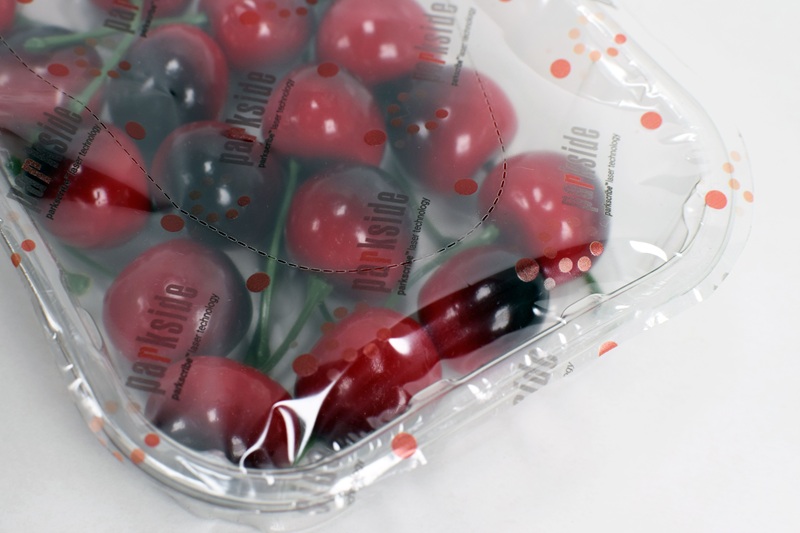
Off-set cutting through single layers of a laminated film creates peel-and-reclose functionality without the need for separate labels or adhesive patches. This not only improves convenience for products such as cheese, deli meats, or snacks, but also helps keep material structures simpler and lighter, which supports packaging reduction and recyclability targets. In many cases, this unlocks possibilities to make packaging more circular. At Parkside, we have used it to create a peel-and-reclose film that can be weld-sealed to a tray. If both film and tray are made from the same plastic, PET, for example, then they can both, as an entire unit, be dropped into domestic recycling bins at end-of-life. This overcomes consumer confusion that can arise when different packaging elements need to be separated into different waste streams.
Single-spot micro-perforations can be used to control gas exchange inside a pack, making them useful for fresh produce where modified atmospheres help extend shelf life and reduce food waste. Meanwhile, perforation lines can separate multipacks or sharing packs into individual portions, supporting both portion control and on-the-go consumption.
Because lasers can be tuned to cut through specific layers rather than the entire structure, these features can be integrated into modern monomaterial or recyclable laminates without compromising barrier performance or seal integrity. And the impact from this goes far beyond the packaging itself – it can have a real-world effect on consumer experiences and behaviour.
Expanding the scope of packaging
Ultimately, consumers judge packaging on how well it works in their hands and in their homes, not just on how it looks on-shelf. But the way packs are made influences how well those expectations can be met.
Laser scoring and cutting expand what is technically and economically feasible, particularly as the industry moves toward lighter, simpler, and more recyclable material structures. It allows converters and brand owners to design opening, resealing, ventilation, and portioning features directly into the pack, rather than adding extra components later. And that creates new possibilities for blue-sky ideas to be introduced that may not have even been considered previously.
That matters in a world where sustainability, accessibility, and convenience are all under scrutiny. It means that functional improvements do not have to come at the expense of recyclability, and that innovation does not have to mean more material.
As packaging continues to evolve under regulatory, commercial, and consumer pressure, technologies that bring flexibility and precision into the converting process will play an increasingly important role. Laser scoring is one example of how the industry is shifting from compromise to cooperation, finding ways to make packs that are easier to use, easier to recycle, and better suited to the realities of modern retail.
Packaging has always been a balance between protection, performance, and perception. And with laser scoring, it becomes about something more – unlimited possibilities.