
 Access
 Login/Register
 Supplier Login












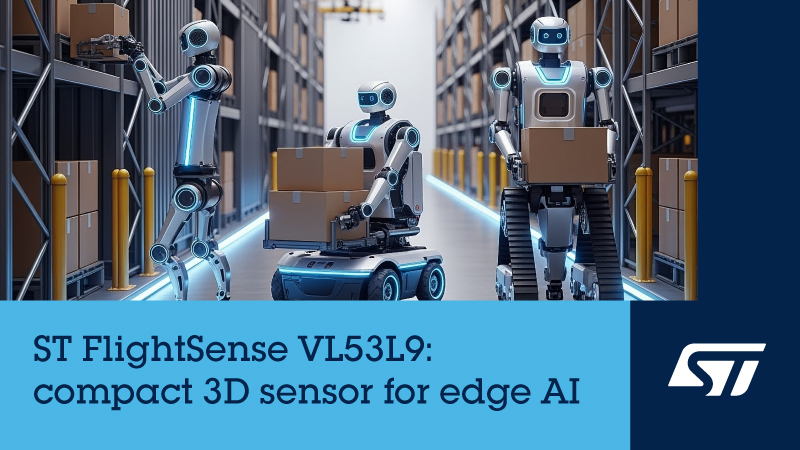
As robots, smart buildings and wearable devices become more intelligent, they also need better depth perception—without relying on power-hungry processors. STMicroelectronics is addressing that challenge with the launch of the VL53L9, its first direct Time-of-Flight (dToF) 3D LiDAR module, designed to deliver high-resolution spatial sensing while keeping edge AI systems compact and energy efficient.
At the heart of the new module is a 2,268-zone (54 × 42) depth sensor that captures detailed 3D information at up to 100 frames per second over distances ranging from less than 5 cm to 9 meters. By combining a stacked SPAD sensor, metasurface optics and on-chip processing into a single package, the VL53L9 simplifies system design while reducing the computing resources typically required for 3D vision.
Unlike conventional scanning LiDAR solutions, ST's dual-scan flood illumination captures both 2D infrared and 3D depth data simultaneously, improving small-object detection, minimizing motion artifacts and eliminating blind spots. The module is also calibration-free and integrates its own power management, helping designers shorten development cycles and lower overall system costs.
The compact sensor is aimed at a wide range of applications, from autonomous mobile robots and industrial automation to smart buildings, AR/VR devices and healthcare systems. In robotics, it enhances obstacle avoidance and simultaneous localization and mapping (SLAM), while in smart environments it enables privacy-preserving people detection and occupancy monitoring without traditional cameras.
Now entering mass production, the VL53L9 reflects the growing demand for AI-ready sensing technologies that bring more intelligence to edge devices while reducing power consumption and system complexity.