
 Access
 Login/Register
 Supplier Login












SAARBRüCKEN, Germany – It all started at Hamba back in 1939, when design engineer Hans Adalbert Müller decided to set up a company to manufacture packaging machinery. The outbreak of the Second World War thwarted Müller's plans to go for the business idea he really wanted to pursue. Instead, he was forced to manufacture aircraft components.
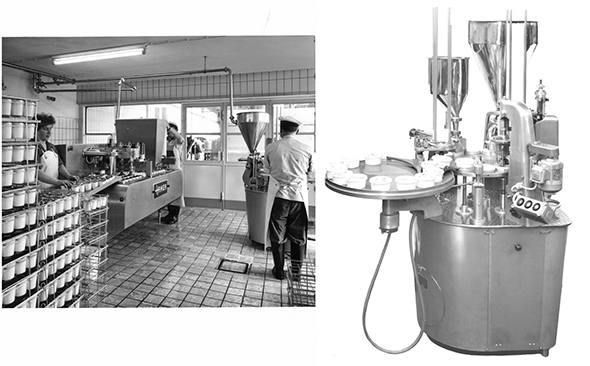
Hamba equipment in 1966 (left) and today’s Hamba BF2400 cup filler
As soon as the war was over, however, Mr. Müller started making tableting, labeling, dispensing and gluing machines for the pharmaceutical industry. At the same time, Hamba developed its first butter packaging machine, which proved so successful that Müller decided to focus exclusively on machinery for the food industry from then on.
In the early 1950s, Hamba manufactured its first filling machines, initially for production of waxed paper bags for disposable milk cartons. Cup fillers for yogurt conquered the market soon afterward. It also started to produce "milk production lines" for major dairies, which were capable of molding, filling and sealing 60,000 polyethylene bottles a day in one machining step.
The business flourished and in 1969, Hamba opened a second plant in Neunkirchen in the Saarland region. The company shifted its entire production activities to Neunkirchen, while its head office and the production facilities for spare parts and subsequent supply remained in Wuppertal.
In the early 1970s, Hamba became one of the first providers in the market to develop special machinery for sterile cup packaging. This was a pioneering and successful development, as it had previously been impossible to offer long shelf lives for dairy products that were not refrigerated. As a result, Hamba made aseptic packaging machinery a fixed component of its production range. As well as the wet-aseptic process, the company also started to use UVC rays for ultraclean applications. This meant that the packaged goods could be kept for twice as long.
The company's founding father, Hans Adalbert Müller, passed away in 1978, with his son Hans Peter taking over at the helm. The company's annual revenue at the time came in at around DM 30 million. By then, Hamba machines could be found in 52 countries across the globe and produced a whole variety of products – from milk, yogurt, cream and butter to ice-cream, custard pudding, jam, mayonnaise and fruit juice.
In 2000, the company SIG replaced the family management team, before the OYSTAR Group, with nine worldwide locations, took the company over in 2007. This move has promoted the company's international growth even further. Today, Hamba machinery is used in more than 60 countries worldwide.
sneakers