
 Access
 Login/Register
 Supplier Login












Hectic lifestyles and desk‑bound routines, apart from convenient indulgence, are driving greater snack consumption. In 2025, the APAC snacks market was valued at USD 287.1 billion and is projected to reach USD 378.4 billion by 2030 growing at a 4.8% CAGR, according to a report released by Grand View Research.
Within the region, markets such as Vietnam and Indonesia are undergoing rapid diversification of product portfolios, shorter brand cycles, and rising demand for private labels. These place new demands on manufacturers to adapt quickly. Similarly, the Philippines is an opportunity-rich market for branded savory and confectionery products, though price sensitivity continues to impact buying behavior. Thailand is described as a steady, competitive market increasingly shaped by health-conscious innovation, with strong preference for savory products, especially extruded and fried formats, as well as clean-label options.
Across these markets, manufacturers are expected to deliver more product variety while they manage constraints in footprint, labor, and capital expenditure. The pressure calls for flexible, scalable processing and packaging technologies that can adapt to diverse local tastes and formats.
To know more about the evolving snacks segment, FoodPacific Manufacturing Journal turned to Luca Menassi, General Manager for Asia at TNA Solutions, for the company’s perspective.

Luca Menassi, General Manager for Asia at TNA Solutions
How would you describe the year that was for TNA Solutions in Asia Pacific / Southeast Asia?
The year 2025 was a positive and promising year for us in Asia Pacific, with momentum particularly strong across Southeast Asia and Japan. We saw fresh demand coming through in markets that have been quieter in recent years, alongside a clear shift in what customers want from processing and packaging partners.
Across the region, manufacturers are running a wider mix of products, and putting more emphasis on flexibility and rapid changeovers. That’s being driven by the growth of niche products, faster brand cycles, and the expansion of private label manufacturing in the region. Overall, it’s an agile market where differentiation matters, and producers are looking for technology that can keep up with local tastes and formats as well as fast-moving commercial demand.
Can you share highpoints that can be considered transformative for the company?
A key milestone for us was the step-change in regional engagement and opportunity, particularly in Southeast Asia. We saw new doors open in Vietnam, including projects where our technologies had not previously been present, and we also saw Indonesia re-emerge as a serious growth market after a long period of relative dormancy.
We also progressed major confectionery installations in the region, which is important because it reflects deeper customer confidence in our ability to deliver and support complex, high-performance lines,” he said. “Alongside projects, 2025 was transformative in regard to the level of support and aftermarket care we provide customers. We strengthened our service engineering presence locally and launched a regional Help Desk, which improves responsiveness and helps customers sustain performance over the full lifecycle of the line.
Which markets delivered positive growth, and what lesson will you carry forward in 2026?
Vietnam and Indonesia stood out as high-potential markets in Southeast Asia, with Japan also delivering strong growth in confectionery. Those markets have three things in common: product variety is expanding, brand cycles are contracting, and manufacturers are under pressure to do more with the same footprint, labour availability and capex constraints. And this is all happening rapidly.
The big lesson heading into 2026 is that the market is becoming more Asia-driven in how projects are evaluated and how decisions are made. Currency pressures and price sensitivity are influencing buying behaviour, and we are seeing stronger demand for solutions that can be delivered closer to the region and supported locally. That reinforces the value of standardized, scalable platforms, backed by strong regional support, rather than assuming the most advanced option is always the right fit.
How are snack and packaged food formats evolving in Southeast Asia compared to mature markets?
Southeast Asia is evolving in a way that puts flexibility at the center. Compared to mature markets, we see more demand for small-batch production, niche products, and differentiated formats that can be adjusted quickly based on local tastes. Private label expansion is a major factor here, because many manufacturers are producing for multiple brands and need equipment that can switch efficiently between recipes, SKUs, and pack formats.
Packaging aesthetics are also distinct. In many Asian markets, packs tend to be more colorful, more text-heavy, and more character-driven. Japan is a good example of where demographic-specific marketing is pushing format innovation, including confectionery products targeted at adults rather than only children.
On the technical side, we’re also seeing a materials shift in the move from very thick 70- to 80- micron films towards thinner materials. That supports higher packaging speeds and better line efficiency, provided the technology is designed to run reliably at those operating points.
Do the shifts toward plant-based proteins and clean-label products have an impact on processing and packaging equipment design?
Yes, although the scale and speed of adoption differ by market. In much of Asia, plant-based trends are still relatively niche today, with pockets of stronger activity in places like Japan. Clean-label awareness is rising, but it is not yet at the same intensity seen in Europe or the US.
From a design perspective, these trends reinforce requirements we already see growing everywhere: hygienic design, repeatable process control, and flexibility. As product mixes become broader, customers need lines that reduce cross-contamination risk and handle more variation in ingredients and textures without compromising throughput or quality. That applies just as much to confectionery as it does to snacks — whether a producer is working with pectin- or gelatin-based formulations, or developing functional products with added ingredients, they want equipment that supports consistent results while keeping changeovers practical.
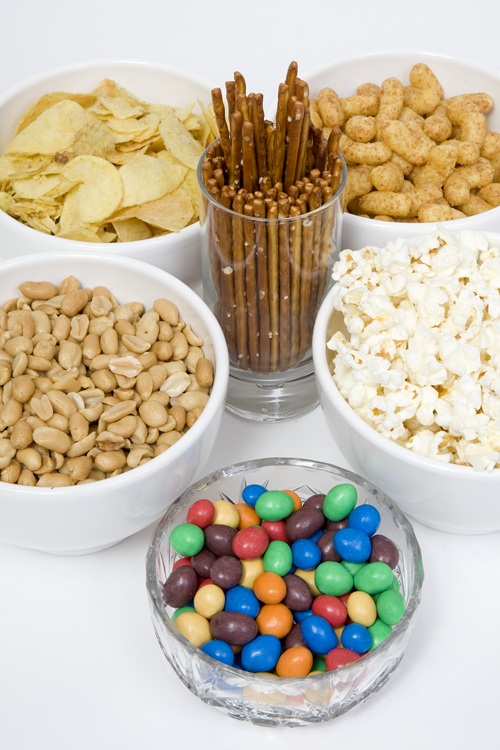
Snack consumption in Southeast Asia is diverse and growing, with chips, nuts, popcorn, and confectionery leading demand.(Photo: snacks © Digitalpress I Dreamstime.com)
What is the company’s commitment to technological sustainability?
Our view is that sustainability must be engineered into performance, not treated as an add-on. That means helping manufacturers improve measurable outcomes that matter to both cost and footprint: namely, energy use, water use, waste, yield, uptime, and total cost of ownership.
There are multiple ways of achieving this. Integration is a major one — when systems are designed to work as a connected ecosystem, it becomes easier to stabilize flow, reduce over-seasoning or rework, minimize changeover waste, and run closer to target without constant manual intervention. Packaging is another, as film reduction and the shift to thinner materials can reduce material use, but it also demands reliable high-speed operation to avoid scrap and downtime.
Beyond that, we support resource-efficient processing approaches, including measures that reduce oil volumes and enable energy recovery in frying applications, and we continue to monitor emerging options such as electrification and hydrogen where they can become commercially and operationally viable.
Finally, sustainability also includes keeping assets performing over time. Strong lifecycle support — from local service engineering to responsive troubleshooting — helps customers maintain efficiency and avoid premature replacement.
In advanced packaging systems, which emerging markets in Southeast Asia do you see as the fastest adopters by 2026?
Vietnam and Indonesia are showing some of the strongest signals. In both markets, we’re seeing rising demand for modern systems that support higher throughput, faster changeovers, and more flexible production models — particularly where manufacturers are serving multiple brands, expanding private label output, or moving into more premium and differentiated products.
“As packaging formats diversify and film specifications evolve, advanced packaging systems become a commercial requirement. The manufacturers moving fastest are typically the ones investing in capability that lets them respond quickly to shifting demand while keeping efficiency and quality stable.
In 2026, what will likely differentiate TNA from other global players in terms of speed, customization, and/or sustainability?
We think differentiation will come down to how well a partner can deliver performance in practice. For us, that starts with engineering capability and the ability to tailor solutions to the customer’s product, format, and operating constraints, particularly in confectionery where one size rarely fits all.
“Speed is another clear differentiator, especially as the industry moves to thinner packaging films. High-speed output only matters if it’s stable, repeatable, and supported with the right integration and controls, so customers can run fast without trading away uptime or quality.
“And sustainability will increasingly be judged on measurable results. That is where integration, digitalization, and lifecycle support intersect: connected lines that reduce waste and simplify operation, and service infrastructure that helps customers sustain performance over time. We aim to be the partner that helps customers move faster, stay flexible, and prove outcomes — with performance and a customer-centric approach built into the way we work.
-------
*Asia Pacific Snacks Market Size & Outlook, 2025–2030
Article by Marijo Gonzalez