
 Access
 Login/Register
 Supplier Login












FRESH produce packaging today is converging on three practical priorities: product protection, material efficiency, and sustainability. Fit‑for‑purpose and optimized compositions are being engineered into fiber‑based packaging formats, delivering protection for fresh produce. Designers also place emphasis on supply‑chain fit, considering factors such as shipping distance and climate conditions that packaging must endure.
In response to global supply‑chain and sustainability pressures, packaging design is also evolving to take both a product‑centric view and a systems view. Global supply chains and evolving sustainability legislation have pushed brands to demand efficient packaging that helps reduce transport costs and carbon impact while still protecting products through multiple handlings and climatic zones.
Sustainability advancements are driving choices of responsibly sourced, recyclable fiber‑based materials and designs that optimize the layers of paper grades composing the box. Equally important is circularity at end‑of‑life: packaging needs to fit existing recycling streams in destination markets. The combined effect is more collaborative development between paper manufacturers, converters, exporters and importers to ensure designs meet both logistical and sustainability targets.
One example of this collaborative approach is Mondi’s project with its trading partner Europcell, and converter and export packaging specialist IncarPalm. The initiative was launched to address a specific market need: banana exporters required a box that combined export‑grade strength with optimized material choice.
The result was an iterative design process — from initial paper grade selection for board composition, to converter and packing trials and an export pilot — culminating in a validated banana box format tailored for long‑distance export conditions.
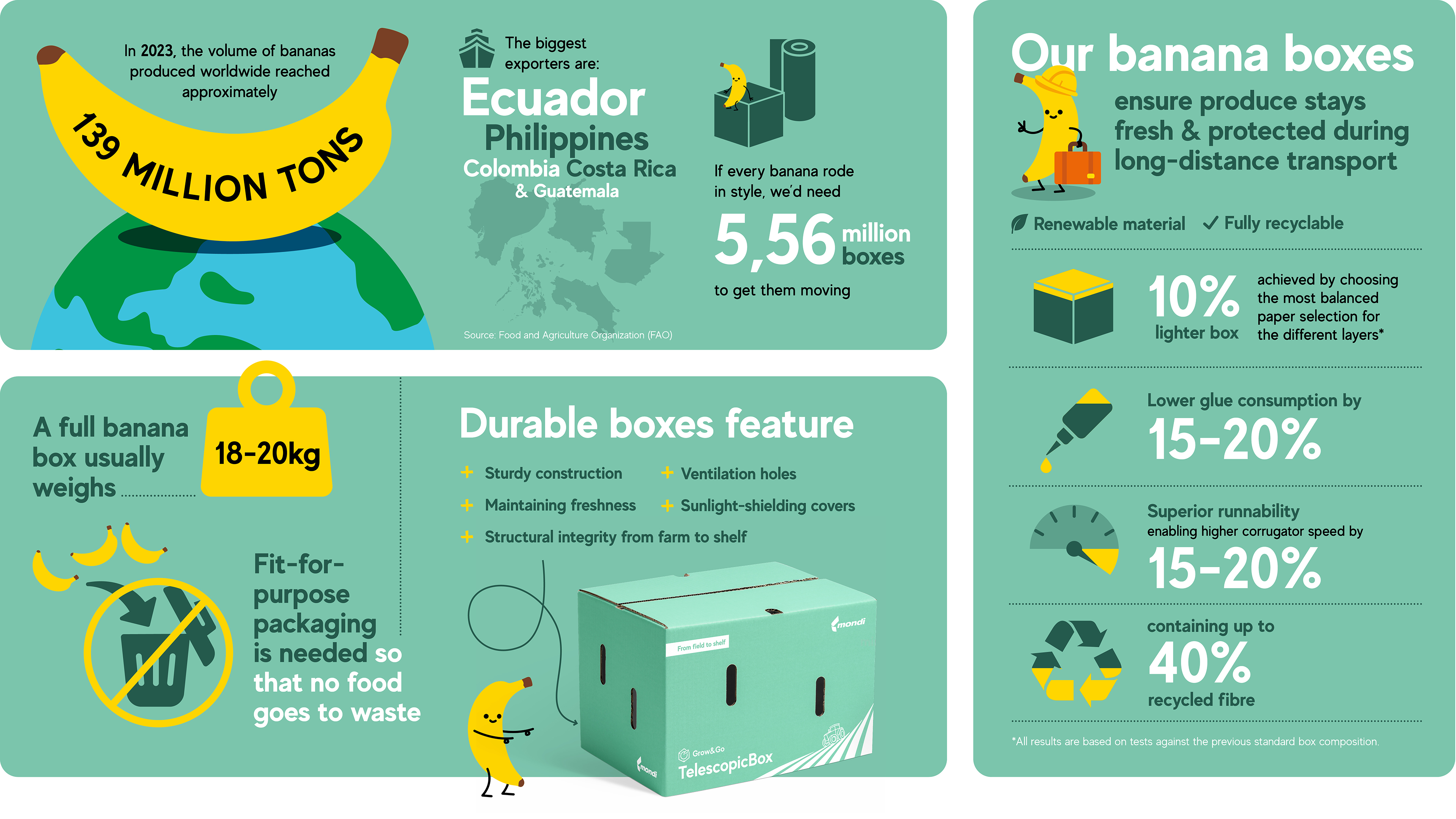
The new concept combines ProVantage SmartKraft Brown, known for its high strength and protective qualities, with ProVantage Frescoflute, a semi-chemical fluting that enhances firmness in lightweight packaging boxes. The box is made with around 40% recycled fiber and up to 10% less weight than the previous design – helping to lower emissions during transport without compromising fruit protection.
The technical innovations in this banana box compared to other formats for fresh produce are centered on optimizing the fiber mix for box performance. This includes a combination of fluting and liners that resulted in a 10% lighter box containing up to 40% recycled fiber, lower glue consumption by 15–20% and superior runnability enabling higher corrugator speed by 15–20%.
Durability, strength and protective qualities tested
Designing a promising prototype is one thing; proving it is another. That’s why the project also included a full‑scale production trial. Bananas were packed into the new boxes and shipped to Europe in two containers equipped with sensors to record temperature and humidity throughout the 33‑day voyage. Humidity levels reached between 96% and 100% — extreme conditions for any packaging. The results confirmed that the new design maintains its strength and stability even under sustained high humidity and fluctuating temperatures, offering real‑world validation that the box performs reliably across long export routes.
To ensure durability and protective qualities, the packaging underwent a full suite of laboratory and performance tests. As part of the development process, the team carried out stacking strength tests to verify load‑bearing performance, edge crush testing to measure the strength of the fluted structure, bursting strength evaluations to confirm resistance to sudden internal pressure, and caliper checks to ensure consistent board thickness and quality. Finally, box compression testing validated the overall compression strength of the assembled box. Together, these protocols demonstrated that the design meets durability and protective requirements.
Unique and scalable packaging solution
This banana box differs from other sustainable banana boxes currently on the market. It stands out for its material‑efficiency engineering, combining reduced basis weight with a tailored board structure to maintain export‑grade strength. Unlike some lightweight alternatives that compromise stacking performance, it leverages a precise fiber mix, lower glue usage, and superior runnability to support higher corrugator speeds. Developed collaboratively with a converter and exporter, the packaging was field‑tested to ensure practical, real‑world performance.
The scalability of this packaging format is clear. The core engineering principles — optimizing flute and liner combinations for stacking loads and humidity, and tailoring handling features to the product — are fully transferable. With adjustments such as board grade or grammage, the format can be scaled for other tropical fruits and a wide range of fresh produce exposed to similar export handling and climatic conditions.
Applicable to Southeast Asian export chains
The potential of this packaging format extends beyond Latin America. The core design principles — fiber optimization, moisture‑resistant paper selection, and pallet‑friendly geometry — are fully applicable to Southeast Asian export chains. Adapting the solution typically involves fine‑tuning the board grade to suit local handling, transport durations, and climate conditions, including high humidity during the monsoon season and chilled versus ambient transport legs. Insights from this project were recently shared in a technical seminar with around 60 regional customers in the Philippines, reflecting Mondi’s extensive global expertise as a paper and packaging manufacturer.
According to Mondi, Asian exporters considering a transition to lighter, sustainable packaging, must consider the specific key factors that come into play. One is climatic resilience, since it is essential to ensure materials resist high humidity, while handling realities mean packaging designs must match pallet, container and forklift practices used by exporters and importers.
They must also keep in mind regulatory and retailer requirements in different countries, including food‑safety standards. Finally, total cost of ownership is critical since lighter packs lower freight costs, but any increase in product damage or handling time would offset benefits. This is where global expertise and hands‑on experience can help customers strike the right balance between right‑weighting, product protection, and operational efficiency.
Read more: Rethinking the banana box: How collaboration sparked a packaging innovation. https://www.mondigroup.com/news-and-insight/2025/rethinking-the-banana-box-how-collaboration-sparked-a-packaging-innovation