
 Access
 Login/Register
 Supplier Login












By Matt Hale, Global Key Account Director, HRS Heat Exchangers
The Netherlands tops the global egg consumption stakes (per person) by some margin, followed by Hong Kong, China, Mexico and the Maldives1. As you would eggs-pect (sorry!), thanks to their great natural packaging, the majority of eggs are supplied in their shells, but depending on country and market, the demand for liquid egg products remains strong, accounting for 17% of the UK market2, and 29% in the US3 last year. For safety and product longevity, most liquid egg products are pasteurised (sometimes known as Extended Shelf Life, or ESL, egg products).
Challenging characteristics
Processing eggs involves a number of key cooling and heating processes to maintain product quality and safety, as well as maximise shelf life, so choosing the right heat exchangers and processing systems is essential. Eggs are not only highly perishable but also contain a complex mixture of heat-sensitive proteins, fats, vitamins and minerals. Furthermore, they are comprised of both white and yolk, each of which have different textural and nutritional characteristics.
Fresh eggs have a thick white and a raised yolk. Over time, the white thins and the yolk spreads and enlarges as water passes through the membrane from the white into the yolk. Because of this, eggs need to be refrigerated and processed quickly, and one of the key stages in the production of liquid egg is to cool the product to around 5 °C or less immediately after breaking and filtering to prevent further bacterial growth. The contents of an egg are essentially sterile until broken, so one of the aims of processing is to reduce or eliminate any bacteria or contamination which may be introduced once the egg is cracked. Liquid whole egg and yolk should be held at or below 4 °C, and egg whites below 7 °C, meaning that heat exchangers (such as the HRS MI Series) are crucial in egg processing.
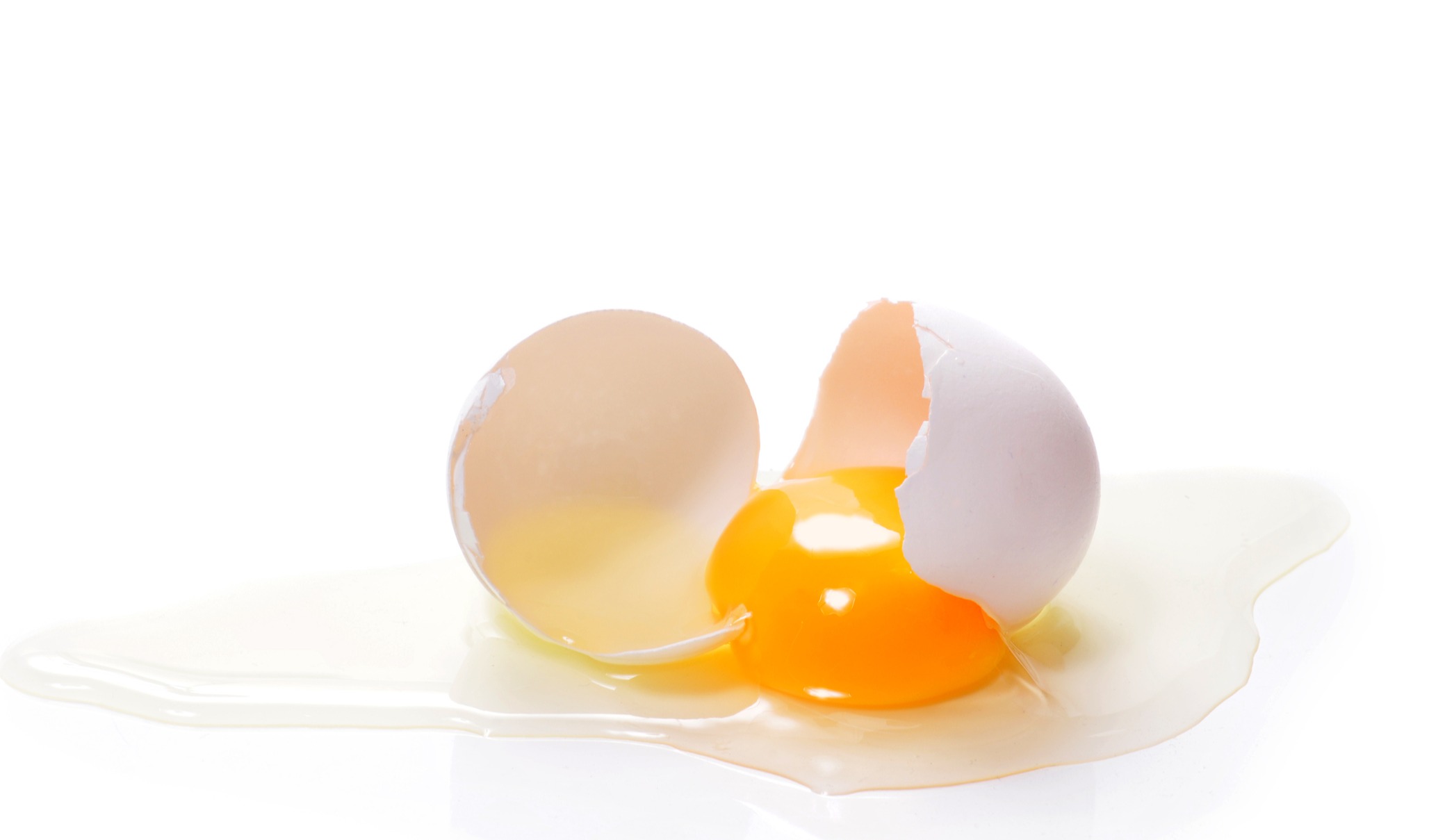
Egg whites and yolks each have different textural and nutritional characteristics, and are denatured at different temperatures (Photo courtesy: HRS Heat Exchangers)
Key pasteurisation considerations
The other crucial thermal process for producing liquid egg products is UHT pasteurisation. However, while the white and yolk are distinct components, when mixed, they interact mutually – for example, egg white is denatured at 58 °C while yolk is denatured at 65 °C. These low temperatures can make it hard to aseptically process natural liquid egg products, so in many cases eggs are cooked before the minimum time and temperature required for pasteurisation has been achieved.
Pasteurisation can induce a number of unwanted effects, however, including gel formation and softening of the yolk, or irreversible denaturation of the proteins and changes to appearance. If not handled correctly, thermal pasteurisation can decrease protein content, change physical characteristics such as texture and colour, and increase product viscosity. Choosing the right pasteurisation regime and equipment is therefore vital to minimise and prevent such unwanted effects.
Various time and temperature regimes are used to pasteurise eggs depending on the product, which could be whole egg; separated egg (whites or yolks); or a treated product, like salted yolk. Each product type presents a different challenge in terms of viscosity, and products with added salt also introduce a higher likelihood of equipment degradation or corrosion.
Despite these difficulties, there are several benefits of pasteurisation, including food safety, product uniformity and improved shelf life. Depending on the exact combination of treatment time and temperature used, it may be possible to produce a shelf life of up to 16 weeks for refrigerated liquid egg products.

Corrugated tube heat exchangers such as the HRS MI Series, are ideal for pasteurising liquid egg and other egg products (Photo: HRS Heat Exchangers)
The benefits of corrugated tubes
Historically, plate heat exchangers have been typically used to pasteurise egg products, but these can allow product to coagulate on the plate surface. This can in turn foul the heat exchanger so that frequent cleaning is required to maintain operational efficiency, adding time, energy and cost to the process while reducing production capacity.
In comparison, corrugated tube heat exchangers such as the HRS MI Series, are ideal for pasteurising liquid egg and other egg products. The corrugated design creates turbulent product flow, which reduces fouling and improves heat transfer. This means that a smaller corrugated tube heat exchanger will provide an equivalent (or even superior) performance to a similar-sized smooth tube heat exchanger. Where there is greater risk of fouling, or where the product needs particularly careful handing (for example, with some cooked egg products), then the gentle action of the HRS Unicus Series of reciprocating scraped surface heat exchangers (SSHEs) is ideal.
A final consideration when choosing equipment for egg processing is the ability to clean-in-place (CIP), which is particularly important given the physical nature of the product and the potential for the formation of harmful bacteria. All HRS heat exchangers and pasteurisation systems are designed for efficient, thorough and traceable CIP, giving users peace of mind in addition to industry-leading performance.