
 Access
 Login/Register
 Supplier Login












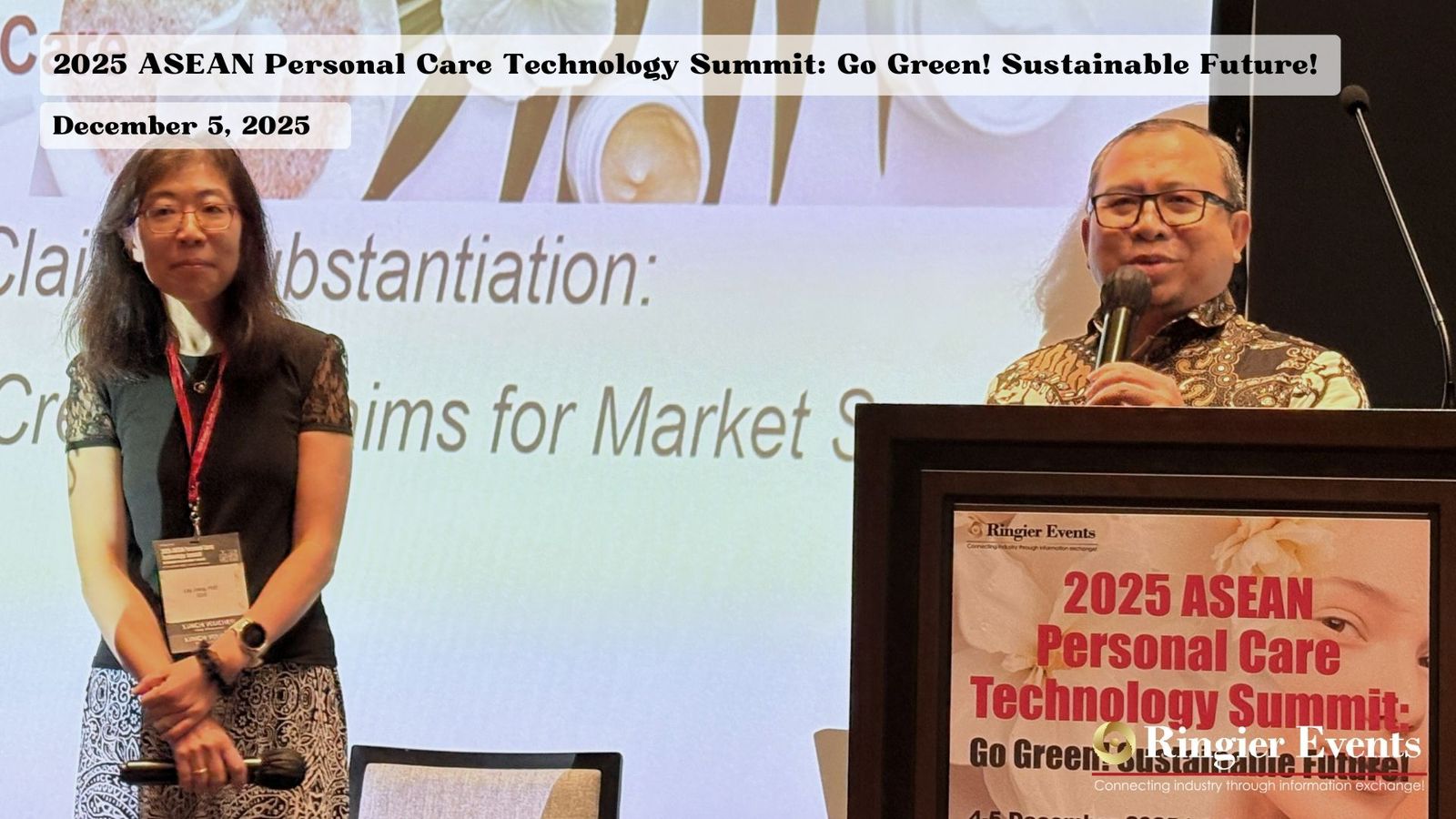
One of the key takeaways from Ringier Events’ ASEAN Personal Care Technology Summit (Jakarta, December 4-5, 2025), is that regulatory rigor in claims substantiation is vital to commercial success in the region. The SGS presentation, Cosmetics Regulations & Claims Substantiation: Ensuring Compliance and Credible Claims for Market Success, delivered by Lily Jiang, PhD, Global Head of Cosmetics & Personal Care and Dermatology, and Toto Waluyadi, Laboratory Manager of Cosmetics & Personal Care, SGS Indonesia (in photo below), discussed Indonesia’s new BPOM requirements, regional regulatory alignment, and the practical laboratory and clinical testing pathways brands must follow to stay compliant and credible.
The updated BPOM regulation
Released on September 3, 2024, Indonesia’s health authority (BPOM) replaced BPOM Regulation No. 12/2019 with Regulation No. 16/2024. This regulation came into force 12 months after promulgation and tightens the country’s approach to contaminants in cosmetics. It classifies contaminants into three categories: Microbials, Heavy Metals, and Chemicals, and shows the maximum limits for contaminants in cosmetic products distributed within Indonesian territory. Furthermore, third party testing facilities are recommended to conduct analyses, and more rigorous documentation of testing results is required in product information files.
For brands and contract manufacturers, this implies that products already on the market or in development must be reviewed against the new limits and documentation requirements, and testing strategies must be updated to meet BPOM’s validation and verification expectations.
What changed under Regulation No. 16/2024
The presentation noted the regulatory changes from the 2019 framework. Key updates include:
- -- Stricter contaminant limits: For example, 1,4‑Dioxane limits were tightened from < 25 mg/kg to < 10 mg/kg.
- -- New chemical contaminants listed: The regulation explicitly calls out Acrylamide and Diethylene Glycol among chemical contaminants to be monitored.
- -- Analytical testing methods: Where the previous regulation was not prescriptive, the new regulation requires validation/verification of analytical methods used for contaminant testing.
- -- Expanded testing facility scope: Testing may be performed by accredited laboratories and internal labs of cosmetic industries that hold a GMP certificate for cosmetics or a certificate of compliance in cosmetic GMP aspects.
- -- Stronger administrative sanctions: The new regulation details written warnings, temporary prohibition of distribution (up to 1 year), product withdrawal/recall, destruction, suspension of production/import activities (up to 1 year), suspension of online notification access (up to 1 year), and notification number revocation.
- -- Documentation requirements: Testing results must be documented in accordance with BPOM guidelines for cosmetic product information documents.
Under the new regulation, manufacturers and local responsible persons must ensure that the product and the testing pathway meet BPOM expectations before and during market distribution.
The contaminant limits brands must know
BPOM Regulation No. 16 of 2024 sets explicit numeric limits across heavy metals, microbial counts, and chemical contaminants. The presentation highlighted the most consequential thresholds:
Heavy Metals
- -- Lead (Pb) ≤ 20 ppm
- -- Mercury (Hg) ≤ 1 ppm for products without intentional mercury use (with mercury otherwise banned except in certain traditional medicinal uses)
- -- Arsenic (As) ≤ 5 ppm
- -- Cadmium (Cd) ≤ 5 ppm
Microbial Contaminants
- -- Total Plate Count: for certain cosmetics < 500 CFU/g or CFU/ml, for others < 1,000 CFU/g or CFU/ml
- -- Yeast & Mold count: same thresholds as Total Plate Count
- -- Pathogenic bacteria (Pseudomonas aeruginosa, Candida albicans, Staphylococcus aureus): Negative per 0.1 g or Negative per 0.1 ml of the test specimen
Chemical Contaminants
- -- 1,4‑Dioxane ≤ 10 mg/kg or 10 mg/l
- -- Acrylamide: specific limits depending on formulation type (e.g., 0.1 mg/kg for non‑rinse body care preparations; other preparations may have different thresholds)
- -- Diethylene glycol ≤ 1000 ppm or 0.1%
For product developers and quality teams, these numeric limits must be embedded into raw material specifications, supplier agreements, and finished‑product release criteria.
Testing, validation and documentation
The presentation further outlined the practical testing and substantiation tracks that brands should prioritize:
Analytical and Microbiological Testing
- -- Use validated methods for heavy metals, 1,4‑Dioxane, Acrylamide, Diethylene Glycol, and other listed chemicals.
- -- Microbial testing must include Total plate count, Yeast & mold, and targeted pathogen testing with appropriate limits and sampling plans.
Laboratory Accreditation and Internal Labs
- -- Accredited external laboratories remain central, but internal industry labs with cosmetic GMP certification can perform testing if they meet BPOM’s criteria. This creates an opportunity for larger manufacturers to internalize testing capacity,provided they maintain accreditation and method validation.
Documentation
- -- Testing results must be recorded in the Product Information Document (PIF) or equivalent documentation following BPOM guidelines. This includes method validation records, certificates of analysis (CoA) for imports, and traceability of raw material testing.
Regulatory Risk Management
- -- Given the strengthened administrative sanctions, companies should ensure they comply with pre‑market testing, periodic surveillance testing, and have rapid corrective action plans in case of out‑of‑specification results.
Claims substantiation and clinical testing pathways
Beyond safety and contaminants, the SGS presentation emphasized claims substantiation as a parallel compliance and commercial priority. Claims that go beyond basic cosmetic benefits such as sunscreen efficacy, hydration, anti‑microbial performance, or skin repair, require robust testing and clinical evidence.
Anti‑microbial Efficacy
- -- Preservation efficacy testing (PET) standards referenced include USP <51>, ASEAN ACM MAL 08, ISO 11930, and EP 5.1.3.
- -- Sanitizer and disinfectant testing standards include EN 1040, 1275, 1276, 1650, 13697, 14561, ASTM E2149, and ISO 22196.
- -- Handwash efficacy in vivo standards include EN 1499, EN 1500, and ASTM methods E1174, E2755, E2783.
Safety Testing
- -- Primary dermal irritation test (PDI): 24‑ or 48‑hour patching followed by clinical grading.
- -- Human Repetitive Insult Patch Test (hRIPT): multi‑week protocol for sensitization assessment.
- -- Safety‑in‑Use: consumer in‑use studies coupled with physician evaluation (~4 weeks) to support physician‑tested claims. “Dermatologically tested” seal.
Sunscreen Testing
- -- In‑vivo and in‑vitro standards cited include ISO 24444:2019 (SPF in vivo), ISO 24442:2022 (UVAPF in vivo), ISO 24443:2021 (UVAPF in vitro), ISO 16217:2020 and ISO 18861:2020 (water resistance), and regional methods such as US FDA guidance and NMPA certified China methods.
- -- Newer methods such as ISO 23675:2024 (Double Plate Method) and ISO 23698:2024 (HDRS hybrid method) were highlighted as part of the evolving toolkit for SPF and UVAPF assessment.
- -- The presentation explained the in‑vivo dose series approach using a solar simulator and the mathematical relationship between MED (minimal erythema dose) and SPF calculation.
Hydration and Performance
- -- Hydration efficacy can be measured by corneometer or equivalent instruments to assess percentage increase in skin hydration and by non‑invasive imaging such as confocal Raman microspectroscopy for water content and ultrastructural effects.
For marketing and regulatory teams, claims must be backed by the right test standard, properly conducted and documented. The choice of standard depends on the claim, the market and the intended label language.
SGS positions itself as a partner capable of supporting the full compliance and substantiation lifecycle. The presentation listed a global footprint of 27 laboratories and 25 clinical sites, with regional presence across Asia, Europe, the Americas and the Middle East. Services highlighted include:
- -- Regulatory services: CPSR (Cosmetic Product Safety Report) for the EU, Toxicological Risk Assessment (TRA) for multiple markets, PIF preparation, and country‑specific regulatory guidance.
- -- Analytical testing: heavy metals, chemical contaminants (1,4‑Dioxane, Acrylamide, Ethylene Glycol), allergens, active ingredients, microbiological testing, stability testing.
- -- Clinical and performance testing: safety‑in‑use, patch test, hRIPT, SPF/UVAPF, hydration mapping, anti-aging claims, skin lightening, oil control, skin barrier function, microbiome, and consumer panels.
- -- Specialized testing: anti‑microbial efficacy, sanitizer/disinfectant standards, and new sunscreen in‑vitro/in‑vivo hybrid methods.
For companies operating across ASEAN and exporting to China, EU, or the US, the combination of local regulatory knowledge and global testing capabilities can streamline compliance and reduce time to market.
Recommendations for brands and suppliers
Based on the presentation content, the following steps will help companies navigate the new regulatory landscape and strengthen claim credibility:
- Audit existing product portfolios against BPOM Regulation No. 16 of 2024 numeric limits and documentation requirements.
- Update supplier specifications to require CoA data for heavy metals and listed chemical contaminants, and include method validation where relevant.
- Validate analytical methods used for critical contaminants and ensure laboratories (internal or external) maintain appropriate accreditation and GMP alignment.
- Embed claims strategy into R&D: choose the correct test standards early (e.g., ISO, ASTM, EN) and plan clinical or in‑vitro workstreams to support label claims.
- Document everything in the Product Information File and safety dossiers to withstand regulatory inspection and to support advertising and labeling claims.
- Plan for sanctions: develop recall and corrective action procedures and maintain traceability to respond quickly to any regulatory non‑compliance.
- Leverage third‑party partners for complex testing such as SPF/UVAPF, Raman spectroscopy for hydration, and anti‑microbial efficacy to ensure impartiality and technical rigor.
By guiding Indonesia’s players in compliance with BPOM Regulation No. 16 of 2024, SGS reinforces consumer trust and credibility in the nation’s beauty and personal care products.
Further information on SGS:
Cosmetics & Personal Care | SGS Indonesia
For details on Ringier Events conferences in 2026, contact: Beng Tan-Guerrero at bengtan@ringiertrade.com
Article prepared by Marijo Gonzalez