
 Access
 Login/Register
 Supplier Login












Size reduction of plastic products requires machine technology tailor-made to fit the recycling process for post-consumer plastics.
Size reduction machinery specialist Neue Herbold of Reihen, Germany offers a range of pulverisers for semi-rigid, brittle and impact resistant plastic materials where a consistent uniform powder is required.A global specialist in size reduction machinery including the ZM pulveriser range, Neue Herbold’s equipment range includes granulators (pipe and profile), grinders, pulverisers, screw shredders, hammer mills, shredders, polystyrene shredders and guillotines.
The pulveriser is typically used to pulverise PVC, PE, PC and various types of plastic materials, and has the ability to process up to 900kg per hour. The final pulverised material when blended with virgin material ensures consistent feeding and processing of the extruders. Granulates of 6-8mm are fed via a vibrofeeder, to a high speed rotating disc that creates a powdered product sized 300-1000 microns based on specific size requirements.
Plastic granulate is fed centrally between the fixed and high speed rotating high alloy steel pulveriser discs, with the centrifugal effect carrying the material through the processing zone before being discharged from the machine pneumatically. The particle size of the product is determined by the type of material being processed, the disc construction and the processing gap between the discs.
Neue Herbold pulverisers packages include long service life of the discs between resharpening intervals; fast and easy replacement and adjustment of discs; low residence time equating to lower thermal stress on the process material; and cost-effective operation.
High output model
In particular, the company’s ZM series pulverisers are designed for the pulverising of mid-hard, brittle to high impact plastics that require the final material to be in powder form. The required pulveriser input material must be in a granulate form with a maximum size of 6-8 mm (1/4-5/16 in.).
The ZM series pulverisersis an extremely high output unit can be supplied with automatic temperature control. The material to be pulverised is vibro feeder fed into fixed and high speed rotating pulveriser discs. In conjunction with an integrated inner disc that material is centrifically forced through the pulverisers discs to the outer chamber for discharge with a downstream material transport system.
Neue Herbold ZM series pulverisers operate without a screening machine. The specific final powder size is dependent on the teeth configuration and the adjustable gap between the pulverisers discs. In the event that the application requires a maximum particle size, a screening machine can be easily integrated into the system.
Specially developed controls in pulverising
The steadily increasing demand for powders of plastic, rubber, or minerals of any kind as well as the constantly expanding quality requirements with regards to flow ability, bulk density, particle size distribution and grain structure, call for pulverising systems of most modern technology. Pallmann offers pulverising systems with specially developed controls. Sensors for temperature, pressure and power consumption register and control the system according to preset parameters.
Pallmann Pulverisers are producing reliable high quality plastic powders for rotation moulding, whirl sintering, coatings, flame spraying processes, carpet backside coatings, extrusion and additional processes. The first Pallmann Turbo Mill was introduced in 1955 and was used for the pulverisation of plastic which was a revolutionary invention. For the first time it was possible to pulverise plastics with a low softening temperature into free flowing powders with a narrow particle size distribution.
Pallmann pulverising systems for plastic and rubber operate on a special processing principle. Granulated feed material is fed into the mill by means of suitable dosing systems. A suction system optimally designed for this application draws the ground material out of the mill. Different screening systems are used to achieve the desired powder qualities. Coarse material from the screen is reintroduced into the mill via a closed-loop system. The finished product is weighed in bags, filled into containers or conveyed to downstream processes and silo systems, depending on the requirements. Standard systems for installation on the production floor are available. An individual installation in multi-story buildings is possible at any time depending on the local conditions.
Different pulverising systems are used for different materials such as HDPE, MDPE, LLDPE, LDPE, PP, PVC, ABS, PA, PES, etc. The "ORIGINAL PALLMANN" Polygrinder® type PKM covers the most broad material spectrum due to the large variety of different key segments available.
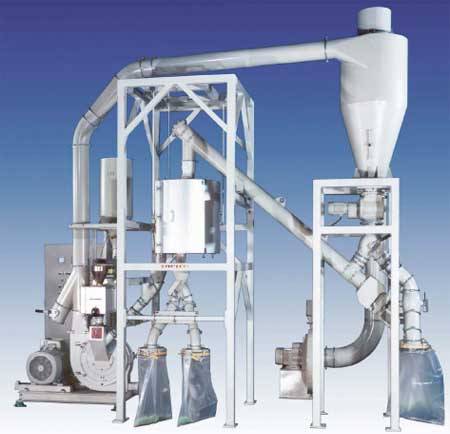
Pallmann offers pulverising systems with specially developed controls
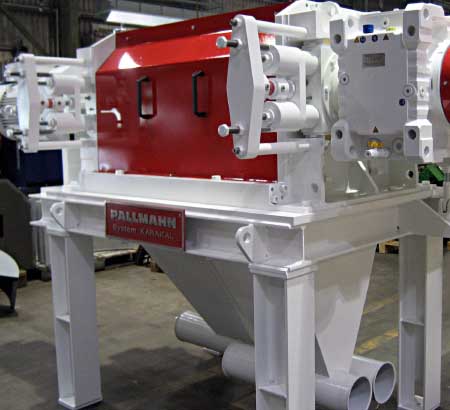
Pallmann’s Karakal can recycle vulcanised rubber waste into fine powder
Recycling rubber into fine powders
Pallmann also introduced energy-efficient recycling of vulcanised rubber waste back into fine powder for direct reuse in rubber processing. This machine, called Karakal, was first exhibited at K 2013. Karakal is a type of twin-roll mill that has been designed specifically for recycling waste from production of technical parts, as well as waste arising from retreading truck tyres. It accepts material that has been pre-cut to a particle size of 4 mm or less, and which is fed to it continuously by a series of screws positioned along the gap between the rollers. Pallmann has applied for several patents on technology incorporated into the equipment.
Large amounts of rubber waste from old tyres are already re-used, but mostly as a low-grade filler in building and construction. Some is also pyrolyzed into carbon black, oils, fuel gas, and other residues. In the past, cryogenics have been used for producing powder from rubber waste, but this creates particles with cubic geometries, which are not best suited for incorporation into new compounds. More recently, conventional roller mills have been used, but these create particles of around 800 to 1000 micron, which is too big for reprocessing operations. This process is also very energy-intensive. The Karakal relies on friction to reduce the size of the rubber particles.
The machine has two main rollers with a diameter of 400 mm and a length of 1000 mm, each covered with micro-serrations. Roller speed and direction of rotation are controlled via variable-frequency drives. The distance between the rollers can be adjusted to an accuracy of 0.1 mm. The rollers are pretensioned by an assembly of springs and a hydraulic cylinder.The temperature at which the process runs is also controllable. Process air is used to cool the powder.
The machine from a distance resembles an ordinary twin-roll mill, but close inspection reveals the micro-serrations on the surfaces of the rolls. The rolls are segmented, and the surfaces sections can be taken off, so that the serrations can be resharpened by the user. The rolls do not have to be sent back to the manufacturer for this purpose, making the machine less costly to maintain. Two additional smaller rollers located below each of the two main rollers to clean them can be fitted on request.