
 Access
 Login/Register
 Supplier Login












"THE idea of having the entire bottling process for water in PET containers running in a single machine is indeed an excellent one," said Han Kyeong-hwan, production manager at HiteJinro Beverage's plant in Cheongwon. "The ErgoBloc L is a particularly sage choice in terms of hygiene. We're delighted that we chose this system."
The plant is idyllically situated at the end of a valley in which the little River Mushimcheon has its source. From springs 200 metres underground natural mineral water is extracted for bottling the Seoksu brand. Last year, the plant produced around 100 million fills, equivalent to 80 million litres, in PET containers and gallon-size water dispensers. And sales are steadily rising.
The world's leading producer of soju
In 2005, HiteJinro was created by the merger between the Hite Brewery and the soju producer, Jinro. Founded in 1924, the Jinro company is the world's leading producer of soju, a spirits brand that's particularly popular in Korea, with a share of more than 50% on the national market. The best-known brand is called Chamisul. During the Asian crisis, Jinro encountered financial difficulties, and in 2005 was taken over by Hite, Korea's premier brewing company, founded in 1933 under the name of Chosun Brewery. HiteJinro is now active in the beer, soju, whiskey, wine, Korean rice wine and water segments, as well as importing beer brands like Kirin or Kronenbourg, and producing redcurrant wine, plum wine and soft drinks. HiteJinro's turnover with beer in 2013 came to 831 billion won (620 million euros) and with soju to 754 billion won (565 million euros).
The subsidiary HiteJinro Beverage supplies the domestic water market with the Seoksu and Puriss brands, plus the market for alcohol-free beer with the Hite Zero 0.00 brand, which for legislative reasons in Korea cannot be integrated into the beer business.
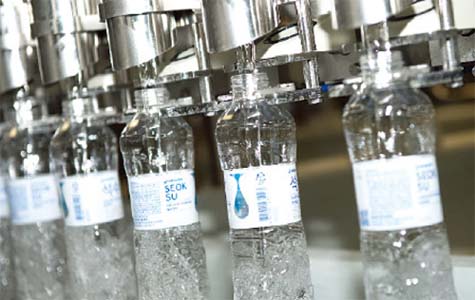
Since the bottles are filled in non-contact mode using the full-jet principle, the Modulfill VFJ volumetric filler guarantees a high level of microbiological safety
72 cubic metres an hour
By investing in the new bottling line at the facility in Cheongwon and giving the Seoksu brand a complete makeover, HiteJinro Beverage has put the foundations in place for lastingly successful participation in Korea's booming water market. Previously, Cheongwon had housed one line rated at 15,000 2.0-litre PET bottles an hour, plus a second line for 54,000 0.5-litre PET bottles an hour. The new ErgoBloc L line has been dimensioned to fill 54,000 320-millilitre and 500-millilitre containers or alternatively 36,000 2.0-litre bottles per hour, i.e. a maximum of 72 cubic metres of water per hour. It's used for handling the main brand Seoksu, plus dealer's brands, in two-shift operation. HiteJinro Beverage bottles the Puriss water brand in the two other facilities at Sejong-Si and Cheonan-Si.
To coincide with the change-over to the ErgoBloc L filling system, the bottle's design was revamped by a Korean design office in conjunction with Krones. One of the major points involved was a reduction in weight, from 17 to 12.3 grams for the 0.5-litre bottle and from 48 to 37 grams for the 2.0-litre bottle, which would not have been possible without the ErgoBloc L. "The improved quality of the bottling operation and the cost savings achieved thanks to lightweighting were the principal reasons for choosing the ErgoBloc L”, explains Production Manager Han Kyeong-hwan. With installation of the ErgoBloc L, HiteJinro Beverage was also able to change the closure: now, a Shorty closure is being used, which is 1.2 grams lighter and can therefore be produced with significantly less material.
All-in-one monobloc
With the ErgoBloc L, everything happens inside an enclosed 30x12m cleanroom. A Contifeed RS brings the preforms into the cleanroom from outside. In a linear preform rinser, they are flushed with air, and dust. From this inclined rinser, they are passed directly to the oven of the Contiform C324 blow-moulder, and then given their final shape in the 24 moulds. This is followed directly by a Starmodule labeller with two Contiroll HS (High Speed) stations, on which the PET containers are dressed in wrap-around labels. This labeller has been designed to run at rated output even during reel exchanges. It also detects bottle gaps automatically, and in this case will transfer neither glue nor label. Then a first PET-View 776 D uses five cameras to monitor the quality of the blow-moulded bottles or the quality of the preforms in the blow-moulder and oven.
Via some more neck-handling clamping starwheels, the prelabelled bottles are passed to the electro-pneumatically controlled volumetric Modulfill VFJ filler with its ring bowl, which fills the containers using a full-jet principle. Since the bottles are filled in non-contact mode, a high level of microbiological safety is assured. The Modulfill filler, with its 108 filling valves, is in hygienic design, features Monotec columns, and does without a front table. It passes the filled bottles to the synchronised capper. Having been blow-moulded, labelled, filled and capped in a single machine, the containers then leave the ErgoBloc L and are inspected by a Checkmat FEM-IR, which uses infra-red technology to monitor the fill level and verify the labels' positioning. Now the containers can also leave the enclosed cleanroom, on SynCo conveyors for end-of-the-line packaging and palletising. At HiteJinro Beverage, the ErgoBloc L produces 0.35-litre, 0.5-litre and 2.0-litre containers using Krones moulds, and has been designed solely for bottling still water.
The ErgoBloc L has entirely eliminated conveyors and buffering sections, because all the machines integrated have been seamlessly concatenated (compactly dimensioned monobloc has a footprint that's up to 70% smaller than a conventional layout). "The space savings were important for our layout planning,"said Han Kyeong-hwan. This is the first time ever that the company has used a blow-moulder of its own. Cheongwon-Gun used to outsource its fully blow-moulded PET containers. "In terms of hygiene, of course, in-house production of the containers is a significantly better solution," said Han Kyeong-hwan.
Trend towards PET portion packs
According to the Korea Natural Mineral Water Association, sales of packaged water in large polycarbonate (PC) water-dispenser containers were until 2010 significantly higher than water consumption from PET portion packs. Since 2012, though, this trend has been reversed. In 2011, for instance, 1.61 billion litres were filled in PET and a mere 1.37 billion litres in the gallon-size containers. In 2012, PET fills rose still further, to reach 1.77 billion litres, whilst consumption from large-size containers fell to 1.28 billion litres. This trend is predicted to continue; it goes hand in hand with steeply rising sales in the PET container segment; the sales ratio between PC and PET is already (2012) running at about 1 to 5. It would appear that the Koreans are only now learning to appreciate water consumption from the practical, lightweight portion pack. So with the new ErgoBloc L line from Krones, HiteJinro Beverage has most definitely taken a significant step in the right direction.