
 Access
 Login/Register
 Supplier Login












From digital manufacturing to a diverse range of materials, the power of 3D printing lies in its ability to bring business benefits to organizations, industries and our world. There is a pervasive conversation taking place today about 3D printing and we are looking at a $3 billion 3D printing market that includes hardware, software, materials and services.
According to Wohlers Report 2013, North America and Europe lead the 3D printing market with 60% of the market share; however, it is believed that Asia Pacific region is poised to take the lead in 3D printing in the coming future.

From digital manufacturing to a diverse range of materials, the future of 3D printing lies in its ability to create tangible business returns to organisations, industries and our world.
At the same time, one should be consciously realistic about the hype. The industry has experienced two cycles of hype – in the 1990s, claims of rapid prototyping would replace computer numeric control (CNC) manufacturing and in the early 2000s, proclamations of a manufacturing revolution would ensue. Today, CNC is thriving and ten years after, manufacturing has not been given any game-changing upheaval.
Asia Pacific to take the lead
According to Wohlers Report released in 2013, we are looking at a $3 billion 3D printing market that includes hardware, software, materials and services. This is a relatively small industry but with tremendous potential to grow and this potential is generating hype.
Hypes are common in technology and may present a negative view by driving expectations to unrealistic levels. However, if one takes a closer look at the inquisitive minds that have gathered for Stratasys Asia Pacific 3D printing forum in Japan, each with a desire to uncover the fallacies and drive change.
Taking Gartner’s hype cycle as reference, it presents the maturity and adoption of technologies in a graphical manner. Aided by consumer interests in personal machines, 3D printing is enjoying massive media attention which might have possibly led to inflated expectations of the hype cycle. When reality sets-in in the post-hype era, practical applications would take over and the technology reach to stable maturity. This is where 3D printing is at today. The visions of the future are possible, just some of them might actualise sooner than the others.
According to Stratasys, majority of 3D printing applications are in product development while the rest is in manufacturing.
Manufacturing does not only refer to finished goods, but also the various tools used in the process. It is clear that product development is the foundation of what we need to act on today, while manufacturing presents a future that is possible for 3D printing industry.
Wohlers Report indicates that North America and Europe lead the 3D printing market with 60% of the market share. It is not a surprise as these markets were early adopters of 3D CAD, which provides the necessary fuel for 3D printing; coupled with a fickle market that relishes product innovation accelerating product development.
However, if one takes a closer look, Asia Pacific is the key region for potential 3D printing adoption, primarily dominated by South Korea, China and Japan which currently contributes to 21% of the market share. The growth potential is supported by an extensive industrial base, supportive government policies and funding in research & development those countries provide, while both Japan and China are noteworthy in terms of government initiatives and rapid growth in this field.
Japan accounts for 9.7% of the market as it was an early entrant in the 3D printing market. Today, Japan is a global leader in metal sintering, which is a hybrid platform for milling and additive manufacturing. Through Technology Research Association for Future Additive Manufacturing (TRAFAM), Japan’s focused efforts in research and development coupled by commercial initiatives driving for 3D printing adoption among small and medium enterprises, the country has a definite opportunity to take leadership in 3D printing.
Revolutionising the manufacturing landscape
3D printing is not here to upset or replace existing technologies. Rather, it serves as a value-added complementary solution to existing methodologies. 3D printing evolutionises the manufacturing landscape by changing the ways things are made, in a faster and more cost-effective approach. The key is to set different goals and expectations.
Prototyping is an exceptional example on how 3D printing has provided alternatives. 3D printing has not replaced CNC but the level of prototyping work is more than ever and that has lifted the production volume driving overall growth.
This evolution will continue, producing impressive growth, rewarding gains and interesting developments. Just consider the current 3D printing market of $3 billion with the assumption that $1.5 billion is in hardware. With a 25% year-on-year growth, the industry will reach $15 billion by 2022 – this is a very sizable and attractive market.
The progress of machine tools industry implies the future of 3D printing. The industry of machine tools is evolving with a diversity of tools. Costs will not plummet and in fact, costs will remain the same in certain classes. Today’s dynamics in 3D printing will mimic the evolution of the machine tools industry.
The market opportunities and promising potential have expanded the 3D printing technology by attracting new entrants, representing different technologies providing an impressive array of solutions.
This is a typical hour glass where it balloons outward as research labs, start-ups explode onto the scene. Naturally not all these technologies will stand the test of time and soon, market contraction begins and only the most robust of technologies will survive, presenting the best characteristics to most companies.
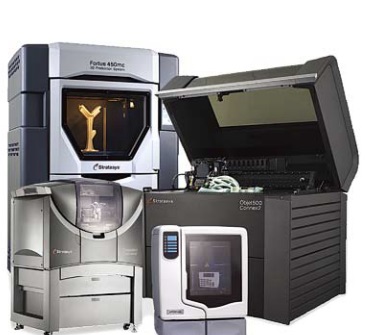
Many will be distracted by new technologies but there are practical sound solutions such as those offered by Stratasys. As the industry moves forward, there will be advancements in throughput, quality, more balanced systems with a blend of quality and performance.
There is no single answer to every issue, and there will be a need to combine different solutions and leverage hybrid platforms emerging to address the plethora of requirements.
Applications are usages; Stratasys offers 3D printing solutions suitable for different industries and applications, such as aerospace and medical industries. As the industry continues to mature, 3D printers will follow; offering technologies unique to each industry for varied applications.
Materials advancement and education
The key to success for 3D printing is material advancement, for this is the top request from all users. The industry has been demanded for a broader range of materials and we have seen advancements in both the quantity and quality of additive manufacturing materials. For example, Stratasys offers a comprehensive range of FDM and PolyJet printing materials with different texture, agility, tensile strength, hardness and opacity, plus a palette of colours.
Image: 03.jpg
Caption - 3D medical model printed with PolyJet materials
Image source: Stratasys
No other class of technology processes such a broad range of materials. Envision a future that leverages additive manufacturing processes to make parts with materials that cannot be processed in any other way. With these new materials, additive manufacturing will not be a substitute. Instead, it will be an alternative with its own set of rules. Revolution and disruption will happen at that point in time when there are materials of superior quality that can only be found on 3D printers. While phenomenal developments will occur, there are already examples on the power of additive manufacturing in the area of materials.
Stratasys Connex can print parts with more than one material, but while these 3D printers can do gradient colours, there is no CAD tool nor the FEA capability to keep up.
The key area of 3D printing that is most exciting is surely in education and knowledge. The claims are that 3D printing can produce anything, but majority of users do not know how to leverage the technology. It is experiential-based learning, on-the-job training, which makes a huge barrier blocking the adoption of 3D printing.
Also, the quest for lighter, stronger materials with the least cost will happen. Just step aside and look at technology in a different light; not to chase after cost and time for a single part, but to start afresh to find out addictive manufacturing’s unique qualities.
Change is necessary
Doing differently is the operative phrase in 3D printing. The key to make 3D printing successful is to be conservatively aggressive in planning for today, and act for tomorrow. Keep an inquisitive mind and gather what is applicable today. Change could be challenging, changing the rules or the objectives to make additive manufacturing a superior alternative means that there are some risks to fulfil its potential. With this, we will see 20% to 40% year-on-year growth, most apparently in Asia Pacific and Japan.