
 Access
 Login/Register
 Supplier Login












THE Kingdom of Bahrain is one of the GCC’s fastest developing economies. While relying on its oil and aluminum reserves, the country has been able to diversify as a result of free economic policies. Its location in the Arabian Gulf is a key asset for trade within the region and Africa.
Bahrain is also a magnet for manufacturing because setup and maintenance costs for industrial facilities there are relatively lower compared to other states, according to the Bahrain Economic Development Board. Furthermore, companies looking to put up a site there get support from the Bahrain International Investment Park.
Food production is among the industries with high potential as it can benefit from the above-mentioned advantages, the Board said. For instance, snackfood manufacturer Mondelēz is opening a second facility in Bahrain to produce for customers in the Middle East and Europe.
Bahrain has the capacity to export some agricultural products like dates although it is dependent on imported food and beverage just like its neighboring states. Owing to its population of only 1.3 million, it accounts for about 3% of the GCC’s food imports which in 2011 totaled USD 34.2 billion, according to the UN Food and Agriculture Organization.
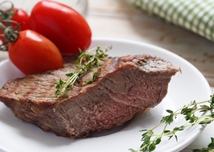
Bahrain (together with Kuwait) exports up to 70% red meat to neighboring states (Photo © Marysckin I Dreamstime.com)
While the GCC averages 1.4% of arable land, Bahrain has a higher percentage (2.9) than most nations, allowing it (as well as Kuwait) to produce 70% of the red meat consumed in the GCC and 25% of the poultry. In 2010, agriculture contributed 0.5% to Bahrain’s GDP. In total, Bahrain is anticipated to account for 1.5% of the GCC’s total food consumption in 2015 – a 5% growth over 2011. Milk/milk products and fruits are the two highest consumed food items in Bahrain. Vegetables are mostly imported.
Aaron Allen, founder of Aaron Allen & Associates, a leading global restaurant industry consultancy specializing in growth strategy, marketing, branding, design and concept development, holds a positive outlook for Bahrain’s food and beverage future.
“We anticipate a continued shift in the consumer consumption mix away from grocery stores and toward foodservice. This trend will naturally encourage and facilitate greater industry investment – particularly in the fast-food sector, a segment we anticipate may reach saturation within three to five years. We also anticipate a greater shift toward the use of restaurant technologies, including online ordering, apps and mobile marketing campaigns. As of December 2014, 94% of Bahrain’s population actively used the Internet, with 90% of households owning a computer at the end of 2013. By the end of 2013, it was estimated that 2.2 million Bahrainis owned a mobile phone. Of these individuals, 1.5 million had broadband Internet subscriptions.”
Bahrain was ranked sixth among GCC nations in terms of annual foodservice company revenues generating USD 370 million in 2012 – 22% of the total USD 16.7 billion GCC market share. Many international brands are already operating within Bahrain, including KFC and Pizza Hut (the Kuwait Food Company), Ponderosa Steakhouse, Bennigan’s and Cucina Italiana (the Bahrain Family Leisure Company). As the market continues to grow, a growing number of Western and Asian brands are expected to enter the Bahraini market. Pizza, burgers, Indian cuisine, sweets and savories and seafood will all be popular concepts.
In 2014, Landmark announced plans to open 80 Jamba Juice locations across the Middle East, beginning in the UAE and working towards markets in Bahrain, Saudi Arabia, Kuwait, Qatar and Oman. Dallas, Texas-based burger chain Mooyah also has plans to open locations in Bahrain after testing the concept in the UAE market. In 2012, Smashburger announced plans to expand into Bahrain, Kuwait and Saudi Arabia, announcing the scheduled opening of 17 stores.
“Seafood concepts, in particular, will be interesting to watch, as the Middle East is reported to see higher-than-average seafood consumption rates, with Bahraini citizens consuming 16.9 kilograms of seafood per year per person. The US, on the other hand, consumes only 6.5 kilograms per person per year,” said Mr Allen.
“As for fine dining, Bahrain severely lags behind other GCC nations in terms of the value of its full-service restaurant market. While the full-service restaurant market in Saudi Arabia is worth USD 2.7 billion and USD 1.3 billion in the UAE, Bahrain’s full-service market sees only USD 100 million – half the size of the nation’s QSR market, valued at USD 200 million.”
In February 2013, the International Investment Bank and Tharawat Investment House bought 49% of the shares of KSA brand Hungry Bunny. The brand, at the time, had 40 outlets across the KSA, Bahrain, Kuwait and Oman. In November 2013, the National Bank of Kuwait purchased 49% of the shares of UAE-based Shakespeare and Company – a brand with franchise locations across Jordan, Lebanon, Qatar, Oman, Bahrain and the US.
Other GCC companies operating in Bahrain include KSA-based Herfy, Kuwait-based Caesars Group, the KSA-based Olayan Group (Texas Chicken) and Bahrain-based Jawad Business Group (DQ Grill & Chill, Papa John’s Pizza, Burger King, Chili’s, Romano’s Macaroni Grill, Maggiano’s, The Great Kabab Factory, Costa Coffee, Magic Wok, Delifrance, Aran, Thai Express, Woodlands, Zen Express, Camille’s Sidewalk Café, Hakisushi, Fratelli la Bufala and Patisserie Valerie – 140 locations across the Middle East).
Nike Hypervenom Phantom II FG Low