
 Access
 Login/Register
 Supplier Login












CARGILL has published its second report on the Cargill Cocoa Promise, highlighting its progress towards making a difference in the lives and livelihoods of cocoa farming communities. To ensure the success of its work, the company employed a monitoring and evaluation system for a more evidence-based approach to help raise the living standards of farmers and their families, as well as to address the sustainability challenges in the cocoa supply chain.
“We have advanced our way of thinking and reporting. It’s not only about reaching the farmer, we are focused on improving livelihoods of cocoa farmers and their communities. Capturing the results of our efforts achieved on the ground is key, as it helps us understand how our actions are delivering results that truly benefit farmers and communities,” said Harold Poelma, President, Cargill Cocoa & Chocolate.
Together with partner organizations, the company is focused on helping business-oriented farmer organizations – about 181 cooperatives now – considered the starting point for farmer training, farm development and community support. It is expected that in future, farmers gain the confidence to manage and generate income from their very own farms.
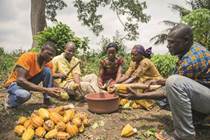
(Photo: Cargill)
In 2015, around 90,000 cocoa farmers attended 2,700 Farmer Field Schools. The training taught them to achieve the most profit from their cocoa farms, to optimize production by using inputs, such as crop protection and fertilizers efficiently, while reducing their impact on the environment. Through applying better plant protection, a 23 percent average yield improvement could be achieved for farmers.
Aside from this, Cargill is addressing other issues: women’s empowerment, children’s protection and family nutrition with the resolve to reduce poverty and improve children’s welfare.
In 2015, over 2,000 women successfully accessed credit to support income generating activities, which is over 50 percent of the total number of people who received finance through Village Saving and Loan Associations set up with Cargill’s support, and 97 percent of children enrolled in the program in Ghana have stayed in school for at least five years. Primary school enrolment has also increased by 4.7 percent as a result of new infrastructure.
The Cargill report shows the achievements with evidence, and these are shared with farmers and farm organizations so they can use these to plan ahead better and to create activities that will improve cocoa profitability. With industry efforts, traceability will provide customers with hard facts to help them deliver their sustainability strategies.
Adidas Fotballsko