
 Access
 Login/Register
 Supplier Login












AT MAJOR trade shows this year, Bühler Aeroglide has been introducing its new dryer for coated ready-to-eat (RTE) cereal products. Designed by the Food Safety Team, the Ceres reduces cleaning times and improves speed and safety. Andy Sharpe, Bühler vice president of Business Development and product director of Global Feed, explains the features of the new machine in this exclusive interview.
 Andy Sharpe, VP of Business Development and Product Director of Global Feed, Bühler Aeroglide
Please tell us how the Ceres was developed. Did you also collaborate with cereal producers based in Africa?
The goal of the Ceres project was to directly address and solve the issues being dealt with by processors of coated cereal products. We knew the outcome would be a “ground up” new design, but we also knew that the most important resource for what that design needed to look like was the industry itself. So from the very start, the Ceres was developed in a collaborative environment. It was our aim to involve those who had the most valuable input in the concept of Ceres, the users themselves. To facilitate this involvement, Bühler Aeroglide formed a food safety roundtable, involving cereal processors from around the world. These processors were invited to speak about the challenges they faced with regards to drying coated cereal products. Some of these processors were large multi-national companies with either direct operations or processing partners in Africa. This resulted in great insight into the challenges they faced on a daily basis in their operations. The Bühler Aeroglide Food Safety team then took that input, and starting with a clean slate, embarked on an 18-month journey that would eventually produce the most revolutionary step change in drying technology for coated cereal products in many years. Obviously, as cleaning was the number one challenge, hygienic design was paramount. But cleaning wasn’t the only challenge. So there are a great number of design advancements in Ceres that also meet the maintenance, productivity, and energy efficiency challenges these processors brought to us.
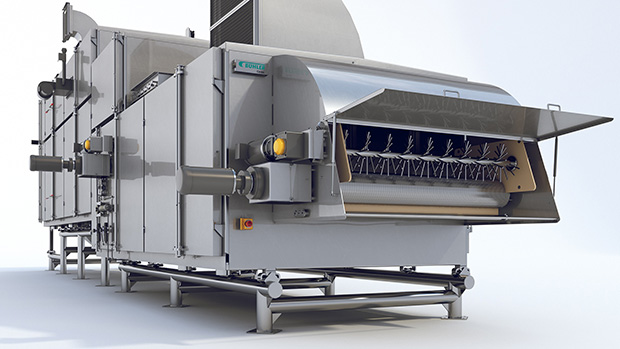
The Ceres is a game-changing design for drying ready-to-eat cereal
How is the Ceres different from the company’s existing dryers for cereal?
Ceres introduces a game-changing design that overturns the standard in every way. Traditionally, a dryer frame is constructed of square and rectangular tubing. But as with any wet washed equipment in a high hygiene zone, hollow shapes can be a bacteria risk when holes are drilled into tubing, or cracks form. The new Ceres features an open frame structure with a formed stainless steel channel design that eliminates the typical hollow shape.
Ceres features a new patent-pending chainless conveyor system that really redefines how coated cereal products are moved through the drying process. This new conveyor system increases cleanability, while decreasing maintenance downtime by featuring many components that don’t require tools to access and change out. The conveyor also slightly increases the open area that exposes the product to heated air flow, thereby giving an additional bump in productivity. And speaking of productivity gains, the Ceres features a higher velocity airflow than traditional technologies, allowing a processor to produce more cereal per square foot than before.
Another big change is the welding technology used in dryer construction. In the past, MIG welded joints have always been considered more cost effective with lower heat distortion than TIG. However, the joints tend to be rough, leaving pits and pockets where bacteria can collect and grow. Bühler Aeroglide switched to a new type of TIG welding which results in a vastly improved finish that won’t harbor bacteria and is easier to clean.
In your markets, what production issues do processors usually struggle with?
Dryers used for sugar-coated products like breakfast cereals can be challenging to thoroughly clean. This directly impacts productivity, with traditional dryers needing an average of eight hours or more to clean. Ineffective cleaning also contributes to maintenance issues and additional downtime. As a result, cereal processors told us Ceres needed to be faster and easier to clean and maintain, and still meet rigorous production schedules. These factors influenced every design decision.
How does the Ceres address these issues?
From day one, the design of the new dryer was about dramatically reducing the time needed to clean, allowing processors to quickly change products without risk of cross contamination. With large doors and removable panels, the operator can easily access the entire interior to clean more easily. Pitched slab floors and roofs combine with an integrated CIP system, a continuous belt washing system, a comprehensive water management system and dozens of other hygienic design elements to not only reduce the average cleaning downtime from eight hours to two hours, but also significantly increase the effectiveness and ease of cleaning.
Maintenance concerns were addressed by using many maintenance-free, or easy-to-maintain components. As mentioned previously, many components feature a tool-less design, making change out a simple and quick process.
Energy efficiency was also addressed with newer air management technologies and a more efficient airflow design, along with an advanced control system that provides processors with a means to precisely manage the drying process, thereby reducing energy waste.
There is an emphasis on hygiene in this model. Please tell us more about this.
With four patents pending and more than 30 other innovations, Ceres provides the highest level of hygienic production for coated RTE cereal products available on the market today. As a result, a food processer can be assured that cleaning is thorough and consistent every time.
Several new components were introduced to improve cleanliness during operation, and access for effective cleaning on product change over. Product side guides, typically constructed of stainless steel, are places where product tends to accumulate and access is limited. We redesigned the side guides using a proprietary non-metallic material with excellent release properties to greatly reduce product accumulation. These side guides can be rotated without the use of any tools to gain access to the product conveyor, while integrated conveyor scrapers can be easily rotated, exposing both sides of the blade for easy access and cleaning. Finally, baffles that are located between the belt to help manage airflow, can be rotated out of the way without the use of tools. This provides access to both sides for faster and easier cleaning.
Because of the company’s extensive research with multi-national cereal processors, Bühler Aeroglide was asked to participate in a North American initiative called One Voice, led by the Association for Packaging and Processing Technologies. Our Food Safety manager Steve Blackowiak supported the effort to create a uniform approach to the most common, non-proprietary sanitary equipment designs that meet a base food safety requirement for the manufacture of low-moisture foods. Food processors and equipment suppliers all have the same objective, to provide food that is safe. One Voice is a great vehicle that will help us all achieve this important goal. It provides a common understanding and interpretation among consumer packaged goods and original equipment manufacturers of the basic needs and requirements for food safety design. It will also clarify equipment costs and streamline the process for requesting an equipment quote.
What specific technologies are distinct to the Ceres?
The unique design of the Ceres dryer allows for high velocity airflow unrivaled in current technologies. This means more production can be packed into a smaller footprint, reducing the need for valuable factory floor space. Effectively managing this increased airflow also provides the opportunity to more efficiently, uniformly and consistently produce product to specification, resulting in higher yields and better product quality.
In addition, new direct drive fans eliminate the traditional belt and pulley arrangement, increasing the hygienic standard and energy efficiency. The new fan features a patent-pending load adapter that helps to dissipate damaging heat, increasing motor and fan life, and reducing maintenance requirements.
How easy is it to incorporate into an existing cereal processing system?
The Ceres is quite easily integrated into an existing cereal line. A new Ceres will require less floor space than an existing dryer of an equivalent capacity, making the install easier. And the modular design provides for a faster install and quicker start-up than existing designs. Of course process knowledge goes a long way in such instances. This is an area where an equipment manufacturer should provide even more value to the processor, over and above what the equipment itself is providing. By working with a supplier like Bühler Aeroglide, a cereal processor benefits from experience and a thorough understanding of exactly how the dryer affects the product and the rest of the process. This goes a long way to ensuring a trouble-free integration.
Shop Women's Boots