
 Access
 Login/Register
 Supplier Login












Sustainability has become a game-changing trend and development in many building and construction projects with concern on environment protection becoming a priority. Building professionals are thus searching for high-performance materials and efficient methods for sustainable construction projects.
Polyaspartic coatings technology was first introduced in the early 1990s. This technology was initially used in conventional two-component polyurethane solvent-borne coating formulations because the polyaspartic esters are excellent reactive diluents for high solids polyurethane coatings. The unique and adjustable reactivity of the polyaspartic esters allows for the design of fast-curing coatings tailored to the needs of the application. The fast curing feature of these coatings can provide significant, money-saving productivity improvements, along with high-build, low-temperature curing, and abrasion and corrosion resistance.
Polyaspartic coating technology is often used in topcoat formulations that are part of a corrosion protection coating system as prevents yellowing and enables good overall weathering. Polyaspartic coating formulations are used in a number of industries all over the world, including rail cars bridges, tunnels, concrete, light poles wood floors, among others.
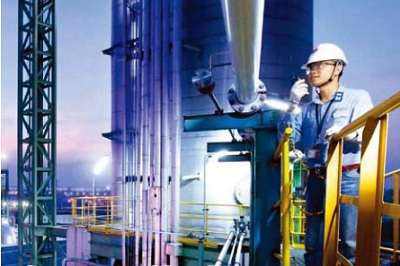
For infrastructure projects such as bridges, polyaspartic coatings are preferred due to their ease of application and fast curing, which lead to cost savings and the ability to keep pace with the construction schedule. A two-coat high productivity coating system can achieve the same performance advantage of a typical three-coat system. For concrete, polyaspartic coatings are ideal for protecting concrete because they can be applied easily, offer outstanding durability and gloss retention, and can be modified to fit specific application needs. For tunnels, polyaspartic ester-based aliphatic polyurea coatings are selected for such applications because the materials can be applied in low-temperatures without problems and they offer fast-cure productivity.
Increased productivity with polyaspartics
When it comes to more environmentally friendly coatings, adhesive and sealant technologies, Bayer offers quite a spread. Of particular note is its High Durability (HD) architectural wall coating technology. This coating's extreme durability makes it ideal for high-touch, high-traffic areas, as it withstands frequent scrubbings and reduces the need for repainting even in low sheen versions.
Bayer's polyaspartic coating technology provides design engineers with a durable, high-performance coating and low VOC levels. Polyaspartic coatings cure well in a range of temperatures and humidities, so builders can extend the application season. A flooring sample in Bayer's booth will highlight the benefits of polyaspartic technology.
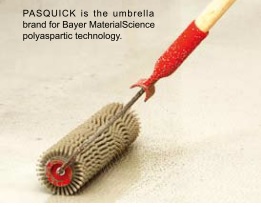
When exceptional performance and durability are required to protect construction and infrastructure projects, there is now a good range of polyaspartic coatings available in the market today.Polyaspartic raw materials from Bayer MaterialScience offer a particularly cost-effective solution and against conventional systems, these often require fewer coating steps and curing is rapid. At the European Coatings Show this year, the company introduced PASQUICK, the umbrella brand for its polyaspartic technology.
The latest development in the PASQUICK portfolio is the new hardener Desmodur® E 2863 XP. Thanks to its very low viscosity, it can be used to produce flexible, solvent-free floor coatings. These are suitable for outdoor applications as well as interior applications such as odourless comfort flooring and sports flooring.
The number of coating steps can be reduced, ensuring savings in time and labour costs during application. Contractors gain greater flexibility, can meet tight completion deadlines and are able to handle a larger number of projects in the same time. The improved efficiency enables coating manufacturers to sell larger quantities of polyaspartic coatings and also harness these highly efficient systems to position themselves on the market.
Thanks to the rapid curing process, several layers of such polyaspartic coatings can be applied in a single day using standard equipment. PASQUICK polyaspartic systems enable a cut in curing time from between 18 and 24 hours for conventional coatings to just 6 to 8 hours, thus boosting productivity two- to threefold. Compared to the three coats required in the past, the coating structure is now limited to a primer and topcoat. Total coating thickness is unchanged, ensuring excellent corrosion protection. Pot life has been extended compared to previous polyaspartic systems, with application taking place under less time pressure. The coating is easily applied at room temperature, and the surface can be walked on after just a few hours. This minimises downtime on construction sites and saves money.
Customers also benefit from the lower costs, achieving savings of around five to ten percent for the complete coating process. Polyaspartic anti-corrosion coatings meet all the requirements of ISO 12944.
Years of experience with polyaspartics
For 15 years, polyaspartic coatings based on Bayer raw materials have proved their usefulness in protecting wind turbines, bridges, industrial plants, and agricultural and construction machinery against corrosion, and have also served as floor coatings. Leading coating manufacturers include the systems in their portfolios and trust in the expertise of MaterialScience. Their increasing popularity has now resulted in the development of industry standards for this technology.
There is still some work to be done in terms of application and cost-effectiveness when it comes to the use of this technology for floor coatings, however. But the new polyaspartic raw materials expand the range of available options and boast unique properties that offer numerous advantages over other systems.