
 Access
 Login/Register
 Supplier Login












The Free State of Saxony is investing in the lightweight construction technology of the future as part of the Federal Government's Cluster of Excellence MERGE "Technology Fusion for Multifunctional Lightweight Structures" with the Chemnitz University of Technology.
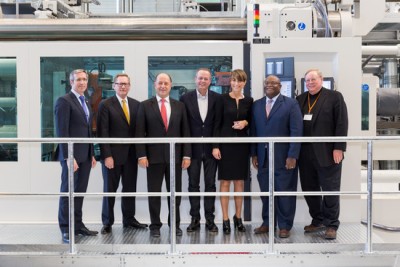
The new MERGE Lightweight Technology Center features an MXW 2500 injection molding machine from KraussMaffei, which offers a host of technical options including maximum flexibility for researching and prototype manufacturing close-to-production in their original size. The ceremonial launch of the new plant took place in October 2015 as part of the 2nd International MERGE Technologies Conference.
According to Georg Holzinger, Vice-President of Technologies at KraussMaffei, "the KraussMaffei MXW 2500 injection molding machine is a true all-round talent in the area of lightweight construction with its numerous options in material, mold or process selection and it is certainly unique in the German research landscape in this design and size." The machine is to be used for conducting research for the automotive industry with the purpose of producing parts of a vehicle with a lightweight design, in an energy-saving way and in serial production. Prototype components can be produced in their original sizes, which is important for industry clients who can test the properties of the parts at a 1:1 scale.
The MXW 2500 is a very compact, high-performance production system that is characterized by short machining times, fast cycles and a high output. The series has a modular design and offers a wide range of configuration options. The center has chosen a large machine with a clamping force range of 25,000 kN to be able to represent large components with measurements of up to 1.5 m x 1.5 m at a close-to-production 1:1 scale, said Prof. Dr.-Ing. Lothar Kroll, Director of the Institute of Lightweight Structures (IST) at the Chemnitz University of Technology and Coordinator of the MERGE Cluster of Excellence.
The "W" in the MXW 2500 machine designation stands for "Wendeplattentechnik" (swivel plate technology). A significant increase in cost-effectiveness in multi-component injection molding can be achieved using the SpinForm design from KraussMaffei. This allows producer to double the output of multi-component parts compared to turntable molds at the same clamping force. Even new components with particularly large dimensions can be functionalized this way. With the TwinForm variant, KraussMaffei created an additional solution with a special multi-daylight mold that also ensures noticeably higher production. An additional bolt-on unit in an L-design enables the flexible, additional metering and processing of thermoplastics as well as thermoset matrix materials.
An additional mixing and metering system also enables the processing of polyurethanes with fillers and other reactive matrix materials. The 40-15/29 hybrid is equipped with a color-metering unit directly on the mixing head and an additional gas charging unit. This offers maximum flexibility during prototype manufacturing.
Utilizing the MuCell process
The new MERGE research system is also designed for what is called the MuCell process. The MuCell process is a physical foaming process with nitrogen or carbon dioxide. The primary advantages of the foamed components are their light weight, decreased warpage, higher dimensional stability and short manufacturing times.
Prototype manufacturing close-to-production in the field of thermoplastic lightweight construction with fiber-reinforced plastic is possible thanks to the FiberForm process developed by KraussMaffei. New fiber-reinforced thermoplastic composite components can be manufactured with particularly high strengths using material-based and design-based lightweight construction. In this process, impregnated fabric or roving made out of continuous fiber, what are called fiber components, are heated, shaped in the injection mold and subsequently back-injected with a thermoplastic matrix. Like injection molding, the FiberForm process is easy to automate and can be used in fully automated production with compact manufacturing cells.
Advanced automation solutions
The streamlined automation solution conceptualized by KraussMaffei for this system offers a high degree of flexibility and support for this process. Four LRX robots have been replaced by two LRX500-TwinZ robots. This type of robot (TwinZ) couples two x/y kinematic units each to the z-axis mechanically. Both robots can be programmed and operated using the multiple kinematics control concept. Integration of up to 24 axes is possible.
Despite the size and complexity, this automation solution has been implemented in a way that optimizes the available space and enables a high degree of operating convenience. This enables the robots to discharge the parts on the operator rearside and the injection molding machine remains completely accessible on the operator side. The sophisticated solution also required the additional injection molding machine bolt-on unit (in the L-design) on the operator rearside. The workstations for feeding insertion parts and the deposit of the finished parts take place on a platform above the bolt-on unit. This spatial separation enables both systems to be operated optimally.
All processes – whether SpinForm, TwinForm, MuCell, FiberForm or automation - as well as the MXW 2500 can be operated centrally via the MC6 control system which eases the operation of complex processes.