
 Access
 Login/Register
 Supplier Login












EMPHASIS on technological innovations is cementing Serac's position as an expert in aseptic filling solutions for highly sensitive products. Matching strict food safety requirements, the company has installed two dairy aseptic lines for bottling low-acid pH products such as milks and nutritional dairy drinks. The lines have been redesigned to match the demands of the company's customers – two leading brands in the premium dairy market.
The whole bottling process conforms to food safety requirements. Toward this end, the company has doubled all key components in line with improved technical specifications. These specifications also impose the tracing of all major parameters and cycles to reduce non-sterility risks to the absolute minimum.
All gas filtration systems in the lines have been doubled as well. The enclosure has a two level filtering of air and a sanitisation system for air filters. Upstream of the filling unit is a double filtering system for compressed air and nitrogen. Besides adopting full automation for the registering system, Serac has added sensors to monitor parameters related to sterile conditions. These developments complement existing monitoring solutions such as leak detection on empty, filled and sealed bottles. Monitoring of cleaning operations is maintained, as are traceability of foil cap decontamination and heat sealing parameters, all of which are legacy security measures.
Hydrogen peroxide, alternative solution
Serac pushes for hydrogen peroxide gas (H2O2) as a replacement for peracetic acid on standard aseptic lines in the treatment of both bottles and caps. Already adopted in some countries, hydrogen peroxide gas treatment does not require bottles to be rinsed with sterile water. It eliminates the need for pre-irradiated reels of aluminium to cut and emboss foil caps, which are sterilised just before their transfer onto the neck. These combined translate to significant production cost savings. Sterile water alone is a value-increasing resource.
Hydrogen peroxide gas treatment can likewise be utilised for the sanitisation of the filling unit itself. This has resulted in an entirely gas-tight unit replacing the restricted access barrier system (RABS) to ensure operator safety. The new cabin's compact design provides additional benefit.
Serac also adopts the chemical agent in its comprehensive system for bottle sterilisation. In this system, an inverting station places the bottle upside down before the H2O2 gaseous mix is injected. The sterilant is activated by sterile hot air, which also dries the bottle in order to reduce the residue level. A patented vapouriser designed to trap the dried residues generated through the evaporation of the H2O2 mix facilitates system cleaning.
Further improvement on the system has been made to obtain a 5 Log reduction on the external surface of the bottle. This is an improvement from the previous reduction of 5 Log on bacteria's rate inside the bottle and 3 Log on the outer surface.
Controlled area, other mechanical adjustments
Another enhancement Serac made involved the implementation of a controlled area below the neck of the bottle, which is a critical point for pollution risks. To achieve objectives, the company reviewed all the machinery and made adjustments on mechanical components. These changes aim to lower the total number of parts in the sterile area and move all critical elements down to the controlled area. They likewise hope to achieve a pharmaceutical level of hygiene within the aseptic enclosure. All these are in compliance with customers' food safety requirements on top of a 100% sterile zone.
The mechanical adjustments included placing the valves of the hydrogen peroxide injection unit and transfer clamps under the table. The mechanical parts of the filling turret are totally isolated from the sterile zone. The static and rotating sections are separated by a peracetic acid (PAA) seal. Serac is also undertaking improvements on the capping aside. It is adopting new magnetically actuated sealing heads with no compressed air for its aseptic heat-sealing station. It is likewise implementing a new design with confined cables.
Added flexibility and full documentation
In line with product flexibility, a key factor in aseptic filling lines requiring heavy investments, Serac offers neck transfer for a quick switch from one packaging to another, regardless of size or material. Recipes can also easily follow one another without a four-hour cleaning and sterilisation process. Pipes can be made ready for the next batch with just one injection of sterile water. A single recipe can even be employed for draining another. Serac supplies a full batch of documentation covering all necessary certification and risk and functional analyses to assist customers. It also provides on-site assistance for installation and operational and performance qualification of the lines.
Whilst it remains committed to meeting varying customers' needs, Serac does not aim to impose any standard to the industry. In this regard, the company can adapt all the new innovations and technological developments it has implemented in the new lines to the requirements and expectations of a customer.
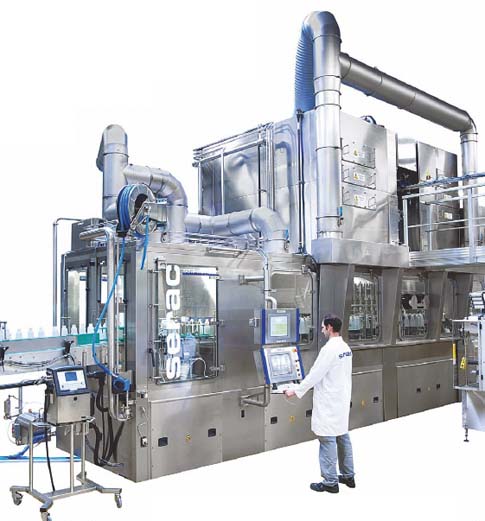
An improvement on the Serac aseptic system has been made to obtain a 5 Log reduction on the external surface of the bottle
Jordan Shoes