
 Access
 Login/Register
 Supplier Login












IMPLANTS made of titanium or non-degradable polymers have been the norm in cases of bone fracture, which may require a second operation to remove them after they have done their job. To spare patients burdensome interventions, researchers at Fraunhofer Institute for Manufacturing Technology and Advanced Materials (IFAM) in Bremen, Germany, are working on a bone substitute that completely degrades in the body but have the load-bearing strength required of such implants. Towards this end, material combinations of metal and ceramic are being used.
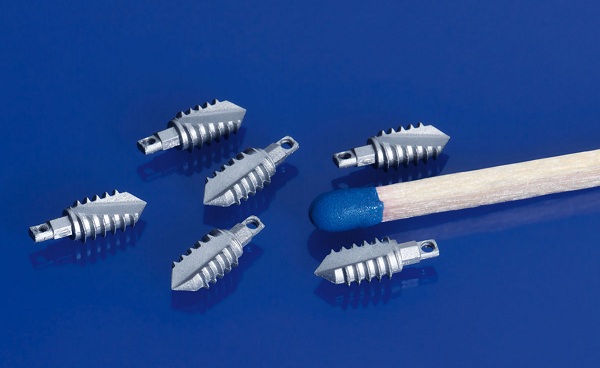
The demonstrator for a suture anchor made of iron-tricalcium phosphate (FE-TCP) is only slightly larger than a match head (Photo © Fraunhofer IFAM)
According to Dr. Philipp Imgrund, manager of the Medical Technology and Life Sciences business field at IFAM, the implant can anchor severed tendons to the bone until they have grown again. Once the function of the fixing element is satisfied after the healing process, the implant is no longer needed in the body, he points out.
“If implants or prostheses that are as wear resistant as possible are required – such as in an artificial hip joint – metallic alloys such as titanium will certainly continue to be used. However, for plates, screws, pins and nails which should not remain in the body, there are other requirements,” Dr. Imgrund adds.
These materials are to be gradually absorbed by the body while, at the same time, new bone tissue is formed. Ideally, the degree of degradation is adapted to the bone growth so that the degradation of the implant meshes with the bone formation.
Specifically adjustable degradation
For the scientists, the challenge with developing materials with specifically adjustable degradation was two-fold. First, the implants have to be mechanically stable enough during the entire healing process so that they are able to fix the bone in place. At the same time, they cannot have any allergenic effects or cause inflammation.
A metal component based on an iron alloy is combined with beta-tricalcium phosphate (TCP) as the ceramic component. Their results with metal-ceramic composites have been extremely promising, according to Dr. Imgrund, with calcium phosphate shown to help stimulate the bone’s healing process.
Explaining the advantages of this material combination, he says, “Iron alloys corrode slowly and ensure high mechanical strength, while ceramic decomposes quickly, stimulates bone growth and aids the ingrowth of the implant.”
Ideal mix established
In the project to establish a materials and technology platform to produce degradable bone implants for use in trauma surgery and orthopedics, the IFAM research team used powder injection molding to manufacture a suture anchor, which is available as a demonstrator.
The powdered materials can be mixed in any proportion prior to processing. But what proportion is the right one? In laboratory experiments, the researchers have found the optimum composition of the materials for the suture anchor. The demonstrator consists of 60% iron and 40% ceramic.
Powder injection molding offers the ability to produce complex structures cost-effectively and in large numbers. Properties such as density and porosity can be controlled selectively – an important factor, since high density and low porosity result in high mechanical strengths.
“It is important to determine the right amount of ceramics as a function of the powder amount. If the proportion is too high, the material will be brittle. On the other hand, the tricalcium phosphate accelerates the degradation of the implant,” explains Dr. Imgrund.
IFAM researchers have succeeded in doubling the degradation rate from 120 to 240 micrometers per year in the laboratory model. These results indicate that a typical shoulder anchor would be absorbed by the body within one to two years.
While shaping processes such as powder injection molding are especially suited in large quantities as fixation elements for standard implants, additive manufacturing methods are used to produce individual implants – such as for bone replacement in the skull area – or implants with defined pore structure.
Establishing technology and safety protocols
IFAM has worked jointly in this project (named “DegraLast”) with the Fraunhofer Institutes for Laser Technology (ILT), for Biomedical Engineering (IBMT) and for Interfacial Engineering and Biotechnology (IGB) to produce degradable bone implants for use in trauma surgery and orthopedics.
ILT researchers are using Selective Laser Melting (SLM) to produce implants made of magnesium alloys, as the team expects that there will be a demand for individualized implants.
To ensure the safety of the novel composite materials from the outset, IGB scientists are meanwhile establishing cell-based in-vitro test systems for analysis of the ingrowth behavior in the bone. The team at IBMT are in turn working on an in-vivo monitoring system to monitor and document the implant degradation behavior in the human body.
Nike Free Rn Flyknit