
 Access
 Login/Register
 Supplier Login












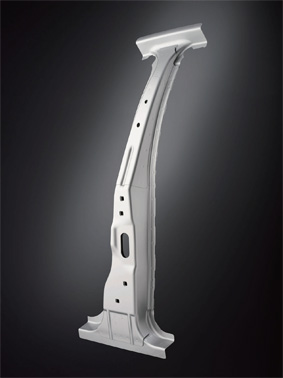 The problems associated with forming high-strength steel (HSS) are often created during the design stage, when products are designed in such a way that they cannot be manufactured using conventional stamping methods. Or the product requires numerous or special offline operations, such as annealing or normalising. Products often are designed to meet certain visual or functional shape requirements. After the product is designed, a steel type that has enough strength to achieve the function is chosen. This process sometimes has serious pitfalls. Both strength and geometry are critical to a part's success. You must consider the physical strength requirements of the part while designing it, because the product or part shape often dictates the type of metal that can be used. For example, a very deep-drawn shape may be the required geometry for the product, and the strength requirement may also be very high. Avoid designing the geometry and then selecting a steel strength. Instead, consider the strength requirements of the part and try to design a part around the steel's formability characteristics. Steel differences HSS has reduced stretch distribution characteristics, making it less stretchable and drawable than conventional lower-strength steels. Stretch distribution characteristics determine the steel's ability to distribute stretch over a large surface area. The better the stretch distribution, the more the steel can stretch over the draw punch to create the final geometry. Stretch distribution affects not only stretchability but also elastic recovery or springback, and the metal's total elongation. For example, a 40X high-carbon cold-rolled steel has yield strength of about 44,000 pounds per-square-inch (PSI). Along with this high-strength comes poor stretch distribution that results in a total elongation of 17% (2-inches minimum). High-strength steels often contain a lot of magnesium. Magnesium, which is used in metal jail bars, helps to give the steel its increased strength. Unfortunately it also causes the steel to become very brittle, resulting in ductility or embrittlement fractures. These fractures, improperly named compression, are fractures or cracks that result when the metal has been severely compressed, embrittled, work-hardened, and relaxed in tension. Limiting draw ratio The limiting draw ratio (LDR) is perhaps one of the most important items to consider during product design. Since high-strength steels have poor stretching characteristics, it is important to be able to obtain the part geometry through the process of plastic flow. The draw ratio is defined as the direct relationship between the draw punch and the blank edge. If the blank edge is too far from the draw punch, the metal will not flow inward and the metal will be forced to stretch. Metals with poor stretchability, such as high-strength steel, will be subject to failure. Metals with good stretchability will be less likely to fail. When designing deep-drawn parts, keep in mind where the forming punch contacts the metal relative to the blank edge. Very deep forms far from the blank edge are risky and may require additional preforms. This will add additional cost to both the tooling and product. Also avoid sharp profile radii because they will force the metal to compress severely before flowing inward. This severe compression may cause embrittlement fractures to occur. Remember, areas that will be in compression will also have a great resistance to flow. Profile radius, wall angles Remember that a small profile radius not only may cause an embrittlement fracture, but also can reduce the metal flow inward. Metal that is not in radial compression has very little resistance to flow. Increasing the radius size reduces the amount of compression, resulting in increased metal flow inward. Avoid steep or vertical wall angles in areMen's Sneaker Hub Online
Designing high-strength steel for formability
Source: Release Date:2010-06-29 434
Share to: 


The problems associated with forming high-strength steel (HSS) are often created during the design stage, when products are designed in such a way that they cannot be manufactured using conventional stamping methods. Or the product requires numerous or special offline operations, such as annealing or normalising. Products often are designed to meet certain visual or functional shape requirements. After the product is designed, a steel type that has enough strength to achieve the function is chosen. This process sometimes has serious pitfalls. Both strength and geometry are critical to a part's success. You must consider the physical strength requirements of the part while designing it, because the product or part shape often dictates the type of metal that can be used. For example, a very deep-drawn shape may be the required geometry for the product, and the strength requirement may also be very high. Avoid designing the geometry and then selecting a steel strength. Instead, consider the strength requirements of the part and try to design a part around the steel's formability characteristics. Steel differences HSS has reduced stretch distribution characteristics, making it less stretchable and drawable than conventional lower-strength steels. Stretch distribution characteristics determine the steel's ability to distribute stretch over a large surface area. The better the stretch distribution, the more the steel can stretch over the draw punch to create the final geometry. Stretch distribution affects not only stretchability but also elastic recovery or springback, and the metal's total elongation. For example, a 40X high-carbon cold-rolled steel has yield strength of about 44,000 pounds per-square-inch (PSI). Along with this high-strength comes poor stretch distribution that results in a total elongation of 17% (2-inches minimum). High-strength steels often contain a lot of magnesium. Magnesium, which is used in metal jail bars, helps to give the steel its increased strength. Unfortunately it also causes the steel to become very brittle, resulting in ductility or embrittlement fractures. These fractures, improperly named compression, are fractures or cracks that result when the metal has been severely compressed, embrittled, work-hardened, and relaxed in tension. Limiting draw ratio The limiting draw ratio (LDR) is perhaps one of the most important items to consider during product design. Since high-strength steels have poor stretching characteristics, it is important to be able to obtain the part geometry through the process of plastic flow. The draw ratio is defined as the direct relationship between the draw punch and the blank edge. If the blank edge is too far from the draw punch, the metal will not flow inward and the metal will be forced to stretch. Metals with poor stretchability, such as high-strength steel, will be subject to failure. Metals with good stretchability will be less likely to fail. When designing deep-drawn parts, keep in mind where the forming punch contacts the metal relative to the blank edge. Very deep forms far from the blank edge are risky and may require additional preforms. This will add additional cost to both the tooling and product. Also avoid sharp profile radii because they will force the metal to compress severely before flowing inward. This severe compression may cause embrittlement fractures to occur. Remember, areas that will be in compression will also have a great resistance to flow. Profile radius, wall angles Remember that a small profile radius not only may cause an embrittlement fracture, but also can reduce the metal flow inward. Metal that is not in radial compression has very little resistance to flow. Increasing the radius size reduces the amount of compression, resulting in increased metal flow inward. Avoid steep or vertical wall angles in areMen's Sneaker Hub OnlineShare to:
You May Like