
 Access
 Login/Register
 Supplier Login












The global engineering plastics market is as dynamic as ever with growth expected to continue in the long term. Various market studies have indicated this trend as applications for engineering plastics become more diversified.
Global Industry Analysts, Inc. suggests that the global market for engineering plastics is projected to reach 25.4 million metric tonnes (MT) by 2020, driven by sustained economic growth, and expanding applications in key end-use sectors. Another study by MarketsandMarkets shows that the global engineering plastics market, valued to be $53.58 billion in 2013 is estimated to reach about $79.026 billion in 2018, growing at a CAGR of 8 percent from 2013 to 2018. Asia Pacific contributed nearly 43 percent of the total revenue, being the biggest contributor. In terms of consumption, China is the biggest consumer followed by US, while India’s consumption is expected to grow at 7.3 percent from 2013 to 2018.
The World’s Economic Forum’s Meta-Council on Emerging Technologies included recyclable thermoset plastics as one of the top ten emerging technologies of 2015. Thermoplastics can be heated and shaped multiple times but thermoset plastics can only be heated and shaped once post which the changes are permanent and are not subject to change even when exposed to intense heat and pressure. Thermoset plastics are an essential part of the modern operating world but also impossible to recycle due to which they end up as landfill waste. Given that sustainability is essential, recyclability of thermoset plastics is very significant. If new trends towards recycling of thermoset plastics is obtained and promoted, landfill wastes owed to plastics will be greatly controlled. This research suggested that recyclable thermoset polymers are set to replace unrecyclable thermosets within years, and to be omnipresent in newly manufactured goods by 2025.
Viable options
In today’s day and age, it is generally accepted that engineering plastics are materials that have heat resistance above 100 degree centigrade and good flame retardant properties. Commodity plastics tend to have very high volume production, dominated by supply and demand though characteristics between engineering plastics and commodity plastics means differences in heat resistance and flame retardancy resulting in an overall higher level of performance for engineering plastics. A new category, Performance Plastics - the highest heat materials made today – are generally considered a subset of engineering plastics.
The automotive and transportation industry is the largest end use application for engineering plastics. High sales of passenger cars in emerging markets is expected to boost the market while electrical and electronics is the second largest application for engineering plastics being widely used in luminaries, connections, circuit devices, LV switchgear, circuit breakers, etc.
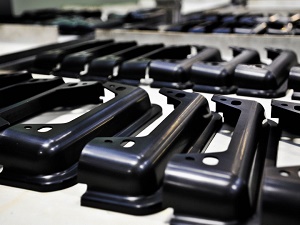
Axion Polymers as used in BMW Mini air vents
Michael Cain, CEO of Radici Plastics USA, stated: "We are focusing our attention on our high performance engineering plastics from the Radilon and Radistrong lines. These products ensure the highest performance and sustainability and are getting a great response from our markets, particularly electrical and automotive, of which the latter still presents the greatest opportunities for growth."
The company has Radilon enhanced heat-resistant specialties, moving away from traditional HHR nylon 6.6 engineering polymers, featuring high heat-ageing resistance at air temperatures of up to 210°C, Radilon XTreme line developed for hot-air applications at continuous service temperatures of up to 230°C. Radistrong long-fibre reinforced PA6 and PA6.6 specialties, ideal for metal replacement applications.
With no currently viable recycling routes for many of the recently developed materials used in modern lightweight vehicles, Axion Polymers Director Keith Freegard asserts ‘these vehicle components and body parts might only be suitable for energy-from-waste schemes at end of life’. Mr. Freegard is calling on the sector to look at locally-sourced, sustainable options first, such as innovative, highly-specified 100 percent recycled polymers derived from a stable long-term supply of end-of-life vehicles. These closed-loop plastics offer significant carbon savings of between 50 and 75 percent when compared with virgin polymers, an important factor when the embedded carbon cost from selecting ‘fancy’ technical materials can become a major proportion of a low-carbon vehicle’s total life-cycle footprint.
Mr. Freegard will be participating in the Materials Innovation Showcase organised by the Knowledge Transfer Network at the Cenex Low Carbon Vehicle Event 2015 in September where he will explain how Axion’s range of Axpoly® 100 percent recycled engineering polymer can help to satisfy the design requirement of the next generation of low carbon vehicles. He said: “While I applaud the use of novel new materials to make lightweight motor vehicle bodies and structural components for cars, my challenge to materials scientists and designers is to think about the simpler alternatives: mono-materials that save carbon and can be eventually recovered for re-use at end of life. It is tempting to use more unusual composite and reinforced fibre products that can make exciting lightweight components. Yet there appears to be scant regard given to how these very technical, high-performing and complicated composites are treated at the end of a vehicle’s life as they currently cannot be recycled.” IRNE