
 Access
 Login/Register
 Supplier Login












CALCIUM is one of the most important minerals in the human body. Its positive effect on bone health and essential role in a number of vital body functions are widely recognized and supported by various research studies[1]. Over the several past decades, growing consumer awareness of the health benefits of calcium and its potential to combat osteoporosis has pushed the demand for calcium-enriched foods to an all-time high. While calcium fortification continues to be a major topic within the entire food industry, formulating beverages can be a challenging task and not every solution that is available on the market will be suitable.
The “super nutrient”
The human body contains more calcium than any other mineral. About 99 % of the entire body’s calcium can be found as hydroxyapatite in the bones and teeth. An essential element for the development and maintenance of strong bones and teeth, calcium also plays an important role in regulating a number of vital biochemical processes in the body, including blood clotting, muscle contraction, cell proliferation and differentiation and regulation of nerve impulses[2]. Furthermore, calcium controls nutrient absorption, fat digestion and metabolism[3]. Because human blood only contains a small fraction of the total amount of calcium available, maintaining its level is essential to ensure normal cell function. Insufficient calcium intake, on the other hand, will cause the blood calcium level to drop and the body may start pulling calcium from the bones.

Calcium for life
Although calcium intake is important throughout life, particular attention needs to be paid during childhood and adolescence. Calcium is vital for a strong bone structure during these critical stages of rapid growth and is absorbed more effectively than at any other time in life. As the human body ages, bone mineral density begins to decline, increasing the daily amount of calcium required. However, should bone mass decline more quickly than the body is able to replace it, bones will get weaker so that even the slightest fall or bump can cause fractures. Although the decline of bone mass is a natural process, changes in diets and lifestyles have caused the number of sufferers from osteoporosis to increase exponentially. According to the International Osteoporosis Society, approximately nine million people a year are currently experiencing fractures due to brittle bone structures with the number of hip fractures expected to increase fourfold by 2050[4].
Ensuring an adequate calcium intake can help reduce the effects of naturally decreasing bone mass and delay the onset of osteoporosis[5]. While the positive effects of calcium on the bone strength are well-documented and widely accepted, recent studies also point to a number of other benefits that come with a high calcium diet. Findings from a recently published US study, for example, indicated that increased calcium intake can reduce the risk of developing hyperparathyroidism, a hormone condition common in post-menopausal women, by 44%[6].
Fortified beverages – a viable solution
Traditional calcium sources, such as cheeses, yoghurt and most of all milk are by far the biggest sources of calcium in most diets. Although alternative calcium-rich food sources are available for people who do not consume dairy products or are lactose-intolerant, they rarely provide the recommended daily amount. As a result, consumers are increasingly looking for alternatives or additional calcium sources that will help them achieve adequate calcium intakes and cater for a broader range of dietary needs.
Rising consumer interest in healthy nutrition is driving growth in the functional foods market, with the world market for functional foods and drinks predicted to reach $130 billion by 2015[7]. While calcium fortification can be found across all types of food sources, beverages have proved to be a good medium for enhancement as they are convenient and widely consumed across many demographics. Calcium fortification is possible in nearly all categories, including waters, sports drinks, soft drinks, soya milk and fruit juices. With various ingredient solutions available, finding a calcium source that will enhance the mineral content of beverages without losing their consumer appeal is not always easy. Depending on the type of drink, its consistency, taste profile, appearance and health claim, manufacturers will need to consider a number of factors, such as bioavailability, solubility, concentration and flavor, before deciding which calcium source is ideal for their product. Selecting the right ingredient from the right supplier ensures the perfection of formulation and significantly speeds up time to market.
Bioavailability matters
Calcium’s bioavailability is possibly one of the most important aspects to consider as it determines how well the body is able to absorb the calcium into the blood. On average, an adult human body is able to absorb about 30% of the calcium consumed, while the rest is discharged, unused[8]. Although calcium in milk is the most bioavailable, research has demonstrated that calcium absorption from carbonate, acetate, lactate, gluconate, and citrate salts of calcium, is similar to that of whole milk[9]. However, establishing the bioavailability of calcium sources is not as straightforward as generally assumed and is highly dependent a number of factors, such as the amount consumed, age and physical state of the consumer, diet habits and type of food.
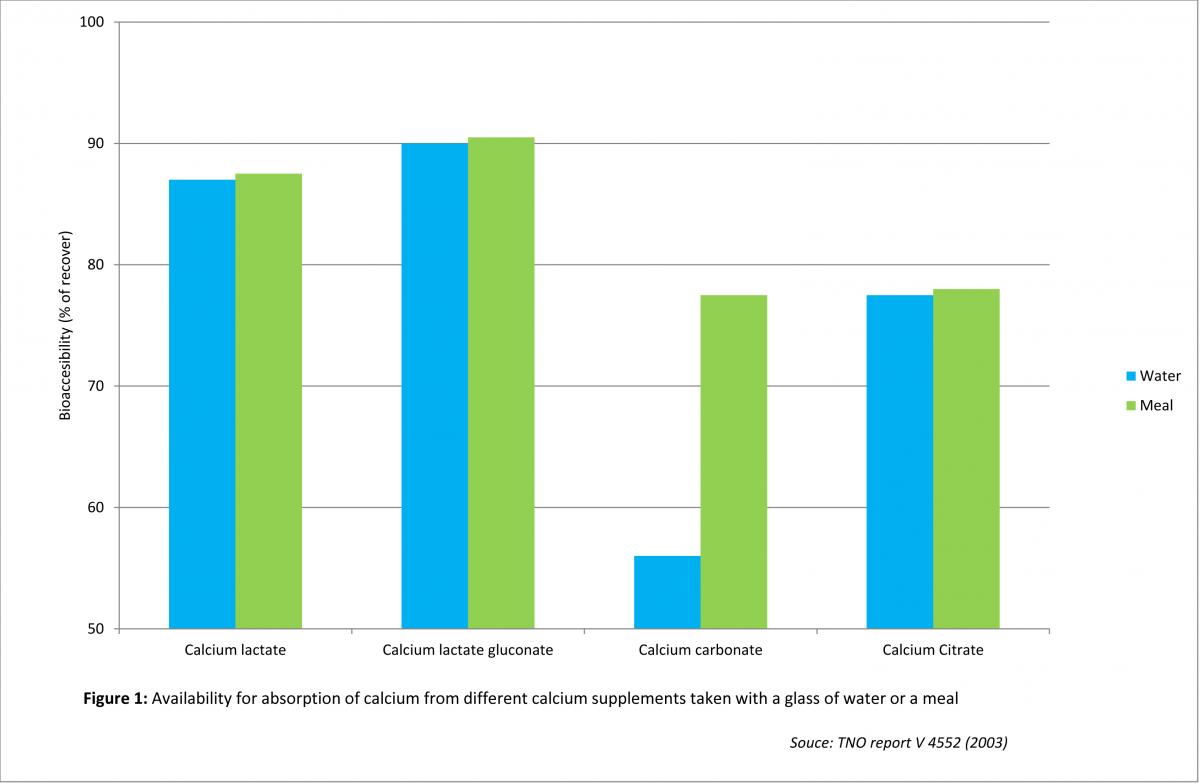
While calcium is best consumed with a meal as the prolonged transport will benefit the overall absorption level, some ingredients, such as sodium and caffeine, can decrease the effectiveness of the calcium source. Vitamin D and some fats, on the other hand, can stimulate its absorption. Although the most common calcium salts, such as carbonate, citrate, lactate and gluconate show comparable absorption levels when consumed with a meal, the same cannot be said in the case of beverages. One study showed that calcium lactate and gluconate delivered more bioaccessible calcium when consumed with a glass of water, making them the preferred choice for a wide variety of beverages, including sports drinks and clear products, such as flavored waters[10].
Solubility or concentration?
Besides a high level of bioavailability, beverage manufacturers are also looking for high solubility, a short dissolution time and sufficient calcium content. While some of the most common calcium sources, such as calcium citrate and phosphate are less soluble, calcium lactate and calcium gluconate have demonstrated high solubility at both low and neutral pH and dissolve quickly even at low processing temperatures.
However, solubility comes at a price – often concentration. While calcium citrate and phosphate boast of calcium contents of 21% and 38% respectively, they are frequently unsuitable for beverages due to their poor solubility. Calcium lactate and calcium gluconate, which are highly soluble contain only 9 to 14% calcium. As a result, the amount of calcium salt that is required to achieve the desired health claim is higher. Nevertheless, for the majority of beverage formulators, solubility will be the deciding factor, because lactate and gluconate allow sufficient fortification without affecting important features like taste and appearance.
Calcium – the sixth taste?
Maintaining the original flavor of the beverage is critical for all manufacturers who are looking to add value to their products. While the importance of calcium in the human diet is widely acknowledged, adding it to beverages has historically been difficult due to its bitter taste profile. Many consumers are highly averse to calcium’s distinctive taste and avoid high-calcium foods, such as collard greens and kale. Some have even suggested naming calcium the sixth taste due to research that indicates the existence of a calcium-sensing taste receptor on the human tongue[11]. Although less soluble solutions such as calcium citrate and calcium phosphate are known to be less bitter than most other calcium salts, they can have a chalky flavor and sandy mouthfeel. As a result, manufacturers are increasingly attracted to calcium sources with a more neutral taste profile, such as calcium lactate or calcium gluconate, in order to maintain the palatability of their beverages without the need for masking agents or stabilizers.
[1] Effect of Calcium and Vitamin D Supplementation on Bone Density in Men and Women 65 Years of Age or Older, N Engl J Med, September 4, 1997
[2] Guidelines on food fortification with micronutrients, World Health Organisation, 2006
[3] Nutrition: Concepts and Controversies, F. Sizer and E.Whitney, 2013
[4] http://www.iofbonehealth.org/node/11862#category-14
[5] http://www.nof.org/articles/10
[6] Calcium intake and risk of primary hyperparathyroidism in women: prospective cohort study, BMJ (Published 18 October 2012)
[7] Global Functional Foods and Drinks Market, Global Industry Analysts, April 2014
[8] Calcium: Dietary Supplement Fact Sheet, National Institutes of Health, 2013
[9] Gastrointestinal Absorption of Calcium from Milk and Calcium Salt, N Engl J Med 1987; 317:532-536 August 27, 1987
[10] Availability for absorption of calcium from four calcium supplements during passage through a dynamic gastrointestinal model, TNO Nutrition and Food Research Institute (2003)
[11] Calcium: Taste, Intake, and Appetite, M. G. Tordoff, Physiological Reviews, Vol. 81, No. 4, October 2001
Mężczyźni