
 Access
 Login/Register
 Supplier Login












The breakthrough material invented by DuPont Researcher Wallace Carothers in 1935 is credited for making many consumer goods – stockings, toothbrushes, hand-held devices – more affordable, attractive and accessible to everyone around the world. The lightweight material is frequently used to replace metal, lowering weight and cost and inviting design freedom and parts integration.
Nylon revolutionized the fashion industry, as Debra Hughes, curator of collections and exhibits and the Hagley Museum and Library said. Beyond textile, nylon opened the world to new design ideas. It’s a material that changed the world.
Nylon’s versatility and strength, backed by science to coax out added performance and a global development network to support customers, proved to be the formula that earned nylon its reputation and its place as one of DuPont’s most successful products.
“If the performance launched the polymer, then design freedom helped it grow and adaptability keeps it young,” said DuPont Performance Polymers President Patrick E. Lindner. “As long as designers can dream it, we can help them manufacture it.”
DuPont pioneered the science that transformed nylon fiber into an engineering polymer in the 1940s. Its exponential growth in that decade is in part credited to the U.S. government, which advised replacing metal with plastics wherever possible to support the war effort. Bottles, cups, even car parts were made lighter and more affordable during this decade.
In the 1950s DuPont trademarked the emerging flagship product DuPont Zytel nylon and a decade later discovered that compounding the plastic with glass and other fillers amplified its functionality. Nylon was in a performance category all by itself and broke ground in automotive underhood applications, where the requirement of long-term resistance to heat and chemicals precluded the use of many plastics.
In 1992, General Motors adopted Zytel nylon for one of its most popular and reliable engines – the 3800. This marked the first high-volume commercial adoption of nylon in an air-intake manifold in the United States and paved the way for a wholesale global shift from metal to plastic in manifolds and other automotive components over the next decade. By the time the venerable GM3800 engine retired in 2008, the 65 percent reduction in mass versus the prior aluminum design had eliminated the need for more than 2.6 million barrels of oil as a result of lower fuel consumption from this engine alone.
Design engineers found Zytel not only reduced weight compared to metals, but also provided freedom to design and manufacture complex shapes, allowed for the integration of many components to enhance performance and enabled a lower total system cost for DuPont’s industry partners.
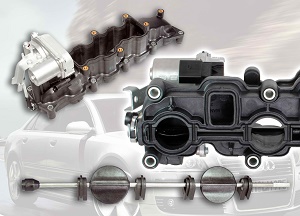
Today DuPont Zytel nylon is used all over the world in a variety of automotive components, such as air ducts, engine covers, charged air coolers, transmission components and radiator end tanks. In electrical and electronic systems, Zytel nylon is widely used in enclosures, sockets, terminal blocks, circuit breakers, switches and relays.
A few years later, DuPont again developed an innovative nylon polymer chemistry and introduced Zytel HTN. This new high-performance polyamide spanned the performance gap between conventional engineering resins and much higher-cost specialty polymers. Zytel HTN enabled even more precise engineering for uses including sensitive electrical and electronic components. It could be molded into much thinner components and it held its shape and dimensions despite exposure to heat and moisture.
Most recently DuPont has developed a portfolio of renewable polymers derived from non-food crop sources. The growing Zytel RS 610 and 1010 polymer family provides a sustainable alternative for handheld devices and underhood automotive components, like radiator end tanks, air hoses and fuel lines.