
 Access
 Login/Register
 Supplier Login












STANDING at 5 feet 2 inches tall, the newest hospital staff at U.S. Air Force Hospital Langley‘ is hardly a commanding presence. After five minutes, however, its impact has the potential to save countless lives around the world.
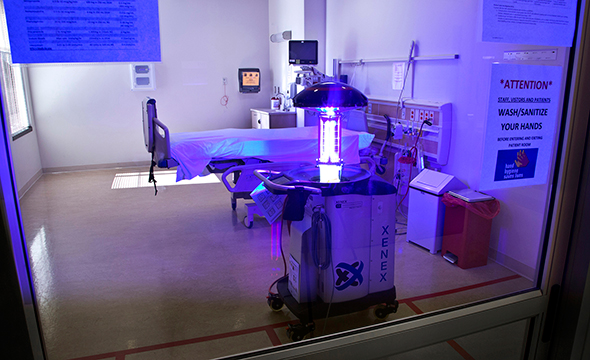
Saul in action at the ICU unit at USAF Hospital Langley
The 633rd Medical Group recently received the germ-zapping robot, nicknamed “Saul”, which harnesses the power of technology to destroy viruses – including the Ebola virus. Shortly after President Barack Obama issued an executive order addressing the critical issue of Ebola, the 633rd MDG responded with cutting-edge technology to protect the health of the service members, their families and the community.
Partnering with Xenex Disinfection Services, the company that created Saul, is part of a response plan designed to ensure the 633rd MDG is equipped to handle viruses like Ebola.
“We are very proud to be the first Air Force hospital to acquire this robot for disease containment and Ebola virus preparedness,” said U.S. Air Force Col. Marlene Kerchenski, 633rd Medical Group director of nursing services. “Saul will provide an extra measure of safety for both our patients and our intensive care unit staff.”
Offering the fastest, safest and most cost-effective method for disinfection of healthcare facilities, such as patient rooms, ORs and ICUs, Xenex robots quickly destroy the microorganisms that cause healthcare associated infections (HAI), such as Clostridium difficile (C. diff), methicillin-resistant Staphylococcus aureus (MRSA), and the Ebola virus.
The Xenex germ-zapping robot works by pulsing xenon, an inert gas, at high intensity in a xenon ultraviolet flash lamp. This produces ultraviolet C (UVC), which penetrates the cell walls of microorganisms including bacteria, viruses, mold, fungus and spores. Their DNA is instantly fused so that they are unable to reproduce or mutate, effectively killing them on surfaces and in the air without contact or chemicals.
The Xenex technology will be used at Langley as a preventative measure to help eradicate and control viruses. The Xenex robot will primarily be deployed for the disinfection of patient treatment areas, including in-patient rooms, operating rooms, isolation rooms, intensive care units and common use areas.
Although each room is cleaned by hospital staff wearing proper protection equipment and using cleaning chemicals, harmful bacteria, viruses and fungi still linger in some areas, especially those areas that human hands can’t reach. As an additional patient safety measure, the Xenex robot can then disinfect a room in five minutes and destroy Ebola-like viruses on surfaces in two minutes. This means they can also reduce multidrug resistant organisms (MRDO) infections considerably.
“Hospitals that are using Xenex’s robots have been able to bring C.diff, MRSA and other MDRO infection rates down in many cases by more than 60 percent,” said Xenex Healthcare Services implementation manager Geri Genant.
Xenex robots are the only non-mercury UV room disinfection solution. The robots are also considerably faster, safer and “greener” than other automated cleaning and infection control methods, including toxic mercury UV and hydrogen peroxide-based systems, which can take multiple hours to achieve the same level of disinfection. In addition, the Xenex robot is available to provide decontamination in response to a natural or intentional biological event.
Saldos - Entrega gratuita