
 Access
 Login/Register
 Supplier Login












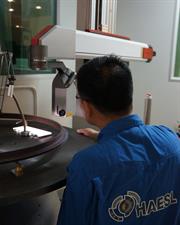 How fuel efficient is a commercial airliner? A Boeing 747 burns approximately 5 gallons of fuel per mile or a total of 30,000 gallons (98 tonnes) on a flight between London and Hong Kong - a significant cost for an airline. The honeycomb seal-ring is an extensively used component, which has been proven to optimise the fuel efficiency of aero-engines, but the measurement of these seals present difficult engineering challenges. Now, HAESL (Hong Kong Aero Engine Services Limited) believes that it has successfully solved this challenge by incorporating Renishaw's TONiC incremental linear and rotary (angle) encoders within its new optical Seal Ring Measurement System (SRMS).
Eric Lau, senior engineer, who has been working at HAESL for almost 20 years, and engineer Raymond Siu explain: “SRMS is a joint development system by HAESL and The Hong Kong Polytechnic University (PolyU), which has transformed the way we inspect honeycomb. Before SRMS, we used vernier callipers to measure the rings manually which is time consuming and relies heavily on the skill and experience of the operator. This new system has changed all of that. SRMS is not only faster, which increases work efficiency by 50%, but also maintains the consistency of the results by eliminating human error.”
Honeycomb seal-rings
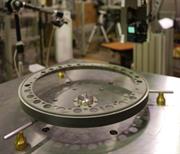 Honeycomb seals are fitted into mounting rings that are juxtaposed to the blades of the turbine. They are used to seal the radial gap between the rotating blades and the turbine wall to optimise both the fuel consumption and service life of the aero-engine. Rotor blades expand, however, as the operating temperature increases. The honeycomb seal-ring, therefore, provides a sacrificial surface that allows the rotating blades to cut into the seal and preserve the integrity of both the blades and the turbine wall. Hexagonal cell size on the ring depends on the rotor blade dimensions; cell diameter typically varies from 0.8 mm to 3 mm, while depth is up to 13 mm.
Reliable performance
 Patrick Ng is the chief designer of SRMS: “The combination of an integrated optical measurement head, ball screw axes, servo-motors and encoded rotary table create an accurate, reliable and maintenance-free system. Unlike conventional probe systems, SRMS employs non-contact and optical inspection technologies to tackle the most typical seal-ring measuring problems faced by the industry. The choice of Renishaw was straightforward. We had experience of Renishaw's encoders from other successful projects in the past, so we knew their quality and how reliable they are. Renishaw's TONiC series encoders offer excellent immunity to dirt and its compact size and ease of installation provided us with a great deal of flexibility in system design. Two TONiC encoders are fitted onto the linear axes of the X-Y stage on SRMS and their excellent performance is surpassed only by their exceptional support.”
Mr Ng continues: “Loading the ring in the correct position on the rotary table is critical, with a direct effect on the measurement result. We compared different brands but Renishaw's has the best cost-performance ratio. To ensure a smooth and stable rotation, it is important that the cyclic error is low and TONiC can achieve this.”
Renishaw's TONiC RESM angle encoder system offers ultra-low cyclic errors of typically ±30 nm and a resolution up to 86.4M CPR (counts per rev) which satisfies many of the most demanding requirements. The high accuracy ring scale is designeNike Converse Shoes