
 Access
 Login/Register
 Supplier Login












Quite recently a manufacturer of laser and sheet metal fabrication machines has combined fiber laser sources with their standard systems. Welding trials using a range of laser parameters and shield gases were performed. These trials showed the relationship between laser and processing parameters on weld shape and profile.
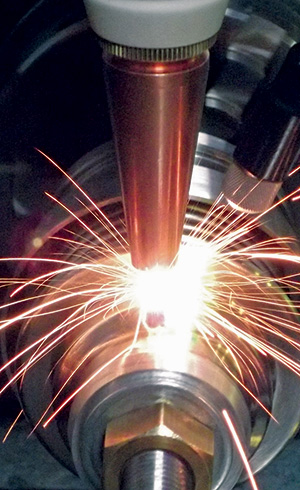 Metallography (cross-sections) and X-ray radiography were used to document the relationship between laser (spot size, laser power, etc.) and processing (shield gas type, gas flow rates, method of gas delivery, welding speed, focus position, etc.) parameters and the resulting weld geometry and structure. For example, the trials showed conditions that lead to weld porosity and those that give porosity-free welds.
Terry VanderWert, president, Prima Power Laserdyne, stated, “Compared to CO2 lasers for welding, it is well documented that the 1 µm wavelength of the fiber laser provides benefits in terms of simplified beam delivery using fiber optic cables instead of turning mirrors; greater absorption by metals, especially those which are good conductors of electricity such as aluminium and copper; and less absorption by the plasma plume that is formed above the weld pool. The higher brightness of the fiber laser compared to high power Nd:YAG lasers means that the laser beam, if desirable, can be focused to smaller sizes which, in turn, leads to increased power density. These factors contribute to deeper penetration and faster welding speed than available from previous sources of equivalent average power. They also mean more stable welding processes in a wider range of metals and alloys.”
The most comprehensive investigation has recently centered on laser welding aerospace alloys. (Photo Three) The major challenge for these materials is the stringent joint requirements. There is no tolerance for cracking or porosity in the weld. The weld geometry must be correct with good mechanical properties at high temperatures. Testing by Prima Power Laserdyne has proven that both CW and QCW fiber lasers are capable of welding these alloys.
However, the challenge lies in developing and consistently delivering laser and processing parameters which will produce quality welds. Laserdyne has developed the laser and processing parameters to weld the full range of aerospace alloys. Studies conducted by the company prove that no single parameter controls weld quality, whereas, it is a combination of both laser and processing parameters that have a significant effect on the weld quality. These studies also show that crack and porosity-free welds can be readily produced in a range of nickel and titanium based alloys.
CW, QCW fiber lasers equipped with wire feed
Welding trials included those with addition of filler wire. Certain alloys and dissimilar material combinations require the addition of filler material to control the structure of the weld metal and avoid cracking to ensure the required mechanical properties. In other cases, filler metal is used to control the weld geometry, such as to create a slight convexity (reinforcement) of the weld fusion zone. Filler material is also used to compensate for poor fit up and mismatch during laser welding in a butt joint configuration. Laser welding with the filler wire is a multi-parameter process and there are a number of laser and filler wire parameters which determine the quality of the resultant weld. Laserdyne has developed and optimised all of the important parameters for adding filler material to produce quality welds.
One significant development is a new focusing lens assembly with cross-jet design that maintains the compact profile of the LASERDYNE third generation BeamDirector, called BD3Y. The cross-jet feature provides a high velocity gas barrier that prevents metal sparks in the weld zone from contaminating the protective lens cover slide. Critical to this design is that the cross-jet prevents contamination or interference with the welding shield gas. Also important, Laserdyne’s cross-jet nozzle can be used with the entire range of shield gas delivery devices including welding shoe and coaxial gas nozzle tip. (Photo Four)
The shielding gas shoe provides a controlled atmosphere for the weld zone while it is molten and cooling to a temperature level that won’t be compromised by the ambient atmosphere. This is important when welding materials, such as titanium alloys, that have a strong affinity for oxygen and nitrogen in the ambient atmosphere. Another important benefit of the focusing lens/shield gas assembly design for laser welding is that they are quickly changeable in order to vary the focused spot size.
Air Max 90 Ultra BR