
 Access
 Login/Register
 Supplier Login












THE WORLD’s population is growing at 80 million a year and is expected to reach nine billion by 2050. The growth in population could mean less space to farm. From water draws to pollution, and energy use, agriculture is taking its toll on the planet. Agriculture, ironically, produces a third of the world’s greenhouse gas emissions. BASF Crop Protection estimates the amount of arable land available to shrink by almost 20 percent between 2005 and 2030.
The challenge of ensuring adequate, nutrient-rich food for an expanding global population is a daunting one, especially given constraints on key resources like water and agricultural land. As it stands, the two leading approaches to enriching and enlarging the world’s food supply are genetic engineering and industrial processing with additives and chemicals.
More people around the world are now looking into the prospect of urban farming which offers to make food as “local” as possible.
Traditional farming goes hi-tech
Vertical farms About a decade ago, four Dutch engineers – three of whom were also horticultural experts – initiated the “plant paradise” project to learn how high-value herbs, vegetables, and berries (not grains or tree fruits) grow best. They studied how much light green beans need to thrive; which wavelengths produce the most delicious tomatoes; what temperatures cause basil to flourish; and which combination of nutrients creates the healthiest cauliflower. Through persistent experimentation, they began developing recipes for each kind of plant, along with a blueprint for “plant production units” (PPUs) that can provide these ideal growing conditions wherever they are installed.
PlanLab envisions vertical plant production units (PPUs) to yield high-quality crops using only few resources
The potential of this project as a scalable business was enticing, spurring the four researchers to found PlantLab in 2010. In 2014, PlantLab began the construction of its $22-million, 18,600 square meter headquarters, including multiple PPUs and research units, inside the shell of a retail food-distribution warehouse 60 miles south of Amsterdam. PlantLab’s vision is based on the fact that a PPU the size of a city block and just a few stories high could produce the same volume of high-quality crops as a large farm, while consuming fewer resources. The only water that leaves a PPU does so in fruits and vegetables; there is no evaporation into the air, no runoff into the ground, and any pesticide or weed. As a result, the PPUs consume only about 10 percent as much water as traditional farms.

Suzanne Sweerman, Executive Director of the Netherlands Foreign Investment Agency
“By growing what we need near where we live, we decrease the “food miles” associated with long-distance transportation. We also get the freshest produce money can buy,” says Suzanne Sweerman, Executive Director of the Netherlands Foreign Investment Agency*.
Floating farms
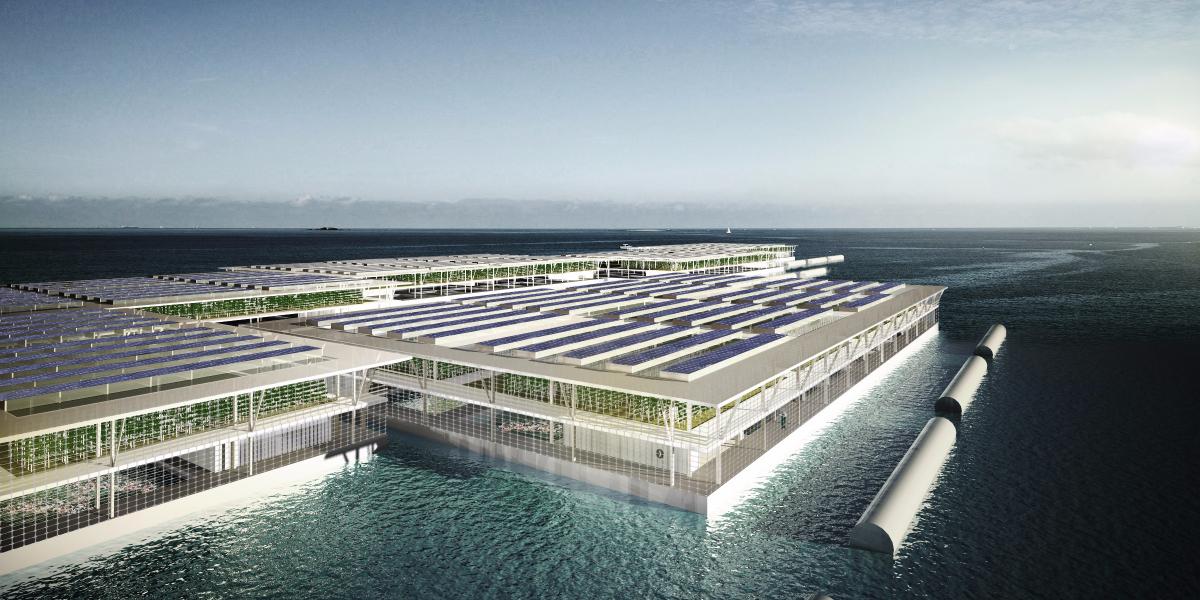
Forward Thinking Architecture, an ambitious Spanish design firm has released a proposal for the construction of a 2.2 million square foot, solar-powered offshore floating farm. Stretching eco-friendly concepts to the limit, the idea of the smart floating farm will comprise large triple-decker agriculture barges that feature fish farms down below, hydroponic gardens up top and solar panels on the roof to keep things running. They do not exist yet, but they’re certainly providing plenty of food for thought.
The Barcelona-based design company’s Smart Floating Farms (SFF) concept is a sustainable, solar-powered vertical farm that floats on pontoons, making it possible to grow food off a coast, in the open sea or just about any large body of water. The designers estimate that SFF can produce an estimated 8,152 tonnes of vegetables and 1,703 tonnes of fish annually. The farm comprises three levels and features innovative agricultural technologies that are already in use around the globe. It can be modified or stacked in different ways to suit the needs of respective locations. The top level incorporates rainwater collectors for irrigation needs, photovoltaic panels for electricity and skylight openings to provide natural light for plants. It’s also possible to integrate other renewable power technologies such as micro wind turbines or wave energy converter system.
The second level features a greenhouse and hydroponic systems (which allows crops to grow year round in any weather and without soil). The ground level is designated for offshore aquaculture. According to the designers, this cage fishing method takes place in the open sea and eliminates the exposure to wind and waves. This level also includes a hatchery where fish eggs can be incubated and hatched, a nursery for growing fish, a slaughterhouse and a storage room to hold the fish before they are ready for the market.
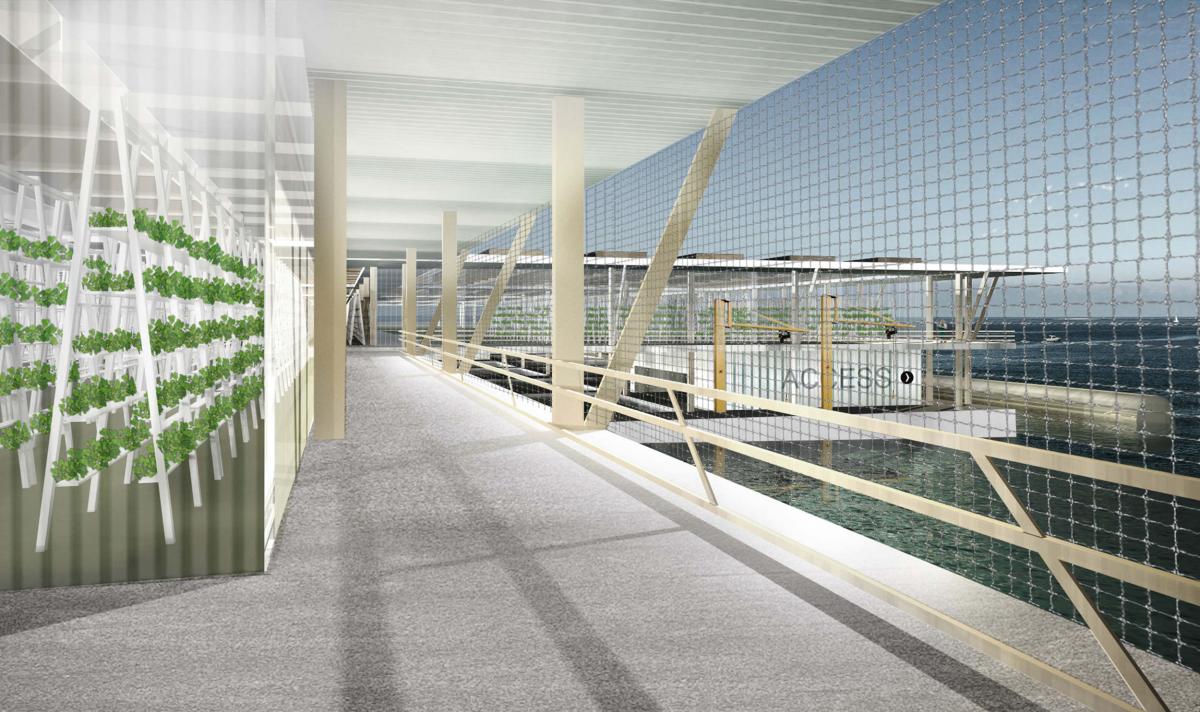
The Smart Floating Farm conceptualized by Forward Thinking Architecture combines three agricultural barges – the lowest to house fish farms, the middle for hydroponic gardens, and the top for solar panels for running the entire farm (Photo: Forward Thinking Architecture)
Floating dairy farm
“Innovative projects such as farms and landscapes on the water or food production as part of urban life in the Netherlands, lending new elements to the country's decades of years of endeavor at sustainable development,” Ms Sweerman shares.
Among the exciting innovations originating in and around Rotterdam are technologically advanced farms, floating on the water. In mid-December, a floating dairy platform began construction in Rotterdam. The pilot project will be secured to the northern banks of Mass in the old port of Merwenhaven, an area being gradually transformed into a site of innovative business in the fields of clean tech, medical and food.
The Floating Farm is all about designing a highly sustainable farm, based on a technological concept that is new to the agro-food industry. It takes into consideration a combination of factors such as the need for animal fodder (biomass), land usage, water needs and the processing of animal waste such as urine and manure. The Floating Farm is also designed to reduce the logistical chain, allowing more production and distribution to be closer to the end consumers.
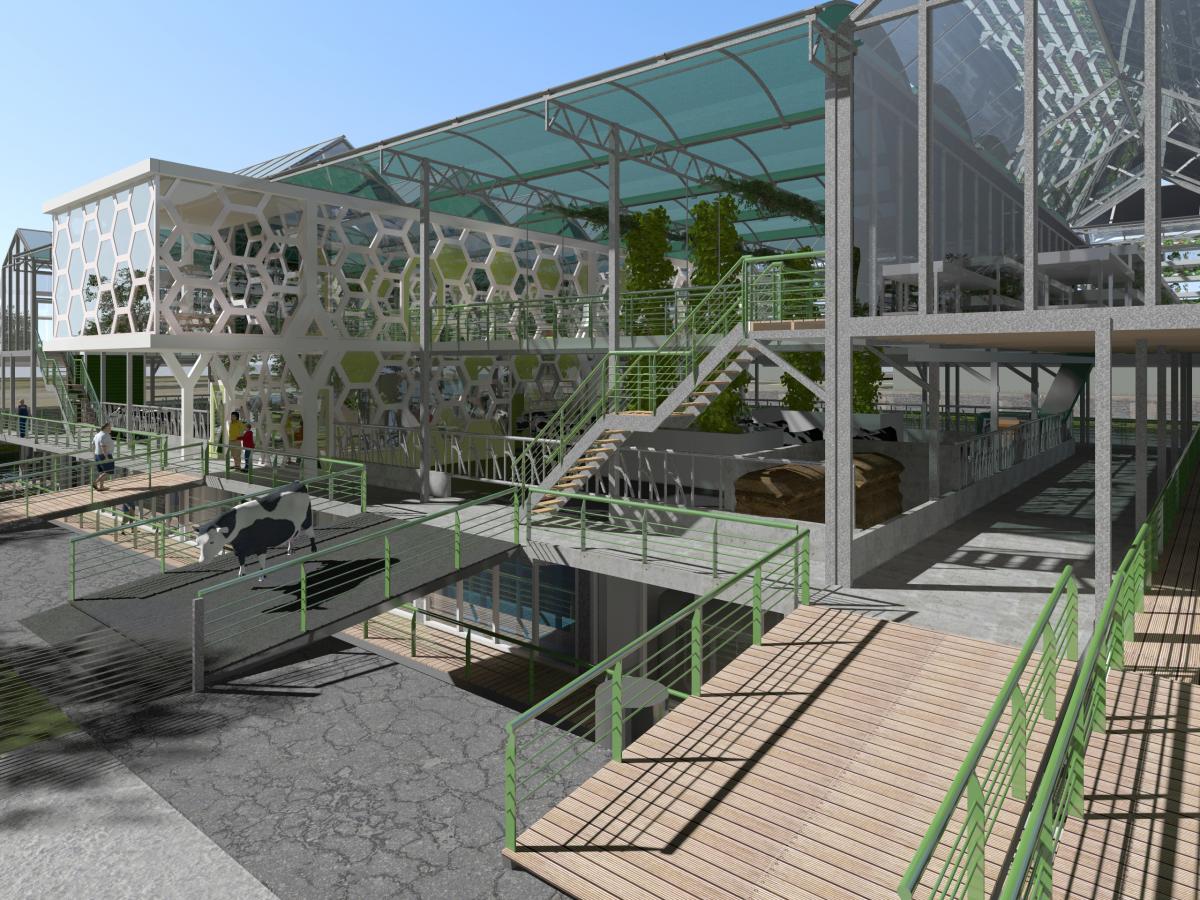
Peter van Wingerden, CEO and partner at Beladon, one of the brains behind the project, calls it a high-tech lab that is completely sustainable. “The world population is growing, whilst the number of arable land is decreasing. The big question is how and where we can produce healthy food. We can do it on the water, eliminating the journey from farm to store completely as most large cities are built near water.”
The platform will have an artificial, permeable, soft floor for the cows to walk on. With an allocation of 15 square meters per cow, they will have plenty of space to move around. The floor will be specially designed to separate urine and manure. By separating these waste materials, the animals are treated better. At the same time, this helps to overcome the massive production of ammonia in the stable.
The urine is collected in the distillation unit where the nutrients are extracted. The dry manure is picked out by a manure robot, distilled and then partly transformed into burning blocks to create energy and heat for the processes on board, and partly into plant feed. The plant feed is then distributed around the city.
Together with partners such as the University of Wageningen and Philips, Beladon is working on light recipes and seed selections to produce biomass in the dark with a fraction of the ground needed for this type of production.
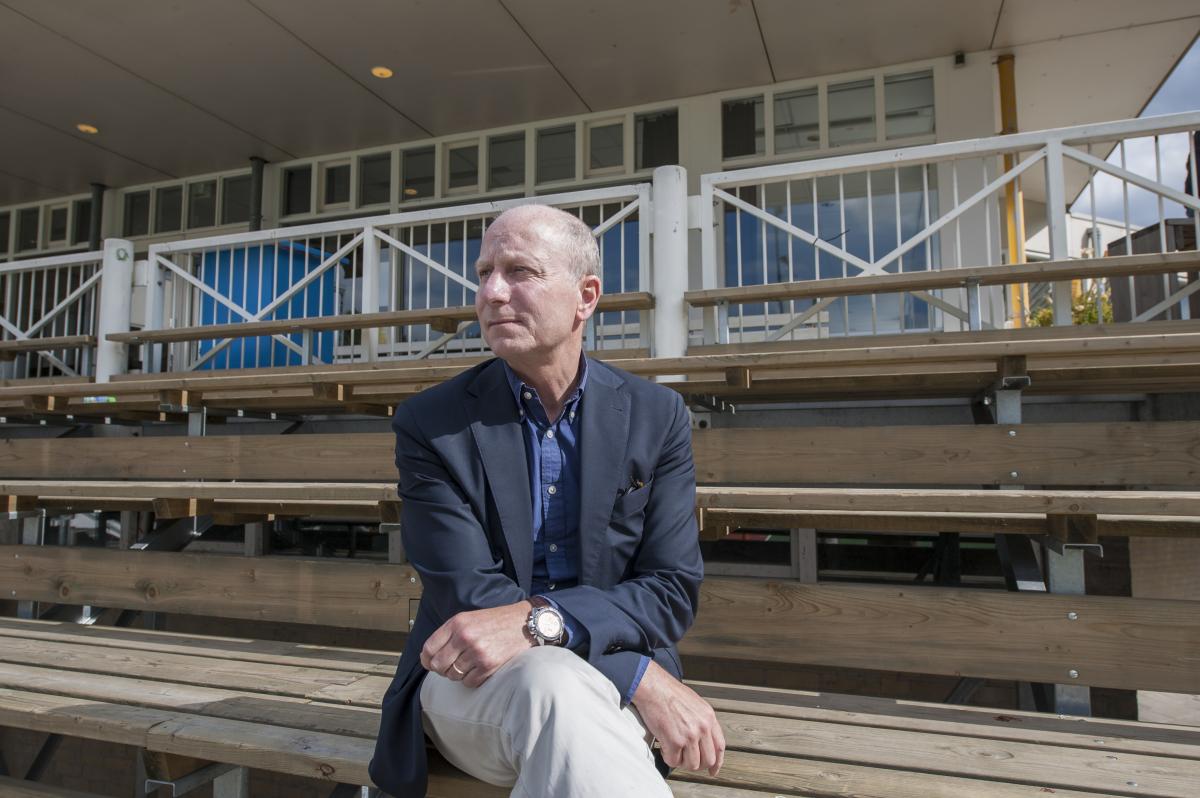
Peter van Wingerden, CEO and partner at Beladon
Mr van Winderden adds, “We work closely with companies in the Rotterdam Innovation District to create more sustainable solutions, so that we are less reliant on increasingly scarce farmland.”
If completed as scheduled in July 2016, this pilot platform is expected to house 60 cows and produce fresh products all-year round, including raw and pasteurized milk, yoghurt, cream, butter and cheese at a later stage. Researchers will work on the platform on better food production process, waste and water treatment. Prices of products from this floating platform will be 10 to 15 percent higher than those in the supermarkets but Mr van Wingerden is confident that his model will run on profits immediately and depreciate investment in 10 years.
Realizing the first Floating Farm in Rotterdam, the agro-food delta of Europe, was the logical choice because of its positive business and knowledge climate, and it is the perfect location on sea and the major rivers. In 2016, the Floating Farm will be present itself as a showcase for Dutch innovation at the World Dairy Summit, which will be held in the city.
A greener future
An obvious benefit of urban farming is that it can add greenery to cities, reduce harmful runoff, increase shading, and counter the unpleasant heat island effect. Garden plots can help people reconnect with the earth, and gain a greater appreciation for where our food comes from.
The floating concept can be implemented anywhere in the world, as long as there’s water. The good news is that this cutting-edge smart floating farm technology is scalable and replicable, which means that as the world’s food needs grow, so too can production levels.
*The NFIA, as an operational unit of the Dutch Ministry of Economic Affairs, provides complimentary advice and consultation to foreign companies planning to establish, expand and diversify their business operations in the Netherlands and Europe.
For more information on the Dutch agrofood industry or investment opportunities in the Netherlands, contact the Netherlands Foreign Investment Agency: Ms Suzanne Sweerman, Executive Director, South East Asia, at tel: +65 6739 1135, email: sweerman@nfia-singapore.com / Ms Adeline Tan, Senior Project Manager at tel: +65 6739 1137, email: tan@nfia-singapore.com or visit www.investinholland.com
Nike Magista Obra FG