
 Access
 Login/Register
 Supplier Login












FOOD scandals happening around the world have made consumers more aware of the potential for food production to go wrong. These days, consumers will not think twice to question the motives and integrity of even the largest manufacturers. With a growing move towards health and fitness, people are more involved and analytical of what they are eating and not afraid to scrutinize the labelling of the products which they are purchasing. If the quality of a food product or drink falls below an acceptable level, or its ingredients deviate from the specified content, consumers will hold the brand owner responsible. With social media playing an increasingly powerful role within all our communities, consumers also have the means to communicate any failings immediately to a waiting and responsive audience. As a result, the consumer can now initiate and drive major change within the food industry, insist on transparency in the supply chain and even cause manufacturers to go out of business.
Safety throughout the supply chain
Food and beverage manufacturers are highly aware of the level of damage that can be caused by any product safety scandal that results in the breakdown of consumer trust in their brands. Most now work more closely than ever with all stakeholders in their own particular supply chains to ensure quality, traceability and the achievement of the appropriate standards. This collaboration covers every aspect, from the sourcing of raw materials and basic ingredients, through the whole manufacturing process, to the filling and packaging of products and the eventual distribution and transporting of the finished product to the consumer. This is because all stakeholders at every level have a shared responsibility to ensure complete food safety.
The importance of traceability practices
Within the beverage industry, traceability practices are equally vital. Drinks companies must be able to understand everything that occurs on their production lines. They should be able to trace any batch of drinks from the raw ingredients stage throughout the whole production process through distribution and storage. In the event of any incident of contamination, only real traceability provides access to critical plant information, either in real time or after the occurrence. These days, of course, there are tracking solutions readily available that can be implemented on any beverage production line. The data acquired by these systems dedicated to monitoring line status and events, improves production traceability and can even be used to improve line efficiency.

Sidel’s Product Package Interaction laboratory
The role of PET packaging
When in direct contact with its contents, packaging needs to meet the highest standards of safety, hygiene and legislative requirements in order to maintain product quality and safety. Whether the beverage is packaged in can, glass, carton or PET, every component of the production line that comes into contact with the contents to be consumed has to be carefully designed to meet these high standards. This also applies to the packaging itself for which the choices of material and barriers are equally important and usually determined by the required shelf life and consumer expectations of the finished drink. As a material of choice for primary packaging for drinks, PET has been successfully in use for over 30 years with no reported adverse effects. This is because it is a biologically inert plastic, for which the constituent materials are well defined, needing no additives for enhanced performance and for which the manufacturing process is equally standardised. It has been thoroughly reviewed as a primary packaging material and fully approved by international safety agencies such as the US Food & Drug Administration (FDA), Health Canada and the European Food Safety Authority (EFSA).
Suppliers of PET resin are required to produce two different certificates demonstrating approval of use for their material in direct contact with food: the Material Safety Data Sheet (MSDS) which provides information regarding the actual plastic resin, its constituent parts and its compliance with food regulations; and the Technical Data Sheet (TDS) related to the performance characteristics of the plastic. The regulations covering the use of recycled PET (RPET) are somewhat different. Unlike the virgin material, a list of possible recycling processes is published by EFSA. Yet no list of approved RPET material exists, neither does a list of approved RPET material suppliers.
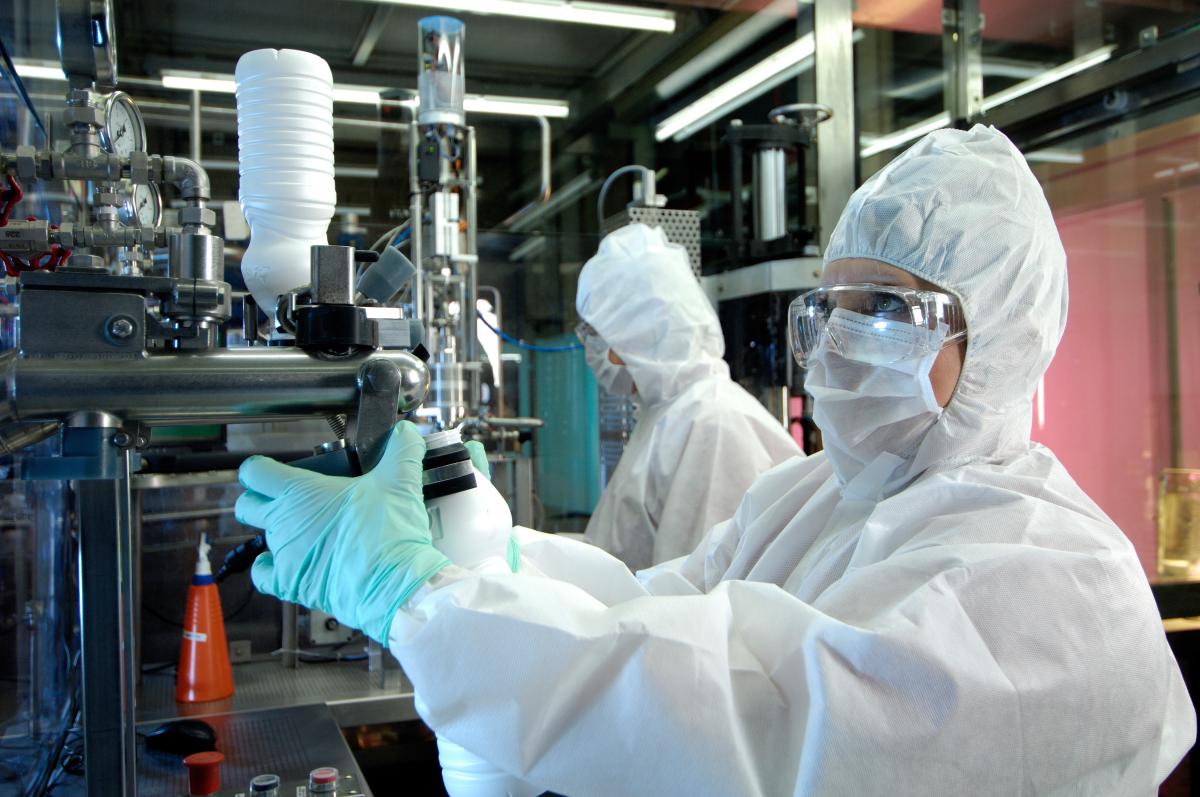
PET bottle is being examined and tested at Sidel’s Product Package Interaction (PPI) laboratory
PET protects the sensitive
Used to protect “sensitive” beverages such as beer, juice and milk products from light and oxygen, ‘barrier’ PET can extend the shelf life of products and improve their look and taste. Regulations and legislation regarding the different barrier solutions vary between solutions and from country to country. In Europe, all the constituent parts of the different layers have to be food-approved materials – even if they are isolated between other layers – whereas in America, the FDA has granted a ‘Non-Object’ for multi-layer PET technologies which offer a functional barrier. This requires an inner layer of virgin PET material of a minimum 0.025 mm thickness to separate the outer ‘barrier’ material from direct contact with the contents. Barrier technologies such as additives or blends, directly incorporated into the composition of the basic PET material, as well as employed as a coating, have the potential to affect the composition of the PET resin and may cause some degradation of the beverage. That is the reason many leading figures within the industry, particularly in Europe, are required to have all components individually approved for direct contact with food.
Blow-molding and lightweighting
EFSA and the FDA correctly identify that the potential threat to food safety linked to today’s packaging material mainly arises from the possible degradation of the material during transformation. This could lead to the creation of ‘by-products’, however there are no by-products that impact food safety during preform injection processing. They are instead, colorless gases at normal room temperature that may migrate to bottled water causing a harmless but mildly unpleasant taste.
The blow molding process itself within the production and filling of the PET bottles has no impact on the features of the packaging material. It is a neutral process involving a preform in which the plastic material has already been transformed. The oven temperature that heats the preform is below the fusion temperature and does not cause any risk in terms of degradation of the resin. The actual blow molding process stretches the material, changing its state from amorphous PET to semi-crystalline. The finished bottle has superior strength and greater barrier properties as a result.
The current drive towards ever more lightweighting of bottles does not have an effect on the properties of PET regarding food safety. Although the thinner bottle walls do have a decreasing effect on the performance of the PET barrier, it requires accurate testing of material permeability to ensure the required shelf life of the beverage is achieved – and to ensure that migration of external components into the product does not take place and cause contamination. All manufacturers also need to be aware of other potential risks such as the migration of inks required for bottle marking or glues from the bottle labelling process through the thinner PET walls.
Hygienic design is essential
Mostly, the general principle of hygiene within machinery is related to the materials used to construct that machinery. The surface finish, the construction and fabrication details, the installation, operation and maintenance are all crucial elements and must be considered from the outset for the entire operating life of the equipment. Surfaces that come into contact with any food or drink product at any point in the production process must be made from materials that are smooth, non-toxic, non-absorbent, corrosion-resistant and easily cleanable under normal operating conditions. As much as is possible, interior surfaces of the equipment should be devoid of joints, sharp angles, pitched to a drainable port and self-draining.
Maintaining food safety
Even when bottling lines have been developed, manufactured, installed and commissioned, correct and regular maintenance is essential in maintaining safe and profitable production. Leading manufacturers will, of course, provide a thorough after-sales service of routine maintenance. Most will pass on maintenance manuals and advice on procedures for the operating personnel. As food standards continue to change and evolve, the collaboration between equipment supplier and operator is vital in ensuring safe and reliable production that meets the requirements of international standards. Operators will naturally be supplied with HACCP (Hazard Analysis and Critical Control Points) plans along with suggestions on laboratory and quality analysis.
Having learned from each customer, each installation and years of experience, leading equipment suppliers are eager to communicate all recommendations concerning the food safety of their equipment. Achieving Good Manufacturing Practices (GMP) is not about meeting legislative requirements, but relaying simple recommended ideas that can help operators to maintain complete beverage safety and quality throughout the entire production life of the machinery. In that way, suppliers will know that they have done everything they can to contribute to the safety of the world’s food and beverages.
*Sid Johari is executive vice president for Industrial Operations at Sidel.
Air Jordan XI 11 Low