
 Access
 Login/Register
 Supplier Login












VÖSLAUER Mineralwasser AG holds 40% of Austria’s natural mineral water market. In 2013, it sold over 300 million litres worth €100 million. About 70% of the volume is for “sparkling”, “mild” and “still” variants. Last year, too, the company did a complete change-over from paper to plastic labels. Within a year, it replaced its labellers in four PET lines with the Contiroll HS wrap-around labellers.

Vöslauer within one year replaced its existing labellers in all four PET lines by the new Contiroll HS wrap-around labellers.
Non-returnable PET predominant
Vöslauer fills way over 80% of its beverage production output in non-returnable PET containers, with the returnable glass bottle now being used only in the catering trade. Back in 2006, Vöslauer – together with four other major beverage producers – set up a company called “PET to PET Recycling Österreich”, which operates a recycling plant in Müllendorf. The Yellow Bin and the Yellow Sack mean that Austria possesses a very efficient closed-cycle system for recycling PET containers: eight out of 10 PET bottles end up in the separate collection scheme, and are thus recycled. For its own bottles, Vöslauer has a recycling quota of 52%; its “Balance” variety, the 0.75-litre bottles of which are homogeneously taken back in Vöslauer’s two-way system, the recycling quota is 100%. To make sure that what used to be a Balance bottle is also recycled to be a Balance bottle once more, both the preform manufacturer Alpla and the recycling plant work in batch mode. By 2015, the target is a recyclate proportion of 66% of total PET consumption.
Contiroll HS
Vöslauer operates a glass bottling line for catering-trade bottles and merchandise rated at 30,000 bottles an hour, and a total of four PET lines, three of which are rated at 30,000 containers an hour each, plus one 24,000-bph line for returnable bottles in crates. The layout for all five lines was planned by the firm’s own engineering department headed by technical director, Walter Goisser. “We drew up ourselves in-house the concepts for everything that’s been done since 1996 in response to the change-over to PET triggered by adoption of the 1.5L PET container,” he said. Vöslauer’s engineering team likewise checked the decision to go for plastic labels instead of paper ones for the PET containers and considered how this could be implemented to optimum effect.
It was precisely at this juncture that Krones launched the new Contiroll ED-PG station (Ergonomic Design, Pre-Glued) for wrap-around labelling. Besides its ergonomically enhanced design, simpler construction and improved accessibility, this newly developed assembly also scores highly in that it handles pre-glued labels.
Vöslauer placed an order for four new Contiroll HS: one each for its four PET lines.
The first two of these were installed in 2013, to be followed by the third and fourth in 2014.
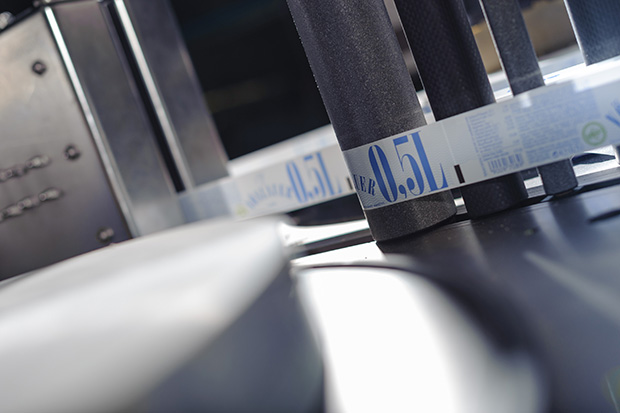
The new Contiroll ED-PG station for wrap-around labelling is also suitable for handling pre-glued labels
Two station variants
The new generation of the Contiroll HS offers two station variants: the Contiroll ED station for hotmelt labels and the Contiroll ED-PG station for pre-glued labels. The latter can be expanded to include a hotmelt unit, so that it can be used for normal hotmelt labels as well. To prevent any dirt nests from forming, the Contiroll ED station has a station base plate, and the cable routing has been covered up to reduce cleaning times. The servo-controlled drives have been revamped: the cutting position, for example, can be adjusted using a separate servo-drive for the counter-cutting roller. Furthermore, both the two film carrier webs and the tracking control unit have been given a central height-adjustment function with counter, which halves the time required for this make-ready routine. The automatic film-reel-splicing unit is a new feature that lessens the amount of label required to be protruding for the splicing function. The insulated gluing unit, with its uniform roller temperature, ensures lower glue consumption and eliminates almost glue vapours and precludes the risk of burns, whilst reducing energy consumption. Another feature is the separate glue bowl with glue pump. Additionally, the station’s angle of tilt can likewise be adjusted during production, so as to compensate for an overlap offset. For the daily work routine, this means simpler and faster overlap correction. When pre-coated labels are processed in the Contiroll ED-PG station, a reversing roller is used to remove the label from the label web reel holder, with those parts coming into contact with the labels having an anti-stick coating. The label is cut on the counter-cutting roller, with the glue strip facing outwards, and passed to the vacuum cylinder by means of an additional transfer roller. It is transferred to the container in the same way as in the Contiroll’s standard application. And the best thing about it is this: with the station version for pre-glued labels, users are not locking themselves into a particular system. It’s possible to handle conventional labels without any problems, by fitting an additional hotmelt unit. Vöslauer is doing this at the moment: “The price-performance ratio of the pre-glued labels offered on the market is not right yet, said Mr Goisser. “For the quantities we were using for test purposes, the pre-glued labels were still about a third more expensive than normal ones.” He added, “We could do without glue in the plant entirely, thus avoiding any glue soiling at the machines and sticky blades, which should ideally extend the cutting blades’ useful lifetime. What’s important for us at the present juncture is keeping our options open, so that we can use pre-glued labels in the future. We shall certainly be starting our tests pretty soon. Our new stations in the latest state of the art available on the market now provide us with the future-friendly flexibility we were aiming at. That’s important.”
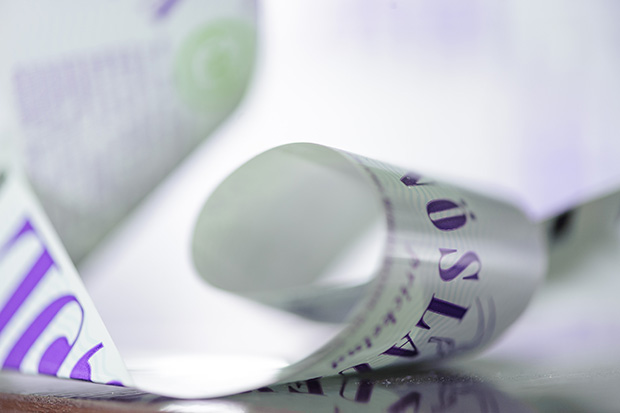 The OPP film, which is only 37 micrometres thick as compared to paper labels weighing 80 grams per square metre, means material consumption has roughly been halved
Glue consumption reduced
Just installing the new Contiroll HS generation has in itself provided the company with enough advantages. Change-overs with the automatic splicing function, and the use of reel-fed labels, mean that a manual intervention is required about twice an hour only. The wet end needs just one employee, as compared to the two previously. Operating costs, too, are lower. Changing over from paper labels to plastic ones has reduced glue consumption by up to two-thirds. For the quantities we’re buying, just the costs for the plastic labels themselves are already lower than those of paper labels. This is hardly surprising, since the OPP film, which is a mere 37 micrometres thick as compared to paper labels weighing 80gsm, means our material consumption has roughly been halved.” What’s more, the film is easier to separate and use than paper.
“The film is simply cut off the recycler and used again in its entirety. Paper labels, by contrast, are washed off, they get frayed, they decompose and at some point in time they end up in the wastewater”, said Mr Goisser. Plastic labels on PET containers also upgrade the bottles’ visual appearance: when PET containers expand, the paper label is inevitably stretched, rendering the glue strip visible. Plastic labels, by contrast, expand to the same degree as the bottle itself.
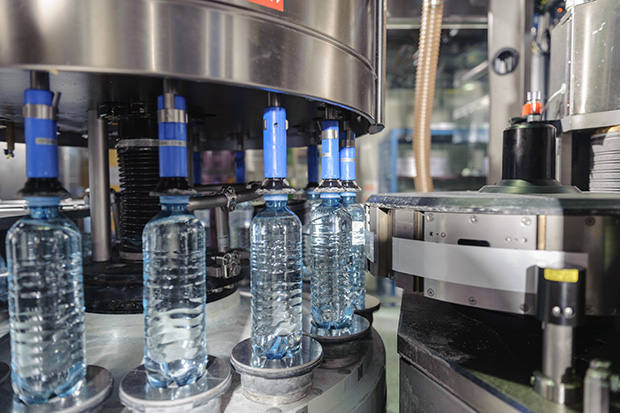
Changing over from paper labels to plastic ones has reduced glue consumption by up to two thirds
Leading edge of innovation
Vöslauer’s overall approach is highly customer-focused, said Mr Goisser. “We attempt to detect any incipient trends at an early juncture, and to translate them swiftly into hands-on reality.” Even though the labellers previously running at Vöslauer were only seven years old, they were replaced by the new Contiroll HS generation. “If this hadn’t been a decision of principle in favour of plastic labels, we would normally not have done that.”
At Vöslauer, it has been a long-standing tradition to invigorate the market with a series of new ideas: in 1990, the mineral water firm had their catering-trade labels designed by the artist Friedensreich Hundertwasser. And Vöslauer was also amongst trend-setters when introduced still mineral water (1998), sportscaps (1999), the Balance line of wellness drinks (2000) or an easy-turn bottle closure (2003). Occasionally, Vöslauer has to acknowledge a flop as well, like the city bag premiered in 2005, the first package for mineral water in the shape of a fashionable shoulder bag, which did not appeal to consumers. “It looks as though we were well ahead of the times with that one,” said Mr Goisser. Another successful innovation, by contrast, is the Pocket Ring (2009), which turns the bottle into an easy-to-carry accessory, or the 4x1-litre pack as a storage variant (2012). – OLIVER STEINER, Krones AG
Shop Women's Boots