
 Access
 Login/Register
 Supplier Login












A recent announcement of South Korea's LG Display Co Ltd that it will invest 1.05 trillion won (or about $908 million) to construct a local plastic organic light-emitting diode (OLED) display production facility gives a glimpse of the future of televisions (TVs). The plant is expected to be completed by the second quarter of 2017 and aims to double the capacity of LG Display’s existing production facility. Such investment responds to the growing demand for plastic OLED screens for such applications as smartphones, smartwatches and TVs.
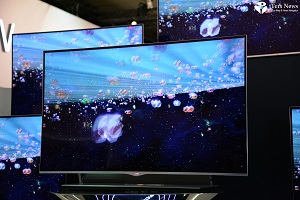
OLEDs are made by placing thin films of organic or carbon-based materials between two conductors. When electrical current is applied, a bright light is emitted. Unlike LCDs, OLED materials can emit light without the need for a backlight. OLED TV panels have certain advantages over LCDs since OLED TVs have better colour and have faster refresh light. OLED TVs are also thinner and lighter than LCD TVs as they are 4 mm thick and new models are getting thinner and more flexible that they can be folded. OLEDs TVs also consume less electricity and are greener since they don’t contain toxic metals.
Flexible OLEDs on plastic substrate are getting to be popular options for electronic goods as well as for other applications, such as in automotive and construction/interior design.
Rising capacity
Another company that has scaled up its facility for next generation TVs is DuPont. DuPont Displays announced the opening of a state-of-the-art, scale-up manufacturing facility designed to deliver production scale quantities of advanced materials that enable large-format, solution-based printed OLED displays. These materials are designed to help manufacturers develop OLED displays that are brighter, more vivid, longer lasting and significantly less expensive than the OLED TVs on the market today. The facility is located at the DuPont Stine-Haskell Research Center (Stine-Haskell) in Newark, Del., near DuPont’s global headquarters in Wilmington.
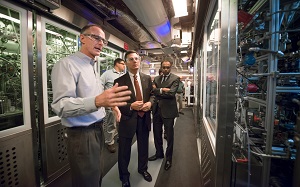
Mr. Jim Collins, executive vice president, DuPont, tours the new OLED materials scale-up facility with Mr. Avi Avula, global business director, DuPont Displays.
DuPont’s new OLED materials scale-up facility at Stine-Haskell is designed to deliver production scale quantities of advanced materials that enable large-format, solution-based printed OLED displays.
“Materials are critical to the performance of an OLED TV and we are confident that DuPont has the best performing solution OLED materials available in the market today,” said Avi Avula, global business director, DuPont Displays. “Our vision is that OLEDs will become the display standard and to make that vision a reality, we are focused on helping our customers bring the cost of large sized OLED TVs down to less than $1000 by 2020.”
DuPont’s new scale-up facility is designed to meet the future growth expectations of the OLED TV industry, which analysts predict will increase by over 70% for the next several years and will require large quantities of highly sophisticated OLED materials. DuPont has been developing its suite of advanced OLED materials for the last 15 years. These materials are highly regarded for both solution and evaporative applications due to their long lifetime and deep colour. In addition to its recently announced collaboration with an inkjet equipment maker to advance solution printed displays, DuPont is actively engaged with the leading OLED display manufacturers to bring solution printed OLED technology to market as quickly as possible.
DuPont’s new OLED facility at Stine-Haskell has large-scale formulation systems and can support simultaneous production of multiple product lines. It was designed with a focus on employee safety, environmental responsibility and producing superior quality materials with the highest possible purity. The project was partially funded by a grant from the state of Delaware in 2012, with DuPont investing more than $20 million in the facility.
DuPont Displays brings more than 15 years of experience in enabling evaporative and solution-based OLED technologies through advanced materials that deliver the color, efficiency and lifetime performance that display manufacturers and consumers demand. DuPont offers highly engineered, next-generation OLED materials as well as solution process know-how that makes the promise of lower cost OLED technology commercially feasible for TVs and other large-format displays.