
 Access
 Login/Register
 Supplier Login












by Franck de Lorgeril, Global Marketing and Sales Manager, Industrial Products at Corning
 Market research shows that the optical component market has grown at 8-12% annually during the past 5 years[1]. The optics market is intensely competitive with increasing demand for optical components as communications markets, internet usage and digitalization of information infrastructure grows. Within this, the trend of miniaturization and high speed performance applies increasing pressure on a product’s thermal and optical properties.
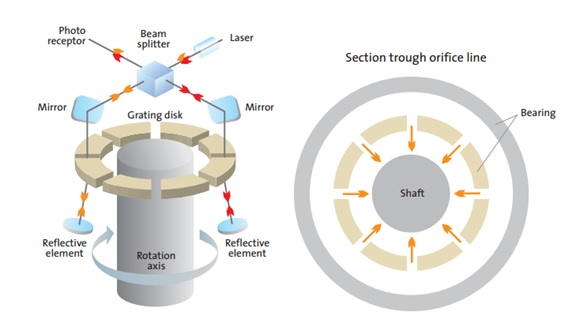
This situation influences all market segments. One interesting product, whose manufacturer found a quick solution to thermal conductivity, is a digital rotary scanner. The optics industry equips digital rotary scanners with the capability to focus laser beams to take a reflective full-scale image of drawings such as those used in the architectural industry. In order to do so a beam of light is projected over a rotary drum to copy the image. Yet the process is not as simple as it sounds and incredibly complex activities take place, deep inside the drum (or rotation axis in the diagram below) that spins.
Inside the drum or axis, there is a metal shaft with optics at one end which is used to focus the light beams. To prevent vibration, that could disturb the scanning process, the metal shaft is cushioned by an air bearing. While the rotary drum spins, the air bearing runs at high speeds and, sometimes, can generate heat over the metal shaft. This heat can be eventually transferred to the optics at the top of the shaft, affecting focus precision. In order to resolve this particular problem, MACOR® was inserted between the shaft and the optics to prevent thermal transfer.
Answer to the need
MACOR® fits perfectly to these requirements as a low density, machineable glass-ceramic material. Manufacturers of digital rotary scanners tested MACOR’s® properties. During the production process of the rotary device with the previous solution, they invested in incredibly sensitive optics that could not operate without a heat barrier. In this case, the manufacturer had to either wait for many months for another set of optics to be designed
Within weeks of utilizing MACOR®, the manufacturer solved the problem with heat transfer and secured new sales of rotary digital scanners. Another advantage over other ceramic materials is the fact that it was very easy to incorporate MACOR® into the production process. The ceramic material fulfilled the manufacturer’s needs of speed of response, machined to high accuracy, and low thermal conductivity. “The manufacturer’s problem could have taken months to resolve but MACOR® provided the solution in such a short space of time that it has enabled production to continue with minimum downtime. Not only was it the right product for a high performance ceramic material, we combined it with the right support service provided by our experienced qualified partners ”, explained Franck de Lorgeril, Global Marketing and Sales Manager, Industrial Products at Corning.More Information
MACOR® is a mica glass ceramic material with a unique combination of properties. It is easily machinable using conventional metalworking tools, with no post-firing required. A versatile ceramic material with technical strength and insulation properties exceeding high performance plastics, it is also stable in high temperatures (continuous at 800° Celsius, up to a peak of 1,000° Celsius) with zero porosity and outgassing. In addition to being tolerant, as little as 0.0005 inches, it can be machined to a surface finish of less than 20 micro-inches, and polished to a smoothness of 0.5 micro-inches AA. The ceramic material also acts as an electrical insulator that is radiation resistant and has low thermal conductivity.
Air Jordan VI Low