
 Access
 Login/Register
 Supplier Login












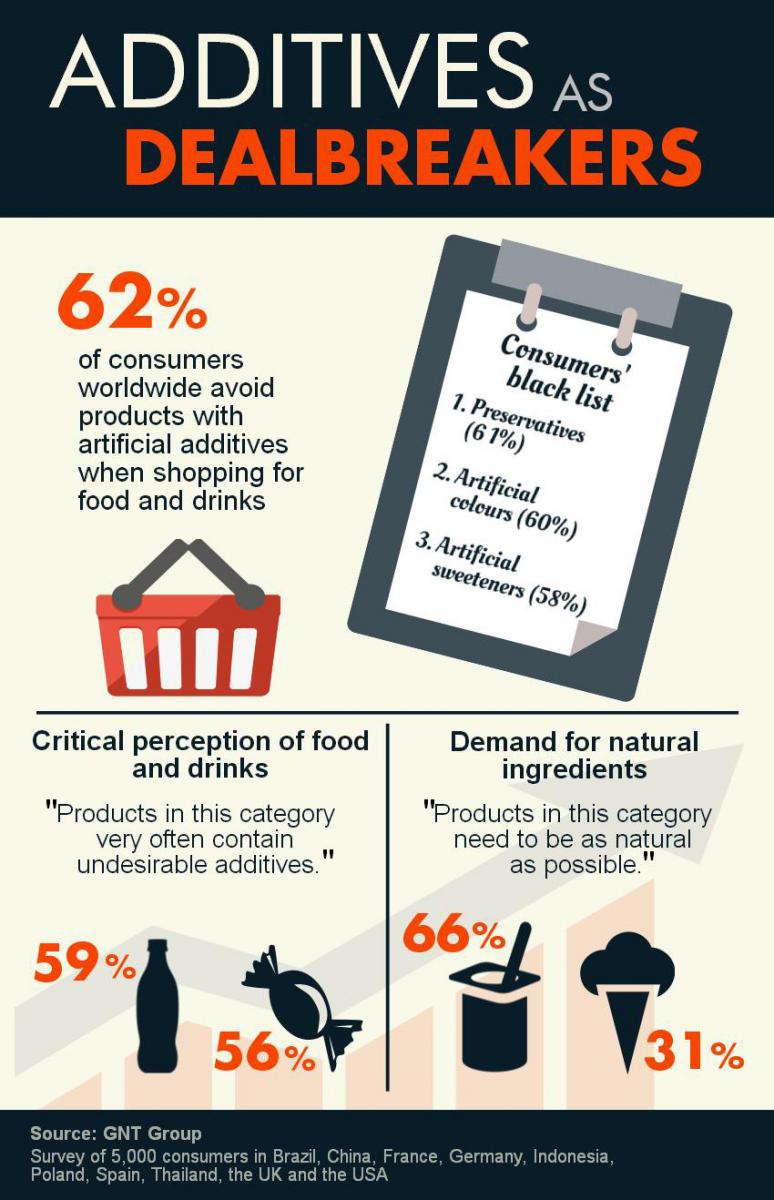
ALL OVER the world people’s priorities concerning their personal diet and nutrition in general have been changing for the past years – leading to an increasing demand for more natural foods and beverages. A global survey, conducted by market research institute TNS on behalf of GNT, leading provider of Colouring Foods, discovered that 68 percent of consumers worldwide deliberately choose the healthier product option in the supermarket, whenever available. As the results show, in China, Indonesia and Thailand this even accounts for 85 percent. However, the first impression still counts. People everywhere wish for appealingly looking products in appetizing colors. Especially when it comes to confectionery, they enjoy their sugar drops, fruity gums and the like in vibrant shades such as lime green or cherry red. According to the survey, one out of three consumers – and 44 percent of all Chinese, Indonesians and Thais – considers the color of a product to be a decisive factor when choosing a particular one from the shelf.
Survey provides deep insights into consumers’ expectations
In order to get a detailed understanding of today’s customer needs and to unveil the true scope of the ongoing trend towards more naturalness, 5,000 consumers from ten countries – from Europe, USA and Asia – were questioned about their view of naturalness, how they perceive specific ingredients – especially those with coloring properties – and how they evaluate labels and food claims. The study’s findings shed light on how all these aspects influence consumers’ purchasing decisions and price acceptance. It is important for food and beverage manufacturers to know the answers to these questions and to understand their customers’ intentions to stay in favor with them in the future.
In the course of the survey, four product categories have received special attention: soft drinks, yoghurt, ice cream – and confectionery.
Asians are very concerned about their diet
The survey identified five consumer types, which are distributed differently around the globe, and have somewhat varying priorities with regard to their diet. But there is one thing they have in common: naturalness is an important factor to all of them. In Asia, the majority of consumers (66 percent) belong to the so called Busy Health Seekers. This consumer type is very concerned about its diet and very careful about what and what not to eat. Consequently, 89 percent of them try to buy products which only contain healthy ingredients. At the same time, this keen interest in natural food has to be reconciled with a hectic lifestyle involving numerous obligations. Most of the Busy Health Seekers don’t have the time or the requisite information to engage in detail with foods and their ingredients. The second largest group (12 percent) in Asia are the Caring Parents. Their role as parents motivates them to opt for a healthy diet. Out of concern for their offspring and in order to be a good role model, they attach particular importance to healthy, natural foods and beverages.
More naturalness for delicious treats
Although most Asian consumers place high importance on a well-balanced diet, 42 percent regularly enjoy confectionery once or twice a week. Especially children like colorful sweets. Nonetheless, more than one third of the interviewed consumers states that sweets – although usually considered as unhealthy – should still be as natural as possible. Consequently, 45 percent would purchase products from this category more often if they were made from natural ingredients.
In order to get a general idea of a product’s composition and to be able to make a substantiated purchase decision, over 50 percent of the Asians thoroughly check the ingredient label before buying sweets. Since they often only have little time for shopping, they wish for clear and easy to understand ingredient information. However, when looking at a label, they do not evaluate every component of a product individually. Especially when the given information is excessive and hard to understand, they will resort to a method of elimination and scan the label for certain ingredients they personally try to avoid. For example: while it is mostly assumed that colors in confectionery are artificial, only one quarter of the surveyed people does not see this as a problem. In fact, more than half of the Asians clearly prefer products with natural colors, if available. According to the study, 52 percent of Asian consumers expect coloring ingredients declared as “natural colors” to completely originate from edible foods like fruit and vegetables. In general, preservatives, artificial colors and artificial additives altogether are on top of the black list for them. About 80 percent will specifically exclude products with such ingredients from their diet.
New chances for food and beverage producers
Against the background of the survey’s results it becomes clear that times are over when people purchased and consumed food products without due regard to what they contain and how they are produced. It is obvious that there is a major global interest in healthy and natural food and ingredients. These current consumer demands present food and beverage manufacturers with new challenges, but also with opportunities. They have to provide their customers with products whose ingredients are not only natural but known and familiar to a wide public. At the same time, manufacturers have to make sure that their products look interesting and appealing enough to raise interest and find their way into customers’ shopping trolleys.
Since they offer crucial advantages, Coloring Foods provide manufacturers with an ideal alternative to additive colors. They are exclusively made from fruit, vegetables and edible plants and are processed by gentle physical methods – no artificial additives, chemicals or organic solvents are applied. Thus, they are perceived as the most natural way to colour food and beverages. Since Coloring Foods are classified as ingredients, they can simply be labelled in a way that is understandable for consumers, for example, “Coloring Food (concentrate of grapes, elderberries)”. They can also be used in products suitable for vegetarians and fulfil halal and kosher requirements. Using Coloring Foods holds important benefits for the manufacturers: The concentrates provide stable, intense and vibrant colors to any application whilst meeting consumer expectations towards clear-label food and beverages to the fullest extent.

All shades of the rainbow for customers all around the world
With more than 400 hues, GNT’s coloring concentrates, marketed worldwide under the brand name EXBERRY®, represent the largest portfolio of Coloring Foods on the market. The possible applications are equally wide-ranging: the concentrates are suitable, for example, for bakery and dairy products, soft drinks, alcoholic beverages, oil and fat based snacks as well as confectionery. GNT’s products are easy to handle and are available as liquid concentrates or powders.
Due to the changes in consumers’ attitudes and preferences, the demand for Coloring Foods continues to show significant growth. As pioneer and market leader in the field, GNT already supplies more than 1,200 clients in almost 70 countries – including seven of the ten biggest food and beverage manufacturers in the world. Nowadays each year 25 billion food servings are already colored with GNT’s EXBERRY® concentrates – a figure that will continue to grow. Given the latest consumer trends, we expect Coloring Foods to evolve into industry standard within the next few years.
Accesorios para el running