
 Access
 Login/Register
 Supplier Login












THE YEAR 2015 promises to be a significant time in hand hygiene across the Middle East. In December, the Arab Hygiene Council advised companies across the region on the importance of informing and educating employees on the possible health consequences of poor hand hygiene in the workplace.
In February of this year Abu Dhabi-based newspaper The National carried out swab tests[1] in its offices to analyze the cleanliness of the hands of its employees. These tests offered startling conclusions – the office was found to be rife with germs. The National swabbed a variety of surfaces, including door handles, kitchen surfaces and keyboards. The full results ought to be mandatory reading for every person who works in an office or a communal working environment as the most worrying findings included E.coli being present on everyday items such as photocopying machines, keyboards and computer mice. A tea tray used to serve beverages to staff also had a heavy growth of E. coli.
It is important to remember that these findings refer to an environment which perhaps would not usually be seen as ‘dirty’ or particularly ‘contaminated’. The likely source of such contamination is poor hand washing and hygiene among workers. Results such as these suggest a naivety and neglect to hand washing; indeed it may not be an exaggeration to refer to this as indicative of society as a whole. It is particularly worrying if this poor hand hygiene is present among those in the food industry – where any form of contamination has the potential to be seriously damaging.
A British report[2] into hand hygiene in the food industry found alarming levels of neglect among workers regarding basic hand cleanliness and is used as a benchmark for highlighting the importance of hand hygiene. The report involved 1,000 respondents in Wales, UK in 2002 from 169 different small independent catering businesses. It was discovered that at work, 39% of respondents neglected to wash their hands after visiting the restroom. An even larger figure, 53%, admitted they did not wash their hands before handling food. Barely one-third (32%) of companies considered food hygiene a priority, and only 52% understood the importance of hand washing. Some 27% did not hold a Food Hygiene certificate.
This was the largest ever survey of its kind and is certainly still relevant today as a reminder that it would be unwise to presume that all workers in the food industry are aware of the importance of hand cleanliness and observe sufficient hand hygiene.
Although this is just one report, the results pose uncomfortable questions for the food industry as a whole suggesting some of the issues related to poor hand hygiene among the general public may also be present in the food industry. How can food companies expect to properly tackle hand hygiene if some workers display such levels of neglect when it comes to the very simple and basic tenets of hand cleanliness?
One significant problem here is that a large proportion of hand hygiene in the workplace is dependent on the workers themselves ensuring they clean their hands properly, and at regular intervals. Workers must clean their hands every time it is required, not just ‘when they get a chance’ or when it may be convenient.
Most food companies cannot be accused of taking no action to tackle poor hand hygiene; it is more a case of taking an approach which is perhaps too simplistic or not adequately far-reaching. Such measures may include installing hand-washing stations on entry points to sensitive areas and on exits from restrooms and communal break areas.
However, measures such as these require the workers to actually use the wash stations – they are powerless if employees forget to wash their hands or do not use them as regularly as is recommended. As a consequence there has been a move towards enforcing rather than merely encouraging hand hygiene in the food industry. This approach holds that employees cannot be relied on to ensure sufficient hand hygiene, and therefore full-compliance hand hygiene initiatives offer more protection against contamination.
Products focusing on hand hygiene compliance may sound aggressive, or perhaps complicated, but in fact the majority are clever, yet surprisingly simple pieces of technology that do not affect or hinder the ability of employees to carry out tasks. One example of such technology is monitoring technology which reminds workers when they are due to clean their hands and logs how frequently they do so before reporting to senior members of staff. Such technology has been adopted predominately in the health sector, but has also been trialled in the food industry. This technology can be useful in monitoring the hygiene habits of staff, but may be accused of being unable to enforce hand hygiene during the times when it is most needed, as it detects if staff overlook hand cleaning too late – when food may have already been contaminated.
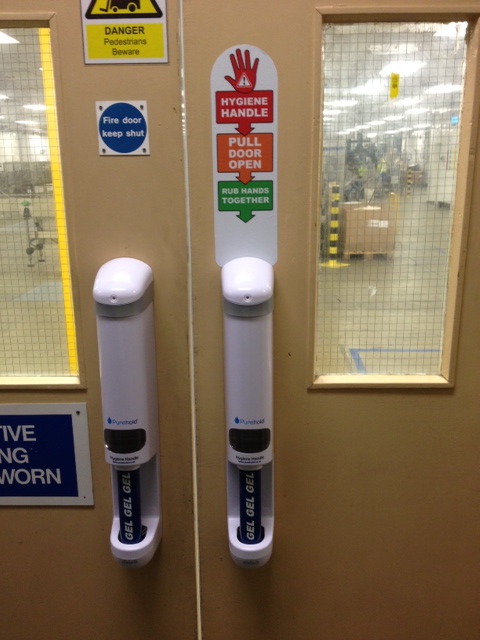
Automatically ensure that your hands are clean before you enter a facility. The Hygiene Handle from the British company Pure Hold is a door handle with sanitizing gel dispenser
Other examples of compliance products include a hygienic door handle which both sanitizes the hands of each user and self-cleans, thereby reducing surface cross-contamination, and specialist Nano self-cleaning surfaces. This latter concept, utilizing nanotechnology in hygiene, is part of an exciting development for such technology. One intelligent report utilizes a light-powered catalytic oxidation process more powerful than bleach yet which is totally harmless and kills a large number of bacteria, fungi and viruses. It is a simple adhesive surface able to be stuck on handles and food preparation areas.
The Middle East is at the forefront of this new trend towards hand hygiene compliance. A hospital in Jeddah became one of the first facilities outside of the United Kingdom to install the aforementioned hygienic door handle.
Self-cleaning surfaces have been found to have an impressive capability in preventing surface cross-contamination. The adhesive nano surface mentioned above was tested in the food sector and in healthcare. Although such technology will never, and should never, be a substitute for hand washing, the tests presented a clear proficiency for reducing the spread of pathogens from surface contact. These reductions were mostly in the 75% to 85% band, with one trial providing very encouraging results – 88% of MRSA and 100% of E.coli killed in one hour.
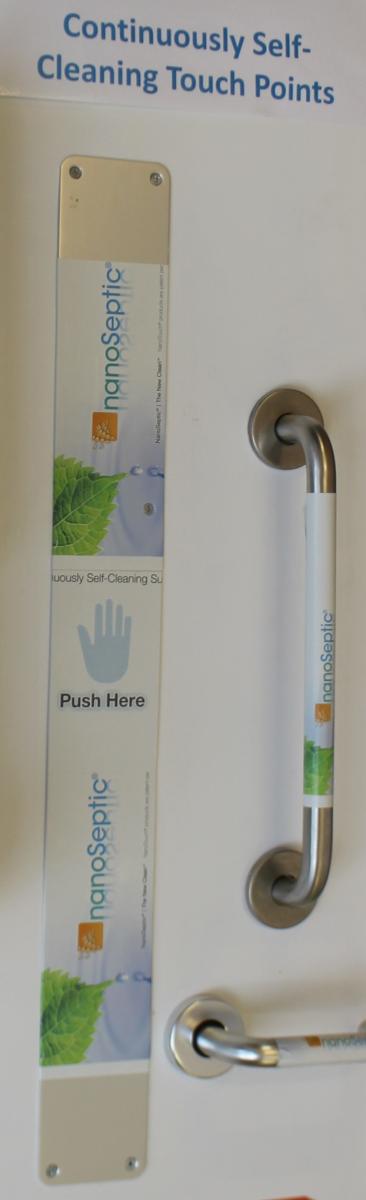
In tests, the NanoTouch® Self-Cleaning Adhesive Surface presented encouraging results, eliminating 88% of MRSA and 100% of E.coli in one hour. This adhesive from Pure Hold attaches to push plates or door handles
The most important aspect of hand hygiene in the food industry should continue to be thorough and frequent hand washing. However there is always the opportunity for more to be done to prevent lapses in hand hygiene resulting in contamination and outbreaks of preventable illness. Hand sanitizing as well as adopting initiatives such as those outlined in this article are an effective addition to hand washing but they should be seen as exactly that – an additional, albeit very important, aspect of hand cleanliness but never as a replacement for hand washing. Products and technology such as hygienic door handles and self-cleaning surfaces offer a variety of options for ‘supplementary’ hand hygiene, from door handles which actively clean the hands of each person passing through to surface covers reducing contamination from the source. Ensuring hand hygiene and preventing contamination requires taking pre-emptive action rather than relying on staff and hoping they are proactive in hand cleanliness. The options for ensuring hand hygiene are available; it is now up to food companies to take hold of hand cleanliness.
[1] http://www.thenational.ae/uae/health/uae-employees-must-be-taught-better-hygiene-practices
[2]http://tna.europarchive.org/20110116113217/http://www.food.gov.uk/news/newsarchive/2002/oct/handwales
Nike Phantom Vision DF FG