
 Access
 Login/Register
 Supplier Login












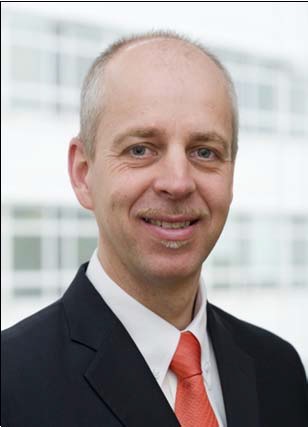 Joachim Zoll, “Everyone’s talking about digitisation – at the METAV 2016 we shall be showcasing our specific range of actual solutions for the world of machine tools.”
Photo: Siemens AG, Erlangen
Digital CAD/CAM/CNC process chains in technically sophisticated plants promise their users that they will be able to design his products faster and respond more flexibly to their customers’ requirements. Virtual machines provide valuable support for production planning.
Specific solutions and trends will be showcased at the METAV 2016 by Siemens AG, for example. Joachim Zoll, who heads the Machine Tools Systems Business Segment talked about the intelligent networking of machine tools and IT systems from the original idea to the finished workpiece.
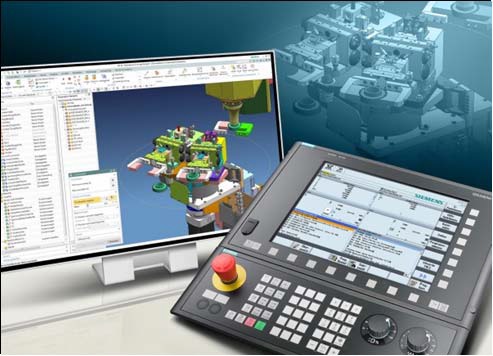 With an integrated engineering approach to machine development, firms along the entire process chain can reduce their
development times by up to 30 per cent. Photo: Siemens AG, Erlangen
What does the harmonised process chain of the future look like?
Joachim Zoll: We see horizontal and vertical integration gaining steadily in perceived importance. Horizontal integration stands for harmonised CAD/CAM-CNC process chains in which with the aid of appropriate CAD software initial optimisations can already be carried out at the product design stage. What is called digital twinning of the machine tool – by which I mean a virtual machine model that is based on the design data involved – can ultimately be integrated into the process chain for control-system-specific simulation of the machining steps concerned. The advantage is this: newly planned workpieces can be run in virtually on the PC, while the actual machine is still producing different parts. Moreover, we support our customers with networking solutions, in order to upgrade the efficiency of their production operations.
And what might these look like?
Joachim Zoll: What we’re talking about here is firstly central data storage, tool management and order management. Secondly, our solutions enable status data to be acquired and tele-maintenance to be implemented. In addition, our control system software offers interfaces to higher-order applications like a collaboration platform or a manufacturing execution system. This creates harmonised vertical IT integration – from the machine tool right up to the master level, with concomitantly enormous potentials in terms of productivity and quality.
Designing, modelling, programming, simulating, producing – are these the building blocks of the ideal process chain?
Joachim Zoll: Essentially, you have to draw a distinction between our integrated engineering approach for machinery manufacturers and the CAD/CAM-CNC process chain for the machinery’s operators. The machine manufacturer begins (in response to his customer’s stated requirements) with a design for his machines: this is called system engineering. It is followed by concept design, from which then the design data and the engineering work for the mechanical parts, the electrics and the automation are created. With our integrated engineering approach, machinery manufacturers are already able to digitally image and optimise the entire procedural sequence involved, from the original idea and the concept all the way through to machine development. The digital image provides reassuring certainty in the development phase, which means the machine can be market-launched earlier.
How does the machinery manufacturer benefit from this?
Joachim Zoll: With the aid of PLM software, machinery manufacturers are now increasingly parallelising these hitherto-sequential procedures, and cutting the development time for a machine by up to 30 per cent. Since all relevant design data for the machine are available in digital form, a virtual machine model (what’s called a digital twin) can be created for the machine that’s been ordered. This enables machine manufacturers to begin the machine development process directly in virtual mode, without actually handling a single mechanical component, and thus to respond simply and effectively to their customers’ wishes. The essential factor here is this: the virtual machine model also enables virtual commissioning to be performed in advance as well. Here, the virtual machine model is linked up to the real control system. This means the machinery designs and the interaction between the CNC system and machine can be tested in detail under real conditions.
And what does this look like for the machine’s owner?
Joachim Zoll: From the viewpoint of the machine’s owner, the CAD/CAM-CNC process chain begins with design of his workpiece. This is followed by definition of the machining strategy. It is here, once again, that the virtual machine plays a crucial role, since it is at the virtual machine, using the original control system software (known as VNCK – virtual NC kernel) that the machine’s owner can already check on the PC whether NC programs are collision-free and their syntax is free from errors, and how the cycle times can be improved. The entire production planning work can thus be performed on the digital twin.
Is implementation merely a question of the right software and the control system used – is every control system “process-chain-compliant”?
Joachim Zoll: Siemens is one of the few vendors to have built up a harmonised portfolio that includes PLM software, MESs (Manufacturing Execution Systems) and MOM (Manufacturing Operations Management), plus harmonised automation and control system technology. This enables us to offer our customers harmonised process chains. Both our PLM software and our Sinumerik control system, of course, are open for use with systems from other vendors.
What benefits do users obtain from harmonised, single-sourced complete-package solutions (CAD/CAM system, control system, machine)?
Joachim Zoll: From the machinery manufacturer’s point of view, they can be summarised as follows: through the entire digital process chain, from the original idea to the machine, all on a shared database, our solutions help machinery manufacturers to respond more flexibly to any individual customer’s requirements. The result is that the time-to-market is reduced significantly, which means that productivity and efficiency in the machine development process are upgraded!
For the machine’s owner, by contrast, we can confidently state: with an optimised CAD/CAM-CNC process chain from the design stage for the workpiece in the CAD system, then simulation, all the way through to production on the machine tool, users of machine tools can significantly enhance the flexibility and productivity of his manufacturing operation. This results in shorter product development times and thus accelerated time-to-market.
Brave new digitised world: how practically effective is the intermeshing of processes on the virtual and real levels?
Joachim Zoll: The use of virtual machine models is already possible today, and is meanwhile being practised successfully by the first machinery manufacturers. There are also examples of companies that have put in place a harmonised CAD/CAM-CNC process chain and are now benefiting from the optimisation potentials involved. Quite generally, it can be stated that today many applications and solutions for the digital enterprise are already in place. Companies that wish to progress their digitisation can begin actual implementation with the solutions that Siemens provides.
Can intelligently networked machines and processes be dependably controlled using new human-interfacing and communication concepts (smartphone or tablet)?
Joachim Zoll: In terms of usability and industrial security, mobile terminals like smartphones and tablets have not been designed for control system applications. Rather, mobile terminals are suited for retrieving current status data like part stocks and order status, or service information from a remote location. With the Smart Mobile solution, which is a constituent part of Siemens’ Smart Operation range, users can use a monitoring function over a secure webserver via their notebooks, smartphones or tablets, for example. Machinery manufacturers can already use these functions when creating new machine concepts and incorporate a capability for retrieving machine data via mobile terminals as a standard feature right from the start.
How can workshop-oriented mid-tier companies benefit from digitisation?
Joachim Zoll: Siemens has developed an up-to-the-future range specifically for workshop-oriented firms, designed to ensure efficient work sequences and complementing our CNC control system. We are convinced that these companies, too, can and should participate in the vision of digitisation – to an extent appropriate for workshop-oriented firms. The new capabilities cover aspects like production planning, IT networking, improved usability thanks to touch-control, plus the use of mobile terminals for observation and monitoring functions. To sum up, this software significantly facilitates the integration of machines into a production process. Its implementation does not require extensive support from IT specialists, and can even be very easily handled by the machine’s owner. This means companies can implement the individual functions involved with a minimised financial and organisational outlay.
Are there any examples already up and running?
Joachim Zoll: Yes, many of our customers are meanwhile using them. Some of them were already putting it on show at the EMO in Milan, and more will be spotlighted at the METAV. What’s important here is the machinery manufacturer’s ability to marry these solutions to the options provided by the machine.
What activities in this thematic category are you planning for the METAV 2016?
Joachim Zoll: Everyone’s talking about digitisation – we are not just talking about it, at the METAV 2016 we shall be showcasing our specific range of actual solutions for the world of machine tools: besides the topics of harmonised digital production and optimum utilisation of manufacturing resources, we are also, of course, focusing on new functions in the field of metal-cutting applications. Numerous new features and functions in the Sinumerik system help to further enhance productivity and quality in metal-cutting operations, such as milling and mould construction, mill-turning and turn-milling – in both series production and in contract manufacturing with smaller quantities.
We’re also talking about trends: we are front-runners when it comes to bringing different technologies together to create multitasking concepts. What’s driving the market is not only digitisation at the large companies, but above all digitisation in workshop-oriented firms. This is why at the METAV 2016 we shall be showcasing our solution for modern-day workshop manufacturing.
Air Max 1 Ultra Moire