
 Access
 Login/Register
 Supplier Login












South Korea is home to one of Asia’s fast-growing exhibition, KOPLAS (Korea International Plastics and Rubber Show ), which is held every two years. It is Korea’s biggest trade exhibition for the plastics industry, and its latest edition, KOPLAS 2015 held last March, presented numerous innovative products reflecting the rapid technological advances in Korea.
There were over 900 exhibitors occupying 4,000 booths. Korean manufacturers of plastic processing machinery and equipment exhibited side by side with foreign companies. This year’s edition was concurrently held with INTERMOLD KOREA (Korea's International Die, Mold and Related Equipment Exhibition), and HARFKO (Heating, Air-Conditioning Refrigeration and Fluid Exhibition), which made the exhibition more interesting at 30% more exhibitors, according to the show’s organisers Korea E & Ex Inc.
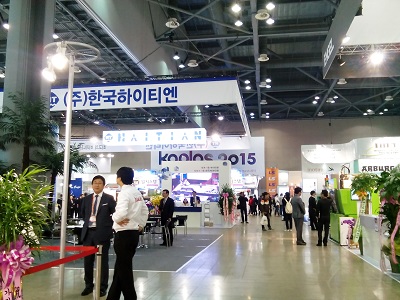
The expansion of the exhibition is an indication of the country’s sustained industrial growth. Korea's key sectors producing automotive parts, IT related products, packaging among others are increasingly demanding high performance plastics and rubber. Trends suggesting replacement of metal and other traditional materials like glass and concrete being replaced by plastics, production of both materials and machinery in Korea has also been on the rise creating huge demand for quality materials and advanced machinery.
EXHIBITORS' FEEDBACK
Efficient and eco-friendly cooling equipment
Frigel presented its closed-loop technology KOPLAS. According to Benjamin Sutch, President of Sales, the company’s products offer substantial savings on water and energy in addition to increased uptime when compared with the traditional approach to process cooling that includes an open-loop cooling tower/central chiller combination. “Frigel’s Ecodry 3DK closed-loop dry cooling can help users reduce water consumption by as much as 95% when used instead of a cooling tower. Compared to an air-cooled central chiller, it can also significantly lower energy consumption. Additionally, it reduces costly chemical use for savings month after month when compared with an open-loop system.”
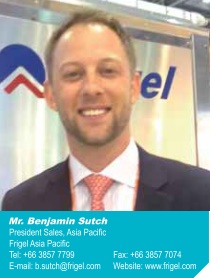
Frigel also presented its Microgel Chiller/Temperature Control Units. These compact, portable units are available as single- or dual-zone models with water- or air-cooled options, which allow users to maintain precise, microprocessor-controlled temperature at moulding machines. “When compared to central chillers, Frigel Microgel units save 60% of energy costs and also conserve space. The systems also contribute to higher product quality and less scrap,” according to Mr. Sutch.
A proven leader in advanced process cooling since the 1960s, many leading companies are served by Frigel. Frigel technologies have been greatly adopted over the last few years, benefitting customers throughout Asia Pacific, especially with its bigger Thailand facility.
Control and measurement products
Korean company Hanyoung Nux occupied a large booth at this year's KOPLAS as a reflection of its continuous efforts to promote its products in the global market. The company has been producing a wide range of control and measurement products intended for plastic processing machinery, specifically injection moulding systems.
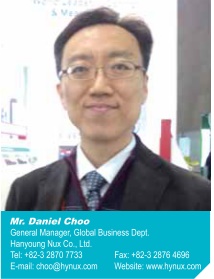
According to Daniel Choo, Global Business Dept. General Manager, the company has been supplying temperature control, measurement instruments, timer, counter, panel meter and proximity sensor which are necessary in the automation industry, and very important components for plastics machinery. Products are a result of the company's continuous efforts to determine what the market wants and conduct R&D to meet market demand. "We have been operating since 1972 and have been expanding in the Asian market. Currently, we have a factory in South Korea, as well as in China (Shanghai) and Indonesia," Mr. Choo mentions. These factories serve not only the Asian markets, but also other international markets. The company's presence at KOPLAS is an important move to explore and meet more customers.
PressureSense for silicone rubber processing
Many new developments in silicone rubber processing have taken place and new requirements for more efficient control of both processing and final product quality have given rise to advanced systems. At KOPLAS 2015, DESMA promoted its newly developed system, PressureSense, as a solution that integrates pressure and sense in the mould and cavity for accurate filling degree and accuracy of the compounds.
PressureSense was earlier presented by DESMA during its Open House in November 2014 as part of a fully automated production solution. The system closes the cold runner nozzles depending on the inner mould pressure. This compensates for variation in batches and reproducibly controls the fill level of the cavities. Furthermore, the PressureSense module makes it possible to produce articles from one tool with differently-sized cavities.
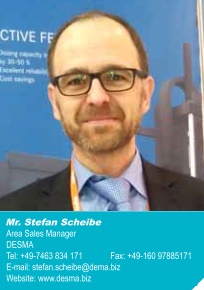
For DESMA, the Korean market remains an important one for the company due largely to the sustained demand for its products that meet the needs of Korea's automotive industry and medical/pharmaceutical sector. "Penetrating the South Korean market can be a bit tough as we have some local competitors but we at DESMA put emphasis on our technical features which would make a very big difference," according to Stefan Scheibe, Area Sales Manager. Inquiries at this year's KOPLAS have been good. "We are happy with the regular inquiriers we get and our participation at this show is always rewarding as we get new customers and get in touch with existing ones for repeat orders." Mr. Scheibe added.
Supplying plastics industry’s lubrication needs
Oelheld GmbH is a Germany-based company founded in 1887 as a lubricant specialist. The company offers lubricants according to the requirements of customers’ machines, and these include dielectric fluids for EDM die sinking and EDM wire cutting applications. Oelheld develops grinding fluids, cutting fluids and water-soluble fluids for many different applications. “Our leadership in Europe in this product line has enabled us to supply customers from all over the world with products according to their specific needs,” according to Manfred Schweizer, Senior Manager-Asia Pacific.
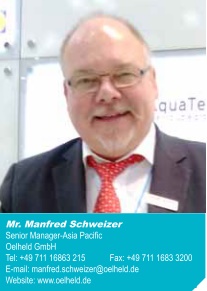
While it was Oelheld’s first time to exhibit at KOPLAS, Korea is recognised as an important market with the presence of a dealer to strengthen its market reach. “We have our production site in China to speed up delivery. The China plant is near Shanghai and this has been serving other Asian markets as well,” Mr. Schweizer added.
In aid of automation
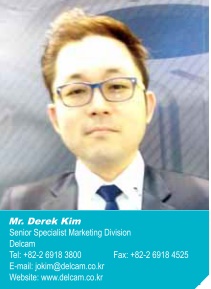
Delcam’s booth at KOPLAS was one of the busiest owing to the fact that the company’s many products are well-received in the Korean market. According to Derek Kim, Senior Specialist at Marketing Division, Delcam has been provding the CAD/CAM needs of about 80% of plastics manufacturers in Korea. “Demand is very high for our products due mainly to the fact that many companies are moving towards automation to improve their productivity and product quality,” Mr. Kim explained. He also said that the PowerMill Robot software for the programming of robots for multi-axis machining operations is very popular in the Korean market.
Recent enhancements in the software enables manual and CNC programming to be combined in a single program so providing the maximum programming flexibility. Other enhancements include improved collision checking, automatic avoidance of wrist singularities and the ability to generate robot programs from tape files produced in other CAM software. The current release includes improvements to the Vortex high-efficiency area-clearance strategy, enhanced collision checking, toolpath simulation and verification, and a new module for machining ribs into tooling.
The new functionality in the 2015 release allows users to duplicate in the virtual environment teach-and-learn programming of the robot for linking moves. The model robot on the computer can be ‘jogged’ between positions where machining is to take place, in a similar way to the movement of the arm in the real environment. The programmed linking moves can then be integrated with the cutting moves to give the complete sequence of operations.
PowerMILL Robot makes it as easy to program a robot for machining as it is to program a five-axis machine tool. As a fully-associated application inside PowerMILL, users have access to all the multi-axis machining strategies within PowerMILL and can use all the system’s project management options to manage, store and retrieve data.
Efficient recycling of laminated materials
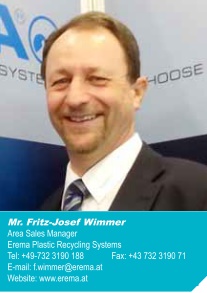
Erema Plastics Recycling Systems promoted its range of recycling equipment at the exhibition. In particular, the new Intarema model took centre stage as one of the systems the company wants to introduce to the Korean market. According to Fritz-Josef Wimmer, Area Sales Manager, Erema has been very active in promoting its new Intarema TVEplus in the market. “The Intarema is highly innovative to enable efficient recycling of plastic materials. In particular, the new Intarema TVEplus is ideal for high capacity recycling of even laminated materials,” Mr. Wimmer explained.
Erema offers the Intarema TVEplus system featuring patented configuration of melt filtration with subsequent homogenisation upstream of extruder degassing, plus the efficient Laserfilter that enables the production of high-quality end products. The recently enhanced Laserfilter is particularly suitable for the processing of materials with a high degree of contaminants such as wood, paper, aluminium or copper and fulfils requirements which conventional melt filters cannot meet. With the new scraper geometry of the Laserfilter, customers now have additional efficiency benefits such as longer screen service life and reduced labour requirements thanks to long screen change intervals. The machines are manufactured solely in Austria but exported all over the world.