
 Access
 Login/Register
 Supplier Login












MANY innovative products are derived from pulses, including meat-free alternatives and gluten-free products, which are very much in demand. Flours made from ground chickpeas and peas for example can be incorporated in pasta, tortillas and noodles. In snacks, the addition of pulses enhances health appeal.
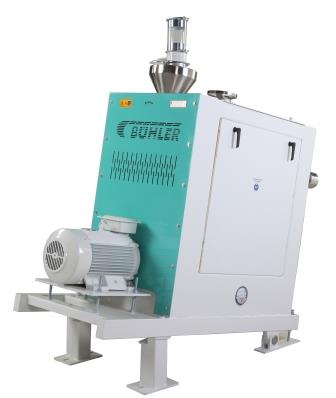
For hulling pulses, processors can consider investing in the PULSROLL™. This new huller from the Bühler Group has been designed to be cost effective, and is fully CE and ATEX compliant, which means it is safe and can be marketed in the EU.
“In the past, particularly in North America, pulse processing was restricted to just cleaning and then exporting. Now, pulse processors globally are looking to adopt complete hulling and grinding operations, in order to access the increasingly desirable nutrients from the pulses, and extract greater value,” explains Surojit Basu, Global Product Manager at Bühler. “Up until now, rice and grain technologies have been commonly employed for pulse hulling and have been insufficient to meet the quality and quantity requirements of modern, large scale EU and US processors.”
What makes it effective?
PULSROLL can handle multiple varieties of pulses, including dry yellow and green peas, to pigeon peas, chickpeas, mung beans and lentils. The machine uses up 15HP which is 50% the power consumed by an average huller to produce 4 tonnes per hour (an industry-leading capacity). This translates to energy savings and lower production costs.
Dehulling is said to be consistently uniform. Pulses are fed by gravity, through the pulse huller, into its milling chamber. Friction created between grinding stones and sieves, separates the hulls from the pulses. By fine-tuning the ‘gap’ between the sieves and grinding stones, processors can easily adjust the ‘grind’ to suit different incoming product. Crucially, the inclination, dictating the flow of the product inside the hulling chamber, can also be altered quickly and easily to accommodate different pulses.
Machine-crafted sectionalized emery grinding stones come in varying grit sizes to fulfil the requirements of the specific pulse to be hulled, and they ensure minimal broken products. According to Basu, this emery grinding stones allow the processing of a minimum of 10,000 tonnes before a change – much higher than the industry average. “An innovative sieve assembly ensures the milling surface is maintained throughout the life of the stones, whilst a strong structural design prolongs the overall life of the machine, and provides the ultimate in product quality time after time,” assured Basu.
No microbial contamination
For hygiene, rubber seals between these stones prevent dead zones that could otherwise cause the capture of residual product. This special design feature reduces the potential for microbial contamination, product accumulation or product cross-contamination during changeover, allowing for easier cleaning of the machine and the more rapid and efficient switch from one product to another.
Bühler has timed the release of its new machine with 2016 International Year of Pulses as declared by the 68th UN General Assembly. The UN through the Food & Agriculture Organization aims to increase public knowledge of the nutritional benefits of pulses, and the part it plays in sustainable food production and food security1.
The FAO defines pulses as annual leguminous crops (such as lentils, beans, peas and chickpeas) that yield from one to 12 grains or seeds of variable size, shape and color within a pod and are used for food and feed. It also clarifies that pulses are limited to crops harvested for dry grain. So crops harvested green for human consumption (vegetable crops), as well as crops used for oil extraction and leguminous crops that are used exclusively for sowing purposes are excluded in the definition of pulses.
Related reports:
Buhler Sortex and NRT partnership offers one-stop-shop to plastics recyclers
Bühler supports African coffee processors
Nike Jordan Melo Shoes