
 Access
 Login/Register
 Supplier Login












Jute is now finding its way into the production of under-the-hood automobile parts such as air intake manifold, radiator end-caps, fan & shroud etc.; housing construction materials; or even items used in the kitchen such as microwavable cooking containers.
Bengaluru-based STEER, a leading company engaged in materials processing technology that effectively transforms materials for various applications, announced the development and availability of technology to process jute-filled polypropylene compounds (jute polymers), that will have the capability to replace minerals and fibers and help reduce product cost, density and carbon footprint, while improving product performance.
The popularization of jute polymers is expected to help provide a major thrust to the Government’s Make in India campaign, by introducing new usage of jute in other sectors, thus stimulating industrial activity. Jute polymers are expected to benefit India's jute industry with its ability to transform the traditional use of jute for modern day products. Nearly 75% of jute goods are used as packaging materials, burlap, gunny cloth (hessian), and sacks.
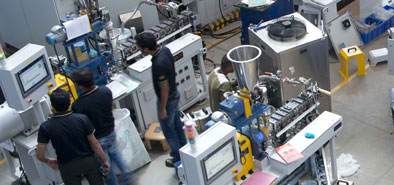
Speaking about this latest advance, Dr Babu Padmanabhan, Founder and Managing Director of STEER said, “Through years of constant innovation and reinvention, scientists at STEER have now developed jute-filled polypropylene (PP) compounds, by incorporating up to 50%by weight of jute, utilising advanced co-rotating twin-screw platform technology with special patented fractional-lobe elements. The new material has formidable advantages – it is strong, flexible, and heat-resistant, not to mention that it is also an economical, lighter and eco-friendly reinforcing agent for plastics.”
India is one of the largest producers of jute in the world. Jute is one of the major industries in West Bengal with 70 of the 94 composite jute mills based in the state, while another 3 mills are located in Orissa. According to government estimates, the jute industry provides direct employment to close to 0.37 million workers in organized mills and in diversified units including tertiary sector and allied activities and supports the livelihood of around 4 million farm families; this is in addition to the large number of people engaged in the trade of the natural fiber.
Dr Padmanabhan stressed that there is a potential for a new sunrise industry to emerge, creating thousands of jobs, especially in jute rich resource states such as West Bengal, Bihar and Orissa. "Jute polymers, if promoted aggressively by the Government and the industry, can have a ripple effect not only on the beleaguered jute sector, but the entire Indian economy by opening up a huge market opportunity for an industry that has historically been low on added value. If these Governments decide to play a pivotal role, they can convert their resource strength to their economic benefits. Create an industry that today does not exist, grow it, empower the jute producers, enhance their quality of living, usher in a new industrial development fueled by its natural resources,” he added.
According to estimates, as many as four million families in India are engaged in jute cultivation currently, producing 1.5 million tons of jute. These jute producers, especially small farmers, would be the biggest gainers because of market expansion triggered by jute polymers. The demand for jute would increase exponentially, triggering a cascading, beneficial effect on local rural economies of jute-producing states. This is significant because the jute industry has been grappling with challenges such as the rapid onslaught of plastic bags as a jute substitute.
Composite and compounded materials from man-made fibers (i.e. glass fiber, carbon fiber etc.) are already available as products for consumer and industrial uses. Jute filled PP composites are today being successfully used for various components and materials. Technological breakthroughs such as jute-filled PP compounds show the way for economic development of the masses by marrying state-of-the-art technology and research with cash crops to create rural and industrial prosperity.
STEER’s state-of-the-art Development Centers are centers of progressive research where competence arising from R&D is tested in real life scenarios, under actual production conditions. STEER Development Centers partner with researchers and manufacturers in a number of different ways, including the development of newer, more sustainable materials; development of high quality materials, with unique characteristics and properties, to help create stronger, lighter, safer products; and optimization of existing processes / formulations to enhance efficiency and improve the overall quality of end-products.