
 Access
 Login/Register
 Supplier Login












By 2025, six new mega cities will have come into existence in Africa (cities with populations of more than five million). These include cities such as Nairobi, Dar es Salaam, and Luanda. Growth in urban populations will continue to impact industries like water treatment, construction chemicals, and paints and coatings as infrastructure is needed for supply of housing and potable water and energy. As such, investment in infrastructure in the key African economies must increase to keep up with this demand. Despite this need, research shows that most key economies in Africa are not reaching the required level of spend on infrastructure.
Kenya has had the fastest growth in investments in its infrastructure sector, where investments increased by 15% to $2.9 billion. Despite this increase, the total spend compared to the budget is just over 50%; it is estimated that Kenya still requires $4–$5 billion per year through 2020 for infrastructural projects. Lagos in Nigeria is the seventh fastest growing city in the world and yet, the Nigerian infrastructure deficit is measured at nearly $20 billion per year. Due to delays in projects, only 60% of the estimated budget was spent on infrastructural activities. Ghana has experienced significant lack of access to funds to complete its planned affordable housing projects, and it is believed that an infrastructure deficit of $2.5 billion will hinder the expected GDP growth of 8% in 2014. Even South Africa has only reached just over 75% of infrastructure budget during the past three years.
Energy demand
Another related challenge in Africa, which presents opportunities for growth, is the inadequate supply of power. In South Africa, some progress is being made in increasing the megawatts produced by building the Kusile and Medupi power stations, in addition to new coal power plants; there has been significant success in introducing renewables to the energy mix. Currently, renewables only represent 1% of the total energy mix, but may contribute up to 12% to the energy mix by 2020. There are 64 approved renewables projects in South Africa now, which include wind, solar photovoltaic, and concentrating solar power. The capacity for these projects is equivalent to 3900 MW and is valued at more than $10 billion in investments. The long term plan for South Africa, Renewable Energy Independent Power Producer Procurement Programme (REIPPP), is to have 30% of energy mix from renewables.
Nigeria and Ghana have insignificant wind and solar projects producing energy in the respective countries, but the potential is high and this could see increased growth in future. This is mainly due to limited investment and the cost of the projects. However, hydro energy is growing in both these countries as fossil fuels decline. Kenya has a fair share of fossil, hydro, and other renewables such as geothermal, wind, and solar. Energy from fossil fuels declined significantly over the 2010–2013 period, as renewables are taking the market share and will continue to do this in the short to medium term.
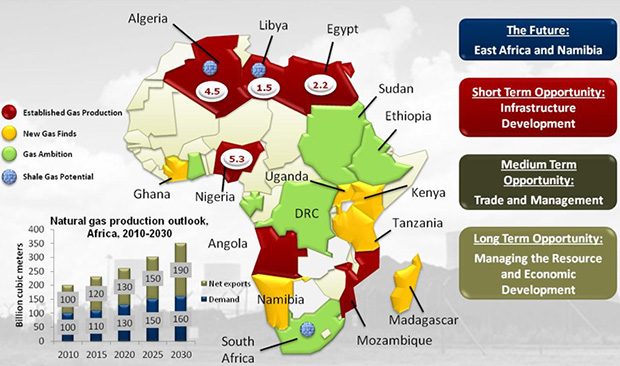
The big game changer in Africa is set to be natural gas, with potential to be the prime choice for technology and feedstock by 2020.
The shale gas revolution is also taking the world by storm, with the United States leading the way. Reserves in Africa are minute, but South Africa is one of the regions with reserves to the likes of 468 trillion cubic feet. The impact of shale gas on the economy could be significant if locally processed. It could save on imports, increase local manufacturing, and reduce input materials such as ethane in other applications.
Water and food scarcity
Green economy definition as per United Nations Environment Programme "improved human well-being and social equity, while significantly reducing environmental risks and ecological scarcities. In its simplest expression, a green economy can be thought of as one which is low carbon, resource efficient, and socially inclusive."
In South Africa, a green economy initiative in the agricultural sector could increase jobs by 170,000 and increase crop yields by 24% by improving the management of natural resources and investing in the environment. "It would also significantly increase the amount of available water," says a study on the South African Green Economy Modelling. Other key findings in the study include: "Investment in a green economy can contribute to 46 % more restored land by 2030, and greater water availability, without reducing land required for the agriculture sector. In addition, it could create jobs for 737,000 people compared to 568,000 under a business-as-usual scenario."
Kenya also has initiatives do drive its green economy activities with preliminary modelling on key sectors which include agriculture and energy. By investing in green initiatives in the agricultural sector of only 2% of its GDP, the crop yield could increase by 15% by 2030.
Nike KD