
 Access
 Login/Register
 Supplier Login












THE BEVERAGE packaging market is forecast to be worth $131.1 billion by 2019, thanks in part to a booming desire specifically among consumers in Asia for on the go beverages to suit their increasingly busy lifestyles. The growth is even more significant in Asian countries; as the demand for consumer goods, including beverages, is increasing due to rapid urbanization and the impact of the growing middle-class population on consumer spend[i]. Major beverage companies are shifting their focus towards expanding their capacities in Asia Pacific in order to cater the growing demand[ii].
Manufacturers are under increased pressure to improve their production line speeds and labeling systems capabilities. With several coding and marking systems available in the manufacturing industry, knowing which one will best address production requirements is essential. Among all the options available, laser systems are well-known and trusted by beverage and canning manufacturers to increase production output and uptime, meeting growing consumer demands. We spoke to Sascha Benke, business unit manager for laser at Videojet Technologies, to find out how labeling technology, including coding and marking systems can help achieve this goal.

Sascha Benke, Business Unit Manager for laser, Videojet Technologies
Can you share some new trends in coding and marking that you see in the beverage and canning industry?
A key long-term trend affecting the Asian beverage market is product proliferation. Both multi-national and local drinks producers are expanding their product offering with new brands and fresh flavors to target new consumers. Coca-Cola is a prime example of this, introducing taste variants like Vanilla Coke and expanding its low sugar options with Coca-Cola Life. Some larger companies are even adding to their portfolio by acquiring smaller brands in Asian markets. All of this has led to a need to increase production speeds to keep up with demand.
‘Late-stage customization’ is another major trend impacting the drinks industry in Asia. This is a phenomenon whereby products for multiple markets are produced and packaged in one location, with the label information required for a particular target market not printed on the packaging until the final stages of the supply chain. By customizing the packaging at the end of the production process, manufacturers can supply goods for a host of markets from a limited number of sites, maximizing efficiency while minimizing risks of wastage for non-compliance with increasingly stringent Asian label regulations.
The late-stage customization method is proving particularly popular with mid-size or larger companies serving a host of overseas markets. For example, if Chinese manufacturers wanted to export to the European Union (EU), with its multiple member states, they would have to ensure their packaging information is printed in the language of each different country. In China, if imported beverages contain content other than protein, fat, carbohydrate, sodium and energy, foreign manufacturers must conduct nutrition tests in line with China’s laboratory standards before Chinese specific labels can be printed[iii], which can be solved by late-stage customization.
With label regulations varying from region to region, manufacturers need to ensure they include the appropriate information of their products for each target market, such as duty information or geographical tracking codes for product traceability. As such, late-stage customization helps manufacturers enhance production line flexibility, as well as reducing downtime from packaging changeover and packaging requirements.
However, there are risks as non-compliant labeling can be an issue with some custom borders. The Chinese Customs destroyed over 3,900 batches of imported prepackaged food during 2012 to 2013, 14% of those rejected were due to non-compliant labeling[iv] so it is always important to work with a labeling expert when making changes to an operational system.
Please describe how the industry has changed in recent years.
The Asia Pacific region has become the largest market for beverage packaging since 2013[v]. Along with a major boost from China and India, Southeast Asia’s booming food and beverage market is currently reported to be worth USD $49bn[vi]. The growth in Asian consumer demand for product diversity as well as the expansion of overseas beverage trade has posed manufacturers with increasing pressure to boost the efficiency of their production lines and minimize product changeover downtime.
Printing product information has traditionally been a necessity to meet regulatory guidelines, such as those managed by the ASEAN Food and Beverage Alliance (AFBA), which require ingredient information as well as codes for traceability printed legibly on the side of packs. However, coding is being increasingly used by brand owners to achieve marketing and brand promotion goals. For instance, QR codes – two-dimensional square barcodes, which can be scanned by smartphones – are being used to give consumers instant access to websites where they can find out about current or forthcoming competitions, brand events and special offers. Brand owners are then able to collect information about their consumers and their buying habits to inform future product development and marketing campaigns.
As the amount of information that a code has to carry increases, it is growing more and more important for manufacturers to optimize printing times on their production line. Coders need to be able to adapt as quickly as possible to product changeovers, not only the selection of different codes, but variation in the positioning of the code on the pack. The introduction of innovative technology such as coding hardware and software set-up tools in the Asian beverage packaging market have simplified changeover processes during recent years.
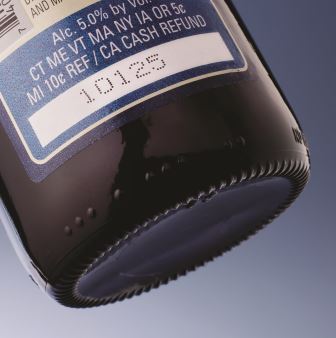
The permanence of laser coding is perfect for traceability as well as counterfeiting prevention
What is the impact of these changes to manufacturers?
Manufacturers need to increase lines speeds (or even add more lines) to meet the growing production demand for FMCG products and maximize their outputs. High end manufacturers do not increase the capacity of their lines significantly as too many things can go wrong with the numerous changes that may be required. Therefore, they increase line speed and may add a second line if necessary. Cost as always, is a big factor and it is important to consider what type of coding technology is being used. Inkjet printers and Thermal Transfer Overprinters (TTO), for example, require consumables such as fluids and ribbons. Laser is the only coding technology which doesn’t consume anything – apart from power of course. As more products go through the lines, laser coding is an option that cost conscious manufacturers might consider.
What are the major coding and labeling concerns of consumers, retailers and manufacturers at the moment?
Only 31% of Asian consumers understand the information presented in nutritional labels despite an overall increase in concerns over product quality and integrity worldwide[vii]. Therefore, it is important for manufacturers to consider alternative methods to communicate with their customers, whether that high-quality QR code printers or assurance over a product’s safety via effective trace and trace systems. The ability to provide legible, fundamental information such as use-by date on its products can also serve as effective communication tools to building stronger brand loyalty.
Retailers are concerned with their logistic chain and developing fully traceable beverage packaging that is compatible with a personalized stock labeling system. Whereas manufacturers are more concerned with legal issues, such as product quality, brand management and other reputational issues that can arise. These can lead to the recall and destruction of products, which is a very costly outcome.
An increase in coding content means that the laser coder has to have enough capacity, in terms of head room, to cope with the demand. Time optimization is therefore prioritized over other requirements as more characters have to be marked. Higher throughput and more content are areas of focus which Videojet is currently looking at. We are working on the integration of additional technology facilitating physical adjustments for changing product diameters (such as bottles) ensuring code quality as well as reduction in wrong data entries.
What other advantages do laser marking systems have over other marking solutions?
The permanence of laser coding is perfect for traceability as well as counterfeiting prevention. This makes laser the preferred printing method for beverage packaging due to the likelihood of being transferred in and out of chilled environments, in which alternatives like stickers or ink printed labels will easily become smudged and rendered unreadable. Laser marking is of the highest quality, for example, the outcome being a nice solid line. Although the purchase price of laser marking systems is higher than the initial cost of an inkjet system, minimal operating costs lead to a lower total cost of ownership over time, giving beverage brands better opportunities to strengthen their product.
[iii] http://www.cirs-reach.com/food/The_labeling_requirements_on_prepackaged_foods_in_China.html
[iv] http://www.cirs-reach.com/food/The_labeling_requirements_on_prepackaged_foods_in_China.html
[v] Marketsandmarkets, “Beverage Packaging Market by Type (Bottle, Can, Pouch, Carton), Material (Glass, Plastic, Paperboard), Application (Alcoholic, Non-Alcoholic, Dairy) & Geography - Global Trend & Forecast to 2019”
[vi] http://blog.socialwalk.com/booming-south-east-asian-food-beverage-market-usd49-billion
[vii] http://www.nielsen.com/us/en/press-room/2012/fifty-nine-percent-of-consumers-around-the-world-indicate-diffic.html
Racing Archives