
 Access
 Login/Register
 Supplier Login












Characteristics such as mechanical strength, dimensional stability, temperature resistance, non-flammability, resistance to abrasion and chemical resistance, as well as their attractive price/performance ratio make thermosets very interesting as materials. They are also replacing other materials such as metals. However, special materials of this type require a special machine technology. Optimum thermoset processing calls for precise temperature control in the process, a cylinder module with high resistance to the abrasive contents and specially designed screw geometries.
Practical processing package
ARBURG offers an efficient combination of proven hydraulic Allrounder machines and a practical thermoset package. This system solution includes all the features required for the immediate production of high-quality moulded parts in large volumes.
Individually adapted technology via the hydraulic Allrounder machines and the thermoset package have been designed as a system solution and include three-platen technology with four tie-bar guidance and central force application for precise demoulding; liquid temperature-controlled cylinder module for precise temperature control suited to a specific material; bimetallic cylinder for a long service life; and special screw geometry for material processing without damage to the fibres. The machine technology can be precisely adapted to the respective injection moulding task, thanks to its range of sizes in horizontal and vertical design, its modular adaptability as well as its wide variety of equipment for processing moist polyesters, for example. The Allrounder machines remain universally applicable, regardless of whether they are being used for thermoplastics processing or extended to complete turnkey systems.
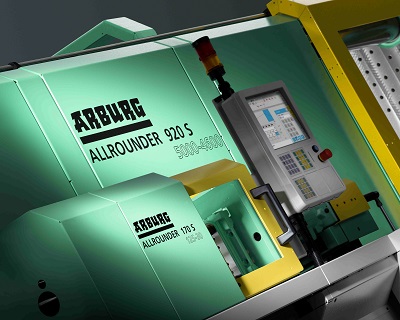
Adapted injection units for granular thermosets and moist polyesters have been introduced into its modular range of technologies in order to fully meet the requirements for thermoset processing. A high level of production quality is achieved through liquid temperature control with up to four zones and separate temperature control for the feed. Bimetallic cylinders ensure a correspondingly long service life, while special screw geometries ensure gentle processing of the material. Particular attention has been paid to minimising return flows during injection and during the holding pressure phase. The play between the screw and nozzle is adjustable to prevent excess material. Constant shot weights are achieved via the screw’s mechanical anti-reversing lock.
Maintaining control over sophisticated machine, mould and robotic technologies is the domain of Selogica. With this setting and monitoring system, one can quickly set up both simple and complex injection moulding processes, operate them intuitively and perform reliable optimisation. In a word: central management. All technical features of the Selogica control system, such as the graphical sequence editor, are also ideally suited for thermoset processing and aimed at making operation quicker, more reliable and more convenient. Selogica ensures straightforward sequence programming via graphic symbols and the patented real-time plausibility checks. The Selogica’s equipment is ideally complemented by features such as adaptive mould heating, compression injection moulding or venting. This results in a correspondingly high level of process stability and reproducibility for thermoset processing in particular.
Compression injection moulding is an important function for improved surface quality, high component strength and reduced distortion. The compression injection moulding sequence is freely-programmable via the Selogica, for example through individual selection of the starting conditions. It can also be combined with venting. Compression injection moulding via core pull permits direct sprue separation.
Venting of cavities is crucial with thermoset processing. It provides an effective means of allowing air and cross-linking gases to escape. As a result, the surface is not scorched and complete mould filling for void-free components is guaranteed. Both single and multiple venting operations can be quickly and reliably programmed via the Selogica, even during the holding pres-sure phase.
The adaptive mould heating automatically adapts the control parameters to the control response of the mould. Several heating zones can also be controlled in parallel via a sensor. This achieves high temperature stability in the mould for excellent reproducibility in production.
The wide range of options for integrating special peripherals such as brush units demonstrates the universality of the comprehensive central control system for all ARBURG injection moulding technology. For instance, pourable thermosets are supplied in the form of granulate, which means they can be fed in the conventional way. The special ARBURG cylinder modules ensure optimum material preparation as they are provided with compression-free screws without non-return valves.
The Injester tamping devices have been developed for automatic feeding of dry materials and materials with a high filler content. They contribute towards optimum pre-compression, thus minimising air and gas inclusions. This keeps the articles free from voids and their surfaces glossy. Here, ARBURG offers several Injester versions with hydraulic pistons as well as one or two servo-electric conveying screws. All of these are fully integrated into the Selogica control system. The conveying pressure is programmable and and the material reservoir can also be filled without difficulty during production. In the case of Injesters with screws the conveying pressure is also regulated.
Application samples
Thermosets have a wide range of applications thanks to their special characteristics such as high mechanical strength and rigidity. Thermoset parts are typically used for “extreme situations” in the automotive industry (engine compartment and lighting components), as well as in the electrics and electronics industries (power and miniature circuit breakers, printed circuit boards).
For instance, in the pistons with internal thread that are used in the clutches of passenger vehicles. This is a substitution component, which is far less expensive to produce using the injection moulding process. For processing the highly abrasive filled material, an extremely wear-resistant cylinder fitting is used. The 4-cavity mould operates using three-platen technology and separates the sprue directly inside the mould. The heart of the system is a hydraulic Allrounder combined with a Multilift V robotic system. Downstream processing stations, such as those for removing burrs and grinding chamfers as well as for visual quality inspection, can be centrally programmed and monitored via the Selogica control system.
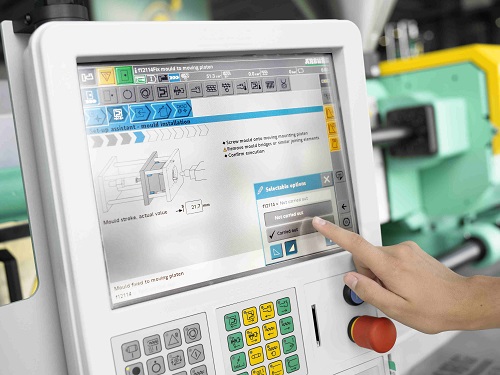
Selogica control system is ideally suited for thermoset processing
Another product are the switch casings for domestic fuses which are injection moulded from a moist polyester (BMC). Feeding of the material is handled by an Injester piston feeder device, part removal by a Multilift V. The four casings are picked up, the sprue separated and the articles placed on a conveyor belt. The high-precision 4-cavity mould is electrically heated to an operating temperature of approx. 150 °C. Scorching and porosity are prevented through the use of an optimised mould venting system. A vacuum can also be applied. All of these functions are fully integrated in the Selogica control system.
Producing an armature shaft calls for precision across the entire process chain. Moist polyester (BMC) is processed on an Allrounder T rotary table machine with Multilift V robotic system. The inserts are preheated to guarantee a reliable connection between the shaft and the laminations as well as uniform cross-linking of the thermoset. To reliably avoid overfeeding, the mould is designed with extreme precision.
A good example of the implementation of customer-specific turnkey projects are insulating rails for domestic irons made from BMC. The system includes a hydraulic Allrounder, the Injester screw feeder device, a six-axis robotic system as well as a camera system for quality and functional checks. The six-axis robotic system with implemented Selogica user interface is ideal for near-contour refinishing of the thermoset parts. This enables the robotic system to be programmed using the same graphics-based system as the machine. No special programming knowledge is required for independent set-up of the robotic sequence.