Access
 Login/Register
 Supplier Login












A great potential for micro and marking applications at a higher sophisticated level can be seen.
Cases in the manufacturing of guidewires proof the attractiveness of e.g short pulse lasers to be a competitive industrial laser device to substitute mechanical, thermal or chemical manufacturing methods.
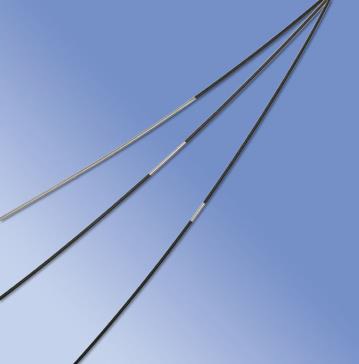
Guidewires in general are wire or spring based guides for placement of a larger device or catheter inside the body. They are used to enter tight spaces, e.g. valves or channels, within the body, to assist inserting, positioning and moving a device. In addition they can be used for drug application at a defined location. Guidewires vary in size, length, stiffness, shape of the tip and material composition. Outer diameters can go down to 0,3mm, so a mechanical material processing is impossible.
A catheter guidewire consists of a metal center wire core surrounded by a flexible tube that is Teflon (PTFE) coated on the outer surface. Those sheaths, in particular the Teflon coating, have to be removed partially, without material damage of the core, no peel off effect (shrinking at the edges) and residue free removal. In some instances, interaction with the base metal below is favoured, for example radio-opacity can be increased by dimpling the metal underneath the PTFE removed area. The ablation band can be seen even in-vivo more clearly using x-ray techniques for example. Another application is to selectively process the metal at the end of the product to reach higher surface roughness, so that adhesive bonding will be improved for connecting plastic pieces.
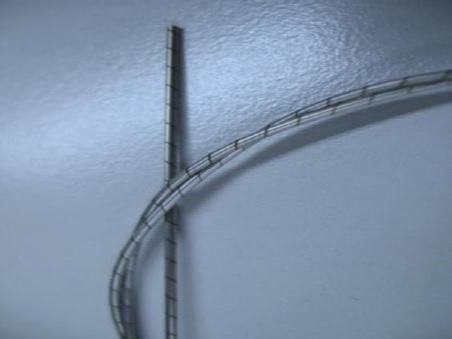
Another possibility to manufacture such a medical device is a tube based guide, called hypotube. In addition to the above described applications, a spiral cutting is necessary to achieve a defined flexibility in certain areas of the device. In addition the tip profiling is done by laser cutting too. For processing coated tubes an ultra-short pulse laser is required to minimize heat affected zones as well as to avoid delaminating of the coating. But also for uncoated tubes, where modulated cw fiber lasers are a common processing tool, an ultrashort pulse laser has numerous advantages regarding heat impact to the device and cleanliness of the cut. A significant reduction in post processing is possible, like the avoidance of an aggressive chemical cleaning. The benefit for the medical device manufacturer is cost reduction and yield improvement.
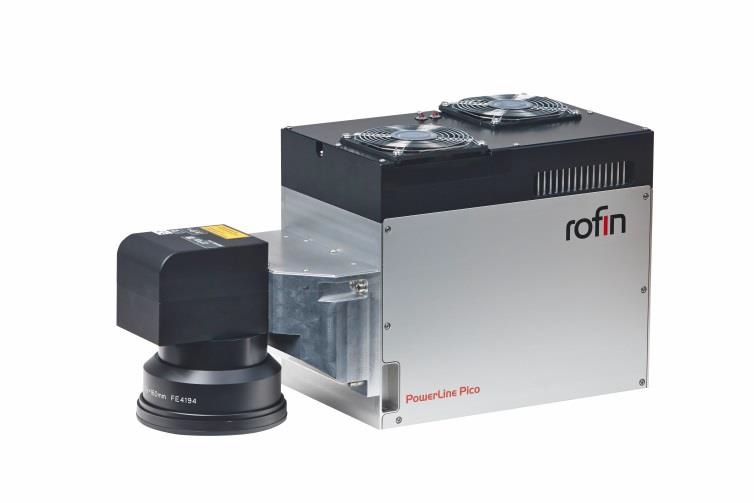
Short pulse laser: PowerLine Pico available in 1064nm or 532nm