
 Access
 Login/Register
 Supplier Login












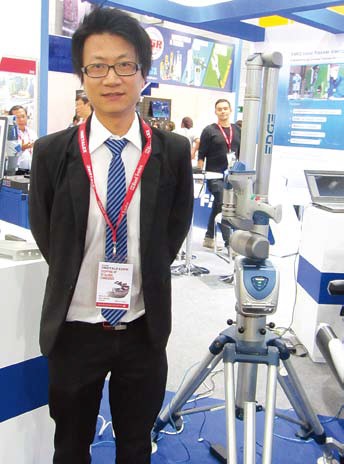 Mr. Boonchai Prasertboonchai, Regional Sales Manager (Thailand) from FARO was upbeat in an interview with INTERNATIONAL METALWORKING NEWS FOR ASIA, sharing some notable facts about the latest FARO® Edge ScanArm HD that features blue light, and about the business in Thailand.
Edge ScanArm HD
According to Prasertboonchai, the ScanArm HD was developed with the end-user in mind. This high performance contact/non-contact device supports rapid point cloud collection with extreme resolution and accuracy. It also features an extra wide scan stripe that increases scanning coverage, plus a new blue laser that offers noise reduction.
He said, “In the previous versions, we used red light. But in the new ScanArm HD, we use blue light to improve the accuracy and the features of the scanner. The benefit of the blue light is that it can scan tiny parts accurately and quickly, and it is eleven times more precise than the previous version. Therefore the data is even more complete.”
The ScanArm HD is an affordable measurement device that enables users to significantly reduce on-site measurement times, scan challenging materials, and sustainably enhance their products and processes. Users can expect dramatically reduced training times with this device, as the new crosshair feature and existing LED Rangefinder functionality facilitates real-time scanning feedback.
The Edge ScanArm – which combines the FARO Edge portable measurement arm with a laser scanning probe - is a portable 7-axis coordinate measuring machine (CMM) that allows the user to easily check product quality through 3D inspections, comparisons with the CAD design, dimensional analysis, and reverse engineering. The integrated Laser Line Probe for laser scanning ensures a perfect 3D measurement without touching the surface of the product.
In addition, the data analysis phase has become easier as the FARO® CAM2 Measure 10 measurement software develops really clear, easy-to-navigate reports. Today, reporting is much more comprehensive and informative than before and, once the point cloud has been obtained, every detail can be analysed in sections, by comparing the theoretical project data with the actual measurements.
Another important benefit is that it is no longer necessary to treat components with opacifiers, which was necessary in the past for the non-contact measurement of black and glossy carbon surfaces. The FARO laser probe technology allows polished carbon surfaces to be scanned without having to apply opacifiers, which also required processing to remove afterwards.
Users’ changing needs
When asked about the changing requirements of users, Prasertboonchai said that manufacturers liked to use small tool inspections before. Now, the trend has moved to digital inspections so as to reduce human error. Next, there is the prerequisite for higher accuracy CMMs. Manufacturers today require much tighter tolerances on parts – whether small or large. There is also an ongoing need for sensor technology that can deal with parts, as they become smaller and smaller. The trend towards miniaturised parts means that manufacturers need to be able to measure the details of those features affecting the part in any other way.
Thai market
In Thailand, Faro’s main targets are the automotive and aerospace industries. However, the aerospace business in the country is not that big at the moment and the automotive industry is experiencing some slow down.
“We are facing some impact because of the slow down but we’re still continuing with R&D, because we believe that by the time the market recovers, we’ll have the best solutions to support our customers’ and future customers’ needs,” he said.
Prasertboonchai mentioned that one of his team’s objectives is to listen to customers, understand their needs, and actively seek their point of view. “More often than not, in the course of a conversation, a customer will divulge information and we’ll pass that on to our R&D. These things are vital to our overall success,” he added.
SOCIETY