
 Access
 Login/Register
 Supplier Login












ENGINEERING a nimble and effective logistics and distribution process has always been a major challenge in the food and beverage sector. With several moving parts to handle, manufacturers have to be flexible as many factors come into play such as market condition, supplier deals, new technologies and even legislation.
Both large and small manufacturers seek the expertise of logistics providers in their pursuit of an efficient supply chain that will drive productivity, meet food safety regulations, and slash costs.
Innovations in the logistics space are widely seen as a crucial differentiator for manufacturers to stay competitive. Automation is one area where companies can reap immediate and lasting benefits despite possible lengthy processes and initial outlays at early stages.
Swedish business software developer IFS, in its published guide on managing F&B supply chain, offers advice to manufacturers planning to automate. It suggests exploring available technology such as handheld bar code scanners and tablets, centralizing information possibly through a resource planning software, and creating detailed processes as IFS contends that the more detailed your processes are, and the more consistent they become, the easier it is to automate them.
Another player in this space is global logistics firm DHL which has launched innovations specifically designed for the F&B sector in Southeast Asia.
“Warehouse automation has been a key innovation to improve efficiency and service quality, but also reduce costs. We have implemented a number of projects across Southeast Asia and select the most appropriate system based on the customer’s specific requirements. One example is an automated solution we manage for a leading food retailer which stores in excess of 10,000 SKUs which can handle circa 4 million cases per month – increasing the throughput and productivity of the operation by over 100 percent,” reveals Dean Eichorn, vice president, Retail, DHL Supply Chain Asia Pacific. “From a transport perspective, we have recently delivered a new solution that delivers products to more than 500 food and beverage retail outlets. The nightly back-of-store delivery is made to a lock-up cage, meaning that deliveries can be made pre-store opening. This in turn increases utilization of the transport network as it allows a longer timeframe overnight to deliver to more and multiple stores versus a shorter delivery timeframe window during early morning hours only resulting in a more effective cost-per-store delivery,” he says.

Dean Eichorn, vice president, Retail, DHL Supply Chain Asia Pacific (Photo: DHL)
“Underpinning our operations are sophisticated IT systems to monitor, optimize and provide visibility of products specially configured to bespoke requirements by our team of retail IT experts. The systems fully integrate with advanced technologies, including warehouse automation for large volume operations or hands free applications for smaller volumes, to create a highly efficient end-to-end solution,” Mr Eichorn explains.
Challenges in operating in the region
Product distribution in Southeast Asia remains to be a challenge for manufacturers because of its topography – consider archipelagic nations such as Indonesia and the Philippines.
“Development of infrastructure across the region is not keeping pace with the escalating logistics needs. Modern ports and road networks are essential to the fast and efficient movement of products, and although investment is being committed it takes time for these projects to be realized,” says Mr Eichorn.
To support its customers, DHL looks to continually refine and optimize the supply chain. A case in point is transport optimization. “Transport optimization is just one example whereby we utilize the maximum capacity of the truck, implement state-of-the-art transport management systems to route the vehicle and train our drivers on fuel efficient driving practices – all with the aim of becoming more efficient. In conjunction, we also work with the governments in countries to review vehicle legislation and allow us to use larger vehicles for transporting snacks and drinks, and have had success in Thailand, Vietnam and the Philippines,” he says.
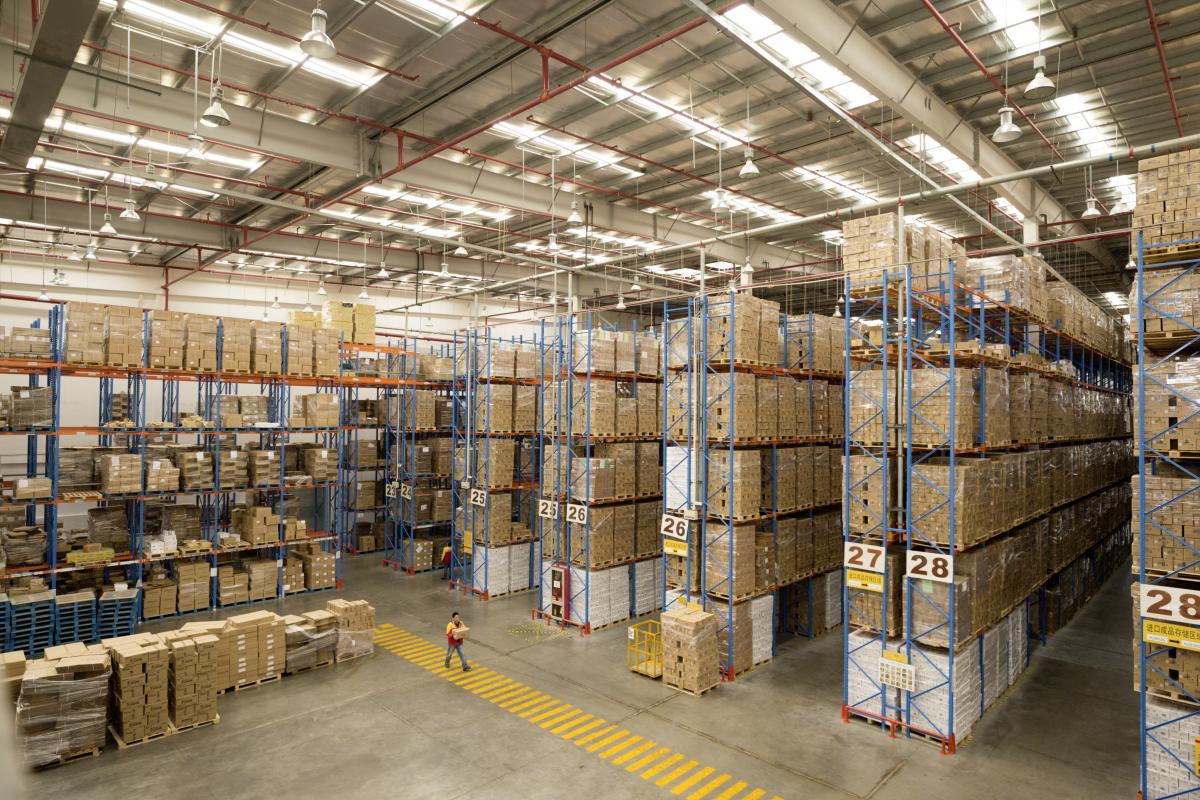
A DHL facility (Photo: DHL)
The firm’s outlook for the F&B sector in Asia remains strong, since over half of the world’s population is in this region. The population increased by almost 200 percent from 1950-2000 and is still expected to grow by another 50 percent by 2050, according to the United Nations. “But in order to succeed, operations need to be scalable and sustainable,” Mr Eichorn says. “As food & beverage retail continues to grow so does DHL, but we are also making sure we stay ahead of the growth curve by strategically constructing modern multi-user warehouse facilities near tier one and two cities to support our customer’s growth aspirations today and tomorrow.”
Business transformation
The 2014 Food, Drink and Consumer Goods Industry Outlook Survey published by professional service firm KPMG, notes that supply chain transformation is a key area of focus for leading organizations in the United States, with 49 percent of respondents seeking to have a more effective and efficient supply chain.
According to the report, food, drink and consumer goods (FDCG) companies are increasingly placing supply chain at the center of their strategies to transform. It mentions that only 29 percent of FDCG companies have their supply chain fully integrated across the business and channels.
“Achieving a successful future-state vision, a true sustainable structural change, and long-term transformation depends on an organization having a fully integrated supply chain,” states KPMG in its survey.
Creating end-to-end supply chain visibility is critical, and enhancing visibility enables FDCG companies to improve responsiveness to real-time customer product demand, overall service performance and manufacturing planning, says KPMG.
On addressing the visibility requirements of its customers, DHL’s Mr Eichorn adds, “Our own proprietary ‘OneView’ portal provides customers with online accessibility to observe their DHL-controlled operations remotely, providing real-time visibility of inventory levels (including details such as expiry dates), order management updates and delivery milestone achievement.”
Rising demand for cold chain solutions
“As consumer income grows in the region so does the demand for modern food retailers, from convenience stores to food & beverage outlets, which in turn is rapidly increasing the demand for specialized cold chain solutions,” Mr Eichorn says as he talks about emerging trends in F&B logistics in the region. “DHL is actively investing in temperature controlled transport and storage operations to ensure product quality is maintained throughout the supply chain.”
Facing the challenges
According to Mr Eichorn, DHL has partnered with several food & beverage customers in Southeast Asian countries with logistics challenges such as Thailand, Vietnam, the Philippines and Indonesia.
“As a logistics provider, we face many challenges concerning infrastructure, government regulations and labor issues – however our ‘can do’ approach means we find ways to overcome the hurdles. Whether it is implementing an automation system in Bangkok for one of the country’s largest supermarket chains, or devising an agile solution that transports stock at ambient and multi-temperature levels to over 1,200 convenience stores across Indonesia, we think of new ways to meet the challenges within the fast-evolving region and ensure food and beverages are delivered on time and in premium quality.”
Looking ahead
“Future plans for the sector revolve around continued investment and expansion of market share in the food & beverage supply chain management space, whilst continuously improving performance levels for our existing customers. We will also continue to train and develop our talented people so they are knowledgeable on the latest best-in-class technology and innovation to drive further cost competitiveness. Our focus will be on larger markets across Southeast Asia such as Thailand, Indonesia, the Philippines, Malaysia and Vietnam and we will leverage our global scale and share best practice solutions between customers in Asia and around the world to generate new value for our customers,” Mr Eichorn says.
Fully owned by Deutsche Post DHL Group, DHL Supply Chain Asia Pacific has over 36,000 employees and is present in 15 countries. It has 8,500 owned vehicles and over 700 facilities catering to automotive, consumer, healthcare, retail, and technology sectors.
Nike Odyssey React