
 Access
 Login/Register
 Supplier Login












IN THIS interview, Neil Giles, Marketing Communications Manager at Mettler-Toledo Product Inspection walks us through the latest inspection technologies crucial for the meat processing industry.
How prevalent are meat product recalls in Southeast Asia? There have been a number of product recalls of late, not just in this region but on a global basis. The reasons for these actions vary from case to case – from undeclared allergens to pathogen contamination such as E.coli or Salmonella, for example. Physical contaminants, such as metal, glass or dense plastic fragments can also be a cause for product recalls, which is where product inspection can play a key role in the production process in terms of detection capabilities.
Inspection programs in ASEAN countries should generally be effective in protecting the public against food contamination.
There have been improvements in recent years, and manufacturers in the region exporting to western markets in particular are required to comply with international standards such as the BRC & IFS, FSSC 22000 and SQF. More recently, changes in the Food Safety Modernization Act in the US are placing extra responsibilities for manufacturers exporting their products or raw materials into the US. In order to facilitate growth in this area it is widely regarded that more investment in infrastructure and research and development is required in some ASEAN countries, alongside a more standardized approach to regulatory frameworks. Traditional food control systems are perhaps too fragmented to be as effective as they could be in places.

(Photo: Mettler Toledo)
Having said that, how would you assess inspection programs?
Improvements are definitely being driven by standards, as well as by learning from the effects of major recalls. The realization that such occurrences can and will have devastating effects on brand reputation is certainly driving far more rigorous inspection program. Product inspection systems are integral to these programs if they are to be effective and which systems are most suitable will depend on the products you are handling. For red meat, for example, metal detectors and x-ray systems are applicable and are capable of detecting a wide range of physical contaminants, from metal fragments and calcified bone to glass and dense plastics.
What should meat suppliers/manufacturers consider when investing in meat inspection technologies?
The starting point before considering purchasing product inspection equipment is to ask what needs to be done in order to meet the standards required and to make certain that the food you produce is safe. This will come as a result carrying out a Hazard Analysis of Critical Control Point (HACCP) audit in order to identify possible risks of contamination and implementing the best solutions to mitigate those risks. The meat industry operates in notoriously harsh environments, therefore equipment must be able to deal with the equally harsh wash-down procedures required. Modern product inspection systems are hygienically designed enabling high-pressure wash-down of the equipment to take place in-situ. This can help in minimizing cross-contamination between process batches and reduces the risk of bio-contamination – one of the major causes of recalls.
With the latest solutions, do suppliers/manufacturers, is inspecting by hand still part of the process?
Product inspection systems are fully automated and dynamic, therefore there is no need for hand inspection. They also operate in line, meaning 100 percent of product is inspected without the need to reduce production speeds. Hand inspection has the potential to cause contamination in itself so we would always recommend an automated solution, selected as a result of a full HACCP audit.
Are there solutions that include inspecting meat for pathogens?
From a product inspection system perspective, the way in which they contribute to reducing the risk of contamination from pathogens is through hygienic design – as mentioned above. Product inspection systems focus on the detection of physical contaminants, such as glass, metal, plastic and calcified bone. It is important to note that the best way to avoid pathogen contamination is to operate in a highly hygienic environment – so in this regard, product inspection systems designed and sealed to meet the IP69K ingress protection standard for example, have an important role to play.
Food safety is of course the end in view for using inspection systems. Can you give us an idea of how efficiency is also enhanced with visual inspection/other solutions for meat processors?
There are a range of options when it comes to product inspection as we have highlighted. X-ray and metal detection systems have the ability to detect physical contaminants during the production process for raw, bulk-flow (loose), pumped and packaged products in ambient, chilled or frozen formats.
Overall Equipment Effectiveness (OEE) is a key area to consider – which is the ability to assess quality performance and availability of equipment. OEE tracks the value-added productivity of equipment. It is a measure of the number of good (shippable) units produced compared to the quantity which should be produced based on the scheduled time and the specified equipment rate. There are a number of features within Mettler-Toledo’s range of product inspection systems that contribute to this area.
The ability to undertake tasks simultaneously is a major contributor to OEE. For the meat industry, as an example, the InspireX R40LF-800 X-ray System is uniquely designed to inspect formed food products for quality parameters such as the roundness of a hamburger patty and indentations caused by defective forming. It carries out this function in addition to contaminant detection, thus streamlining the overall process of quality control at the same time as mitigating the risks of contaminated products entering the retail supply chain.
Elements such as intuitive operator interfaces, which make set-up and adjustment of inspection systems quick and easy also contribute to OEE, as time saved leads to increased productivity on the line.
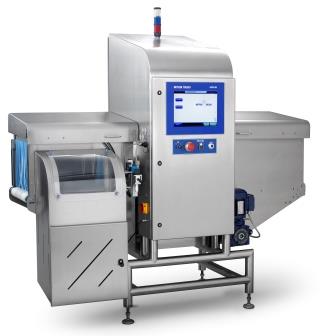
The X36 series utilizes Mettler-Toledo Safeline X-ray’s advanced x-ray imaging technology. It is effective in detecting and removing small foreign matter, while simultaneously performing product integrity checks
What are the latest features in Mettler-Toledo’s inspection systems?
There are a number of exciting features we can mention across the range, starting with our Profile Advantage range of metal detectors. Manufacturers and processing companies in the meat and poultry industry can now achieve detection sensitivity levels previously only seen in dry product inspection. For years the ‘product effect’ (the electrical signal generated by some foods with a high moisture, salt content or packaged in metallized film) has reduced detection sensitivities significantly below the levels achieved with inspections of dry non-conductive food products. Using a sophisticated inspection algorithm, the Profile Advantage metal detector all but removes the ‘product effect’ phenomenon from the process, resulting in up to 50 percent improvements in detection sensitivity levels irrespective of packaging material, ensuring that the Profile Advantage finds more metal contaminants than traditional systems in challenging applications such as wet, warm or chilled food. In addition, the solution is capable of rigorously reducing the number of false rejects. For example meat and poultry producers can typically see false rejects rates associated with ‘product effect’ reduced by up to 95 percent when trying to detect the smallest metal contaminants. The Profile Advantage uses pioneering multi-simultaneous frequency (MSF) technology to step change performance.
Safeline X-ray is also driving the development of maximum efficiency product inspection and quality control for food manufacturers with the X36 Series. The X36 series utilizes Mettler-Toledo Safeline X-ray’s advanced x-ray imaging technology, guaranteed to produce consistent and reliable product inspection results on single and multi-lane applications. Designed for manufacturers seeking to detect and remove miniscule contaminants, such as metal, glass, dense plastic, mineral stone and calcified bone in a wide range of packaging materials, whilst simultaneously performing product integrity checks. The X36 offers a choice of innovative detector diodes, 0.8mm or 0.4mm, detector widths and generator size options. The 0.8mm detector, for example, can be used in conjunction with a low powered 20W generator to increase sensitivity five times more than standard x-ray systems. In addition, the 0.8 diode can be combined with a 100W or 400W generator, with the 0.4mm detector diode designed with either a 100W or 400W generator. This versatility provides manufacturers with a range of x-ray technology options to suit their current and future product ranges. When equipped with a low power generator (20W), the machine does not require additional cooling, thus reducing power consumption and energy costs.
Finally, checkweighers play a key role in meat production facilities and the C3000 both increases the safety of the production processes and ensures high throughput rates. This new generation of checkweighers is a modular platform which is available in numerous different configurations and offers high weighing accuracy. It covers a calibratable weighing range of 3 grams to 10 kilograms and checks up to 600 products per minute. The C3000 System also has a range of functions which guarantee safety in food production. The system helps manufacturers to improve overall system productivity and reduce overall operating costs, meaning that companies can be ready for a sustainable future while competing on international markets.
Neil Giles is Marketing Communications Manager at the Mettler-Toledo Product Inspection Division of Mettler-Toledo, based in the UK. He currently specializes across all four main product inspection technologies, which are x-ray, metal detection, vision inspection, and checkweighing. A member of the Chartered Institute of Marketing, he has over 20 years of experience in the food and pharmaceutical industries and has extensive knowledge of equipment for the packaging, process weighing and inspection sectors.