
 Access
 Login/Register
 Supplier Login












NO DOUBT with the availability so many convenience foods, fast foods, snacks, and sweets, most consumers find it hard to turn away from attractively packaged food and drinks. Statistics show the continuing rise in the number of people with type 2 diabetes, obesity and other diseases as a result of poor food choices.
For his contribution to health and wellness, Wenyao Xu is working on a food tracking system that will monitor calorie intake through sounds that foods make as we bite, grind and swallow them. The computer scientist from the University of Buffalo in New York is completing a catalogue of these unique sounds to be used on a new software package that supports a high-tech, food-tracking necklace called AutoDietary.
Xu, who is working on the project with researchers at Northeastern University in China, said AutoDietary is especially for people already suffering from diabetes, obesity, bowel disorders and other ailments by enabling them to better monitor their food intake and, thus, improve how they manage their conditions.
"There is no shortage of wearable devices that tell us how many calories we burn, but creating a device that reliably measures caloric intake isn't so easy," says Mr Xu, PhD, assistant professor of computer science in UB's School of Engineering and Applied Sciences.
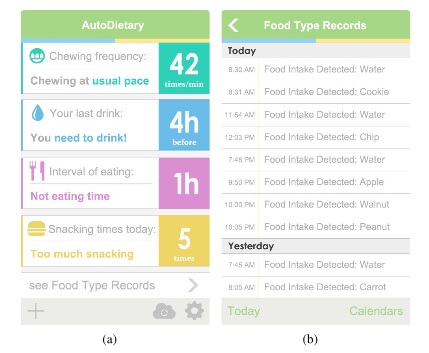
A prototype display of the mobile app for AutoDietary (Photo: University of Buffallo)
How it works
AutoDietary wraps around the back of the neck like a choker necklace. A tiny high-fidelity microphone – about the size of a zipper pull – records the sounds made during mastication and as the food is swallowed. That data is sent to a smartphone via Bluetooth, where food types are recognized.
The study describes how 12 test subjects, male and female, ages 13 to 49, were given water and six types of food: apples, carrots, potato chips, cookies, peanuts and walnuts. AutoDietary was able to accurately identify the correct food and drink 85 percent of the time.
“Each food, as it's chewed, has its own voice," says Xu, who says the device could someday help people suffering from diabetes, obesity, bowel disorders and other ailments by enabling them to better monitor their food intake and, thus, improve how they manage their conditions.
Mr Xu plans future studies to build upon his library by testing different foods and recording the sounds they make. He also plans to refine the algorithms used to differentiate the foods to improve AutoDietary's ability to recognize what's being eaten.
A biomonitoring device
A wearable necklace that measures sound has limitations when used alone. For example, it cannot differentiate similar foods such as frosted corn flakes and regular corn flakes. It also can't distinguish the ingredients of complex foods such as soup or chili.
To address these limitations, Xu is planning a biomonitoring device which would complement AutoDietary. The device is underdevelopment but it would be activated once the necklace recognizes that the user is eating a general category of food.
The biomonitor would then determine the nutritional value of the food via blood sugar levels and other measurements. The system then gathers and presents this information on a smartphone, while providing suggestions on healthier eating.
The system is only active as food is consumed and immediately after, therefore the user is not overwhelmed by continuous stream of information, researchers said.
--
Yin Bi, Mingsong Lv, Chen Song, Wenyao Xu, Nan Guan, Wang Yi. AutoDietary: A Wearable Acoustic Sensor System for Food Intake Recognition in Daily Life. IEEE Sensors Journal, 2016; 16 (3): 806 DOI: 10.1109/JSEN.2015.2469095
Kobe AD EP Shoes EM