
 Access
 Login/Register
 Supplier Login












Ever increasing speeds and precision in high-performance multi-axis moving and machine systems – is the focus of the Wangener Machinentage 2015 specialist conference scheduled to be held in Wangen (near Göppingen) from June 30 to July 1, 2015. Ahead of the event, Dieter Manz, CEO of MANZ AG, one of the world's leading high-tech suppliers of production systems from Reutlingen, Germany, and Martin Neumann, Managing Director of RAMPF Machine Systems and organiser of the industry get-together, discuss the importance of dynamics and precision in future-oriented production technology.
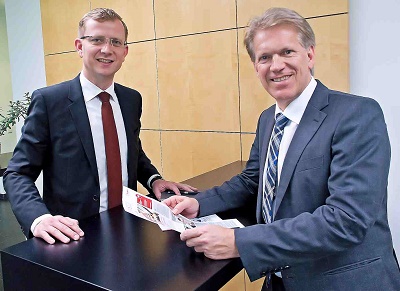
Mr. Martin Neumann, Managing Director of RAMPF Machine Systems (left), and Mr. Dieter Manz, CEO of MANZ AG (right)
This year’s Wangener Machinentage is entitled “Ultra-high speed and precision”. What does this refer to?
Mr. Martin Neumann: The increasing demands on cutting-edge production technology in terms of extreme dynamics and precision can only be met using multi-axis systems developed and manufactured using holistic and interdisciplinary processes. This very current topic is the subject of the Wangener Machinentage 2015.
Mr. Manz, you are the keynote speaker at this conference. Why is this issue important to you?
Mr. Dieter Manz: Achieving production that is both more accurate and faster is the paradox being asked of state-of-the-art production technology. Whether in electronics, lasers, display, battery applications, 3D printers or machine tools: precision and dynamics can make the difference between success or failure on the market.
Let me give you a couple of examples. A special laser procedure for processing ceramic components enables 200,000 holes with a diameter of 15 to 25 µm and a positional tolerance of +/- 1 µm to be created in the space of less than 40 seconds. Or look at the manufacturing process for monocrystalline wafers – in wire sawing of wafers, a diamond wire tears through a silicon block at 100 km/h and produces razor-thin wafers with a thickness of just 1/10 mm. The curvature must be no more than 20 µm – a third of the thickness of a hair. Our Speedpicker moves 5,000 of these wafers an hour with the lowest breakage rate in the world – that’s less than one second per wafer. Another example is the laser cutting used for lenses in smartphone cameras with a cutting speed of more than 800 mm/s and a linear accuracy of under 2 µm.
As you can see, the strategic business areas of MANZ AG – Electronic Devices and Components, Solar, and Energy Storage – cannot be separated from high-tech mechanical engineering, that is to say from multi-axis moving systems that are both highly dynamic and ultra-precise.
Mr. Neumann: Take another good example from machine tool engineering – high-speed milling machines with highly dynamic spindles rotating at up to 180,000 revolutions per minute and axial accelerations of up to 5G are used to mill and drill high-quality smartphone housings with 5 µm precision.
Mr. Neumann, your core business is mineral casting machine beds – why have you organised this conference?
Mr. Neumann: In implementing our strategic mission “From machine base to basic machinery”, we see the growing importance of structural, i.e. the machine base, mechanical, drive, and control interfaces and the interactions between them. We also recognise that these high demands can only be met with an integrative, interdisciplinary, and therefore mechatronic approach.
That isn’t really anything new.
Mr. Neumann: You’re right. WZL Aachen [Laboratory for Machine Tools and Production Engineering], Siemens, and others have been working intensively on the multidisciplinary interaction between mechanics, electrical engineering, and control technology in the design development phase for several years. RAMPF Machine Systems has added interdisciplinary manufacturing methods to this approach. Aspects such as ensuring the precision of the machine bed meets the requirements of guides and drives, and assembling drives, linear systems, and moving structural components in a way that is coordinated in terms of service life and energy balance are particularly relevant to this.
Mr. Manz, are these not issues that mechanical engineers and their suppliers have been taking into consideration for a while?
Mr. Manz: Unfortunately not to the extent required. Issues such as thermal expansion, the resulting effects on precision, and impermissible loading of mechanical components have to be considered holistically. Key here is also the issue of whether the compensation for inaccuracies by the control systems has negative effects on the service life of important assemblies. When manufacturing equipment runs around the clock for months on end – as is the case with smartphones, for example – then these kinds of issues become more and more relevant.
Mr. Neumann, who is taking part in the Wangener Maschinentage 2015?
Mr. Neumann: We have identified three target groups. Firstly, of course, the mechanical engineers – the manufacturers of production equipment for all future-oriented industries. Secondly, manufacturers of components such as guides, drives, and controllers, including associated service providers such as engineering offices and programmers. Thirdly, the “integraters” – the developers and manufacturers of fully integrated multi-axis moving systems, basic machinery, and rump machines. The response to the event has been outstanding. I am sure this is partly because of the opportunity to visit leading manufacturers and suppliers as part of in-house trade shows and plant tours. Mr. Manz is also opening his doors to the participants.