
 Access
 Login/Register
 Supplier Login












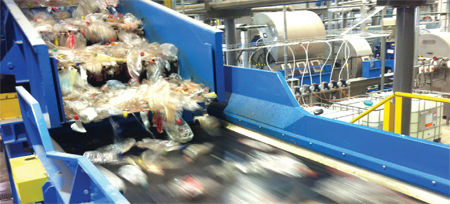
Many new processes in recycling are being launched in a bid to present innovative solutions to plastic wastes. At the heart of these revolutionary processes are new machinery and components that have enabled recycling at reduced costs. Two leading companies have embarked on providing new dimensions to recycling by adding special functions.
Erema Plastic Recycling Systems (www.erema.at) is presenting its new Intarema? K system for the first time at interpack 2014 in Germany. The new model is the successor of the KAG system designed especially for the recycling of PE edge trim – a fully automatic recycling system which ensures material-friendly processing through a short extruder, i.e. minimal thermomechanical stress and excellent material properties as a result.
The new plant generation Intarema was launched in 2013, with which the T and TE systems (for PE, PE-LD, PP, BOPA, PA/PET, PLA etc. edge trim) and TVEplus (heavily printed materials and strongly contaminated post-consumer waste) have already experienced an enormous boost in efficiency.
The fully automatic Intarema? K recycling system features the new, patented core technology Counter Current, the energy-saving ecoSAVE system including direct drive and, for the first time, a touchscreen, the new Smart Start System for even more user-friendliness through a high degree of automation. Intarema K is designed above all for the processing of edge trim and enables an up to 100% return to the production process.
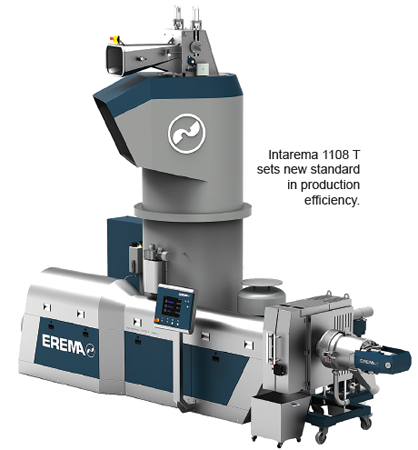
The company is also launching Intarema? 1108 T system at CHINAPLAS 2014 with efficiency boost and a throughput of e.g. 600 kg/h when processing BOPP. With the patented Counter Current system, the central core technology of the new Intarema? plant, Erema is setting another milestone in the plastic recycling systems. The innovation is in the interface area of the cutter/compactor and extruder. To date the worldwide technical standard has been a system in which the material in the cutter/compactor moved in the direction of the extruder. The difference with the Counter Current system is that the material spout in the cutter/compactor is now reversed and thus moves against the direction of the extruder. The result of this inverse-tangential configuration is increased process stability and, at the same time, considerably higher throughput.
Elimination of unwanted materials
In the field of sorting, washing and recycling of PET, the patented system from AMUT S.p.A. (www.amut.it) has been revolutionary that it guarantees the complete elimination of impurities from recycled PET by using a continuous and carefully controlled process. All this with a water consumption reduced by two-thirds compared to all other cleaning systems. What makes this interesting is that the AMUT plant allows a substantial saving of water: actually it uses only one litre of water per kg of PET (compared to 3 liters used by competitors), and the final product has high purity levels (levels of organic residues are in the order of 20ppm, compared to 100/200 of the other systems on the market).
The Friction Washer has the function of eliminating from the PET flakes (or from the bottles) any type of polluting material: labels, glue, residues of organic substances and surface dirt. The machine is fed directly from an external screw conveyor, which transports the material to be processed and discharges it into the entrance mouth. Inside the Friction Washer, the PET is washed with hot water and chemicals, soda and detergent. The task of the soda is to attack the organic soils (especially glue labels), whilst the detergent prevents glue and pollutant from redepositing on the surface of the flakes.
During the permanence of the product in the drum, the combined action of the friction generated by the rotor, together with the action of hot water and chemicals, enables a perfect washing of the PET flakes. The operation of the machine is automatic and continuous, which means that the same quantity of material enters and comes out after being treated for a certain time.
The residence time of the material being treated is a determining factor for the success of the washing action. Normally this setting is done when the system is started, but if necessary, it can be changed by the operator. The water coming out of the Friction Washer, together with the impurities (traces of paper, glue, etc..) is treated with a special kieselguhr vacuum filter, and is recirculated through a heat exchanger which resets the working temperature parameters
The system ensures residence time control, as this is a continuous system: entering material pushes the residing material towards the exit so that there is no chaotic movement inside and the residence time is controlled by the ratio volume / flow rate. It also enables friction coefficient control and temperature control as the process requires a well defined temperature, which is automatically maintained by the control system, through hot-water supply and, when necessary, direct steam injection.
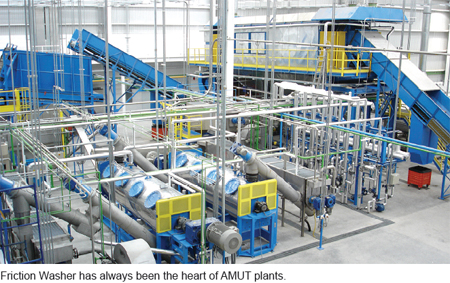
The Friction Washer is connected with a fow water recirculation and fltering system. Once the pollutants have been detached by friction, they are continuously collected and discharged by water flow in order to avoid any random deposit.
Air Max 95 VaporMax