
 Access
 Login/Register
 Supplier Login












A BREAKTHROUGH technique for preserving liver prior to transplantation has enabled surgeons at the University Hospitals Leuven to successfully transplant liver in two recent cases. The first transplantation was performed in early December 2014, and the second one a couple of weeks later. Both transplanted patients have left the hospital and are recovering well.
The OrganOx Metra, which was developed by the University of Oxford, is a device designed to preserve and maintain a liver before transplantation to make sure it stays “healthier.” It creates an environment that mimics that of the human body, where the organ is perfused with oxygenated blood at normal body temperature. It can also assess and improve the quality of the liver.
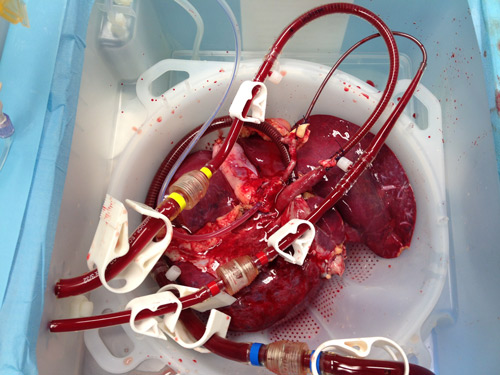 OrganOx Metra preservesand maintains a liver in an environment that mimics that of the body (Photo provided by University Hospitals Leuven)
The successful liver transplantations mark the first time the innovative technique is used outside of the UK.
The preservation method used by the OrganOx Metra offers many advantages over cold storage technologies as supported by research in pigs. The conventional practice of storing donated liver before transplantation involves storing it on ice to cool it down to a temperature of 4 to 6 degrees. In addition to slowing down the metabolism, this ensures the organ remains ‘healthy’ for a longer time even without oxygen supply.
According to Professor Jacques Pirenne, one of the physicians of the transplant team, “The classic preservation method usually causes damage to the organ. When this damage is too extensive, it renders the liver unsuitable for transplantation. Another disadvantage is the limited preservation time, turning every transplantation into a race against the clock.”
“Over the last decades, there has been little progress as far as preserving livers for transplantation is concerned. This new technique changes all that. Now that a liver can be kept ‘alive’ outside the body, the quality of the organ improves, leading to better outcome for transplant patients. We expect that, because of the improved quality as well as the fact that the device can assess liver function, more organs will become viable for transplantation. This is important: today there are still patients dying because of a lack of suitable organs,” Professor Pirenne said.
He added that more than 50 liver transplants have been done in the UK using the OrganOx Metra.
“Now the University Hospitals Leuven team follows suit by participating in an international trial. This trial enables us to test the technique on a larger scale while at the same time checking whether the technique can live up to its expectations,” Professor Pirenne further stated.
The trial is part of the European Consortium on Organ Preservation in Europe (COPE), a project financed by the European Commission to optimize organ preservation.
Highsnobiety Sneakers